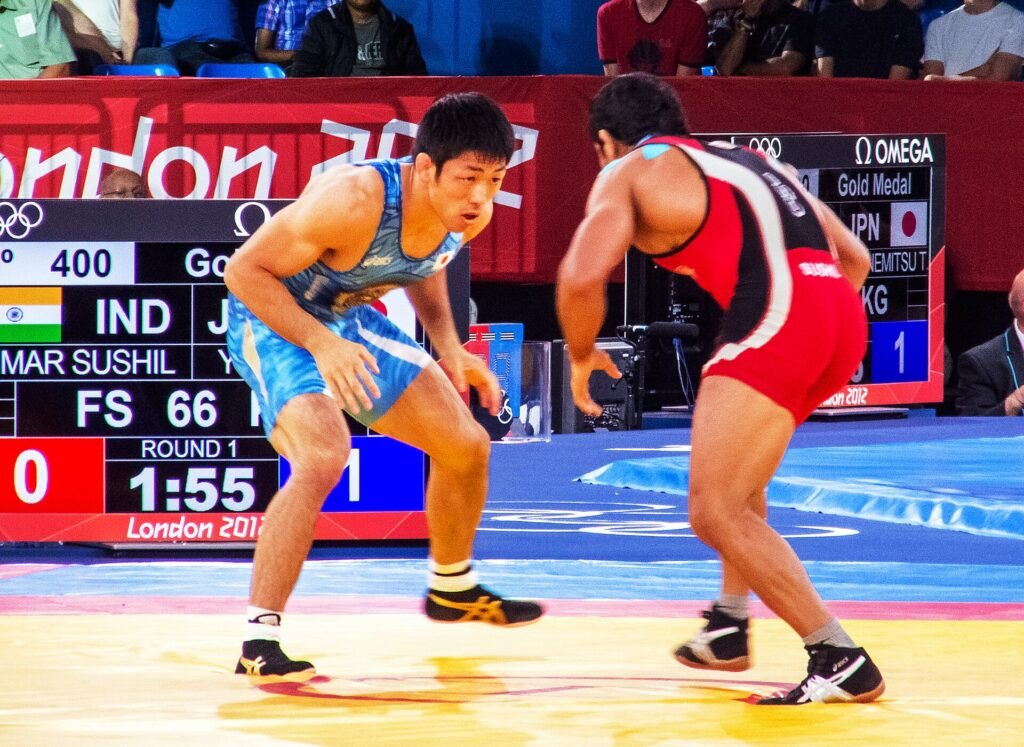
Wrestling is a combat sport in which two competitors try to take each other to the mat and pin the opponent’s shoulders, or to win on points, using holds and throws. It is the most ancient known competitive sport, and its Olympic forms today are freestyle and Greco-Roman wrestling, governed by United World Wrestling.
History of wrestling
Wrestling was introduced into the ancient Olympic Games in 708 BCE, shortly after the Games’ recorded history begins in 776 BCE. Olympedia lists ancient champions from Eurybatos of Sparta in 708 BCE to Aurelius Helix of Phoenicia in 213 CE. The most titled was Milon of Kroton, who won six wrestling titles between 532 and 512 BCE and one boys’ title in 540 BCE. Hipposthenes of Sparta won five wrestling titles between 624 and 608 BCE, along with a boys’ title in 632 BCE. Those names span more than nine centuries of ancient Olympic wrestling.
In the modern era, wrestling has been on every Olympic programme except Paris 1900. The 1896 Games in Athens revived Greco-Roman wrestling, and freestyle was added in 1904. Both styles have been held together since Antwerp in 1920. Before that, apart from 1908, only one form was used, usually Greco-Roman.
Women’s freestyle wrestling was added to the Olympic programme at Athens in 2004, with four weight divisions, which opened Olympic wrestling to women for the first time. The sport’s governing body traces its roots to the Internationaler Ring Verband, formed in 1912 at the Stockholm Olympics as the first organization responsible only for wrestling.
Rules and styles of wrestling
Olympedia describes four main forms of amateur competitive wrestling: Greco-Roman, freestyle, judo and sambo. Judo is treated as a separate sport at the Olympics, and sambo is most popular in the Asian republics of the former Soviet Union but has not been contested at the Games.
Freestyle is similar to American collegiate or folkstyle wrestling. Holds are relatively unlimited, provided they are not dangerous, and can be applied to any part of the body. Greco-Roman restricts holds to the upper body, so competitors attack and hold only with their arms and torsos. In freestyle, wrestlers may use their legs for pushing, lifting and tripping, and may hold an opponent above or below the waist.
A bout is made up of two periods of three minutes, with a 30-second break between them. A wrestler wins immediately by a fall, which means holding both of the opponent’s shoulders on the mat. If there is no fall, the wrestler with more points wins.
A bout also ends early on technical superiority. In Greco-Roman wrestling this happens when one wrestler leads by 8 points, and in freestyle and women’s wrestling when one leads by 10. In short, a fall or technical superiority ends a bout early, and otherwise the wrestler with more points after the two periods wins.
Scores depend on the move. According to the United World Wrestling rules page, pushing an opponent out of the circle earns 1 point, and a takedown or exposing the opponent’s back to the mat earns 2. Throwing an opponent from a standing position earns 4, and a throw with grand amplitude earns 5.
Equipment and venues for wrestling
Competition takes place on a circular mat 9 meters across. A 1-meter orange passivity zone runs along the inside edge of the circle, and the rules award a point for pushing an opponent out of the circle.
Weight categories use direct elimination with a repechage, a second-chance round for wrestlers beaten by eventual finalists.
Governing bodies and major competitions
United World Wrestling, or UWW, was formed in 1921 according to Olympedia, which gives its original name as the International Amateur Wrestling Federation, or in French the Fédération Internationale des Luttes Amateur. It was renamed in 1952, became the Fédération Internationale des Luttes Associées in 1994, and took its present name in September 2014.
The International Olympic Committee’s own profile dates the independent body to 1912 and its renaming as FILA to 1953, which shows that sources differ on some of the dates in the federation’s early history. UWW has its headquarters in Corsier-sur-Vevey, Switzerland.
Olympic wrestling has two styles for men, Greco-Roman and freestyle, and one for women, freestyle. Wrestling has been part of the Youth Summer Olympics since the first edition in Singapore in 2010, with Greco-Roman events for boys and freestyle events for boys and girls.
Records and notable moments in wrestling
The Soviet Union and its former republics have dominated the sport, especially in Greco-Roman wrestling. The United States is close in freestyle, and as of 2024 it was only three gold medals short of the Soviet Union’s 62.
Mijaín López of Cuba is unique in having won five Olympic medals, all of them gold. Aleksandr Karelin of the Soviet Union has three golds and a silver, and Wilfried Dietrich won five medals, including one gold, for Germany and West Germany.
Among women, Kaori Icho of Japan won four consecutive gold medals between 2004 and 2016. Her compatriot Saori Yoshida won three golds between 2004 and 2012 and a silver in 2016. Mariya Stadnik of Azerbaijan has also won four Olympic medals, but no golds.
Global participation in wrestling
UWW reported 246 member federations from 190 countries and territories in January 2026, according to Olympedia.
Besides the Soviet successor states and the United States, nations that produce good wrestlers include Japan, Russia, Türkiye, Sweden and Finland.
Olympedia notes that multiple regional variants of wrestling exist throughout the world beyond the Olympic styles. It also notes that the United States has surpassed the Soviet Union in the total number of medals won, even though the Soviet Union leads in golds.
More in Sports Coaching and Performance
Key facts
- Wrestling entered the ancient Olympic Games in 708 BCE and has been on every modern Olympic programme except Paris 1900.1
- Greco-Roman wrestling was revived at the 1896 Games, freestyle was added in 1904 and women's freestyle in 2004.21
- A bout has two periods of three minutes, and a fall means holding both shoulders of the opponent on the mat.3
- Technical superiority ends a bout at an 8-point lead in Greco-Roman wrestling and a 10-point lead in freestyle.3
- United World Wrestling reported 246 member federations from 190 countries and territories in January 2026.1
Related concepts
Quick checkWhat is the difference between freestyle and Greco-Roman wrestling?Show answer
In Greco-Roman wrestling, holds are limited to the upper body. In freestyle, holds can be applied to any part of the body, provided they are not dangerous.
Sources
- Olympedia, Wrestling (discipline overview, with governing-body history and Olympic medal data), olympedia.org, https://www.olympedia.org/sports/WRE
- International Olympic Committee, United World Wrestling, olympics.com, https://olympics.com/ioc/united-world-wrestling
- United World Wrestling, Wrestling rules and scoring page, uww.org, https://uww.org/fr/node/14578
Editorially reviewed by Specialty Digest Editorial TeamLast reviewed November 4, 2026Researched and drafted with AI assistanceReport an issue