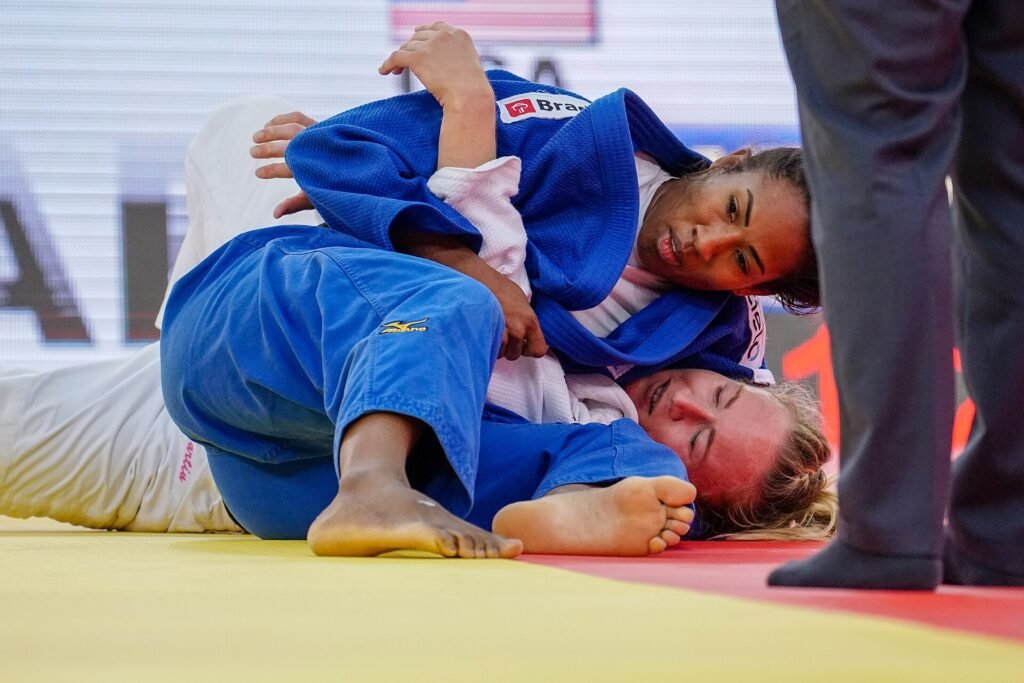
Judo is a Japanese combat sport and martial art in which competitors try to throw an opponent onto the back, pin them, or force a submission with a choke or joint lock. It was created by Jigoro Kano, it became an Olympic sport at Tokyo in 1964, and it is governed worldwide by the International Judo Federation.
History of judo
Kano was a long-time member of the International Olympic Committee. Judo is a form of wrestling that he developed from the ancient Japanese schools of yawara and jujitsu. In 1882 he founded his first dojo, or judo school, which he named the Kodokan. Olympedia describes judo as a form of wrestling, although the Olympics treat it as a separate sport from wrestling.
Judo’s Olympic history has had interruptions. It made its first Olympic appearance at Tokyo in 1964, was left off the programme of the 1968 Games in Mexico, and returned at Munich in 1972. Events for women were first held at Barcelona in 1992, and a mixed team event made its debut at Tokyo 2020.
The sport has been dominated by Japan, followed by France and South Korea, according to Olympedia.
Rules and scoring in judo
Contests last four minutes of regulation time for men and women. If there is no winner, or the scores are level, the match goes to golden score, a sudden-death period with no time limit in which the clocks reset and the first score wins. Scores and penalties from regular time stay on the scoreboard, and a single shido does not end the contest unless it is a third. Under the 2016 revision, only technical scores decide a contest in regular time.
An ippon ends the contest at once. It is awarded for a throw that lands the opponent on the back with force, speed and control, for a 20-second pin, or for a submission through a choke or joint lock. A waza-ari is awarded for a throw that lacks one of the ippon criteria, or for a pin lasting 10 to 19 seconds.
The International Judo Federation, or IJF, has revised the scoring several times. In a December 2016 announcement for the next Olympic cycle it said the older yuko score had been folded into waza-ari and that waza-ari would no longer add up to an ippon, whereas an NBC Olympics explainer describes two waza-ari as equal to an ippon. Readers should check the current IJF refereeing rules for how scores combine.
Penalties are called shido. The first two are warnings, and a third shido in one contest becomes a hansoku-make, a serious infringement that disqualifies the offender and gives the opponent the win. Examples of shido include being non-combative, stepping out of bounds and fighting too defensively. Under the 2016 revision, grabbing the legs or trousers brought a shido for a first offense and a hansoku-make for a second, and a defensive attitude brought a shido.
Belts, safety and venues in judo
Judoka are classified into grades. Pupils hold kyu grades, with five classes advancing to first kyu and a brown belt, and degrees are called dan. First dan is the black belt, and the system theoretically runs to 12th dan, shown with a white belt. Fighting ability and technical knowledge advance a judoka to fifth dan, after which advancement depends on service to the sport. Leading international judoka are usually fourth or fifth dan, and the 11th and 12th dan have never been awarded, according to Olympedia.
Safety has shaped the rules. In the 2016 revision, the IJF said that a defender who avoids landing on the back with a movement dangerous to the head, neck or spine receives a hansoku-make and loses the contest. False breakfalls are not valid, and a fall onto two elbows counts while a fall onto one elbow does not. Other rule changes included reducing the number of shido leading to a penalty from four to three.
The IJF text also set a time limit of 45 seconds for taking a grip and attacking.
Governing bodies and major competitions
The IJF was formed on 11 July 1951 in London with eight founding members: Austria, Belgium, France, Germany, Great Britain, Italy, the Netherlands and Switzerland. All eight founders were European, although the sport originated in Japan. Olympedia gave the IJF 205 members as of January 2026.
Judo is part of the Summer Olympic Games and has been part of the Youth Summer Olympics since the competition began in Singapore in 2010, with events for boys and girls.
Records and notable moments in judo
Through 2024, the top male Olympic judo medalist is Teddy Riner of France, with five golds and seven medals in total. Tadahiro Nomura of Japan has three golds, and Takanori Nagase of Japan has five medals. Riner is also the male judoka with the most Olympic medals overall, ahead of Nagase, and no other man has reached his total of seven.
In the women’s tournament, Clarisse Agbegnenou of France leads the gold medal count with three golds and has five medals overall. That equals the five medals of Ryoko Tamura-Tani of Japan, who won two golds. Nine other judoka have two Olympic titles, and four of them are from France.
Global participation in judo
Japan leads the all-time Olympic judo medal table with 51 golds and 104 medals, followed by France with 18 golds and 67 medals and South Korea with 11 golds and 51 medals. China has 23 medals and Cuba has 37, while Brazil has 28 and Georgia and the Soviet Union have 15 and 23.
The medal table shows a sport that spread widely from its Japanese origins. Countries as varied as Kosovo, Slovenia, Azerbaijan, Mongolia and Austria have won Olympic judo golds, and the IJF’s 205 members cover most of the world.
More in Sports Coaching and Performance
Key facts
- Jigoro Kano founded his first judo school, the Kodokan, in 1882.1
- Judo made its Olympic debut at Tokyo in 1964, and women's events began at Barcelona in 1992.1
- The International Judo Federation was formed on 11 July 1951 in London with eight founding members.1
- A judo contest lasts four minutes, with golden score if there is no winner.23
- Japan leads the all-time Olympic judo table with 51 golds and 104 medals as of 2024.1
Related concepts
Quick checkWhat is an ippon in judo?Show answer
An ippon ends a judo contest at once. It is awarded for a throw that lands the opponent on the back with force, speed and control, for a 20-second pin, or for a submission through a choke or joint lock.
Sources
- Olympedia, Judo (discipline overview, with IJF history and Olympic medal data), olympedia.org, https://www.olympedia.org/sports/JUD
- International Judo Federation, Adapted rules of the next Olympic cycle (news of 9 December 2016), ijf.org, https://www.ijf.org/news/show/adapted-rules-of-the-next-olympic-cycle
- NBC Olympics, Judo 101: Rules and scoring, nbcolympics.com, https://www.nbcolympics.com/news/judo-101-rules-scoring
Editorially reviewed by Specialty Digest Editorial TeamLast reviewed November 4, 2026Researched and drafted with AI assistanceReport an issue