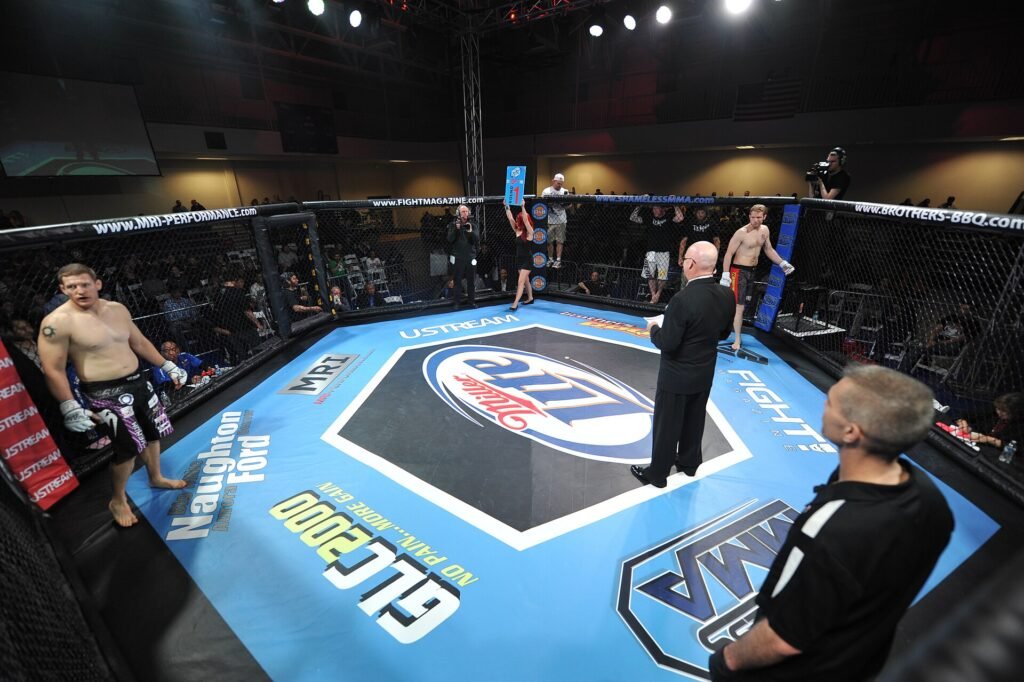
Mixed martial arts, often shortened to MMA, is a full-contact combat sport that allows striking and grappling both standing and on the ground. Fighters compete in a cage or ring under regulated rules, with bouts decided by knockout, submission or the scores of judges. The modern sport took shape in the 1990s and is overseen in the United States by state athletic commissions.
History of mixed martial arts
Reference works trace a forerunner to the ancient Greek event of pankration, which is believed to date to the Olympic Games of 648 BCE. It combined wrestling, boxing and street fighting. Only biting and eye gouging were banned, and matches ended in submission or unconsciousness. Roman emperor Theodosius I banned the Olympics in 393 CE, which ended pankration as a popular sport.
A twentieth-century revival of that kind of fighting developed in Brazil as vale tudo, meaning anything goes. Carlos and Helio Gracie opened a jujitsu school in Rio de Janeiro in 1925 and popularized the style, and their matches drew crowds large enough to require soccer stadiums. Their story links the sport to Brazil.
The Ultimate Fighting Championship held its first event, UFC 1, in 1993 at McNichols Arena in Denver, Colorado. Royce Gracie, Helio’s son, won the tournament. It was the first cable pay-per-view event of the series, drawing about 86,000 viewers, and audiences rose to about 300,000 by the third event. The early rules banned only biting and eye gouging, and bouts ended by submission or when a corner threw in the towel.
Rules and how MMA is played
Under the Unified Rules of Mixed Martial Arts, non-title bouts have three rounds of five minutes with one-minute breaks, and championship bouts have five rounds. Fights can end by knockout or by submission through a tap-out or verbal surrender. If time runs out, three judges score each round using the 10-point must system, in which the winner of a round normally receives 10 points and the opponent 9 or fewer, and a round can also be scored 10-10.
Fighters wear padded fingerless gloves and no shoes or headgear. Gloves must weigh at least four ounces, and hands are wrapped with gauze and tape under limits on length and width. Body oils and gels are banned.
The rulebook lists 28 fouls, and only the referee may assess them. They include headbutts, eye gouging, biting, hair pulling, groin attacks, strikes to the spine or the back of the head, throat strikes, downward elbow strikes, kicks or knees to the head of a grounded opponent, and holding the fence. A foul can cost a point, and flagrant or repeated fouls can lead to disqualification.
Rules for amateur events are stricter. The Association of Boxing Commissions recommends extra fouls for amateur MMA, including elbow and forearm strikes, neck cranks, most leg submissions, hand chokes and knee strikes to the head. Straight kneebars and straight ankle locks remain allowed.
Equipment and venues
Bouts take place in a fenced cage or a ring. The cage canvas must be between 18 and 32 feet on each side, with at least an inch of foam padding. The fence must stop fighters from falling out, and a vinyl-coated chain link fence is one example. Metal posts are padded, and the cage must have two separate entries. A ring, where used, measures 20 to 32 feet square inside the ropes and has five ropes.
Governing bodies and major competitions
In the United States, state athletic commissions assign referees and judges and conduct medical and drug tests on fighters. The Nevada State Athletic Commission and the New Jersey State Athletic Control Board were among the early regulators. A committee chaired by Nick Lembo of New Jersey drafted amendments that the Association of Boxing Commissions adopted unanimously as the Unified Rules of Mixed Martial Arts on July 30, 2009, with any commission free to require stricter rules. Wider questions of regulation are discussed under sports law and compliance.
Weight limits are enforced for each bout. A one-pound allowance applies to non-title bouts only if the bout contract or regulations say so, and a commission may approve a catch weight between classes. The UFC is one promotion that follows these rules. Under the Unified Rules the men’s weight limits run from flyweight at 125 pounds (56.7 kilograms) through bantamweight, featherweight, lightweight, welterweight, middleweight and light heavyweight at 205 pounds (93.0 kilograms), up to heavyweight at 265 pounds (120.2 kilograms). Above that is super heavyweight. Women’s classes include strawweight at 115 pounds (52.2 kilograms).
Records and notable moments
The sport’s early marketing as no-holds-barred drew heavy criticism, and US Senator John McCain called caged combat human cockfighting and sought to ban it. After new management arrived in 2001, the UFC added weight classes, rounds, time limits and more fouls. California sanctioned MMA on December 28, 2005.
UFC 12 introduced heavyweight and lightweight divisions, which until then had been optional or absent. Strawweight was added to regulated classes in 2015, and in July 2017 further classes were added, including super lightweight and cruiserweight. By 2009 US regulators and many promotions had adopted the Unified Rules.
Health and safety in MMA
Regulators set rules intended to reduce harm, including medical requirements, drug testing and a list of prohibited substances. If both fighters risk serious injury in a double knockout, the referee may stop the bout and the result is a technical draw. A corner may also retire a fighter during competition, because towel throwing was removed as a foul.
Strikes to the head are legal in competition, so background reading on concussion in sport is relevant. The sources reviewed for this entry give no injury statistics, and this entry is general background, not medical advice.
More in Sports Coaching and Performance
Key facts
- UFC 1 was held in 1993 in Denver, Colorado, and was won by Royce Gracie.1
- Non-title bouts under the Unified Rules have three five-minute rounds, and championship bouts have five rounds.1
- The Association of Boxing Commissions adopted the Unified Rules of Mixed Martial Arts on July 30, 2009.2
- Cage canvases must measure between 18 and 32 feet on each side.2
- The rulebook lists 28 fouls, which only the referee may assess.2
This entry explains a medical term. It is not medical advice. If you are concerned about your health, speak with a qualified health professional.
Related concepts
Quick checkHow are MMA fights decided?Show answer
A fight ends by knockout or by submission through a tap-out or verbal surrender. If it goes the distance, three judges score each round using the 10-point must system.
Sources
- Encyclopaedia Britannica, Mixed martial arts (pankration, vale tudo, UFC 1, rules and regulation), https://www.britannica.com/topic/mixed-martial-arts
- Association of Boxing Commissions, Summary report on the Unified Rules for MMA (adoption in 2009, weight classes, cage, fouls, scoring), https://abcboxing.com/committee-report-on-unified-rules-for-mma/
- UFC, Unified Rules of Mixed Martial Arts (list of fouls and penalties), https://www.ufc.com/unified-rules-mixed-martial-arts
- Wikipedia, Mixed martial arts weight classes (kilogram equivalents and class history), https://en.wikipedia.org/wiki/Mixed_martial_arts_weight_classes
Editorially reviewed by Specialty Digest Editorial TeamLast reviewed November 4, 2026Researched and drafted with AI assistanceReport an issue