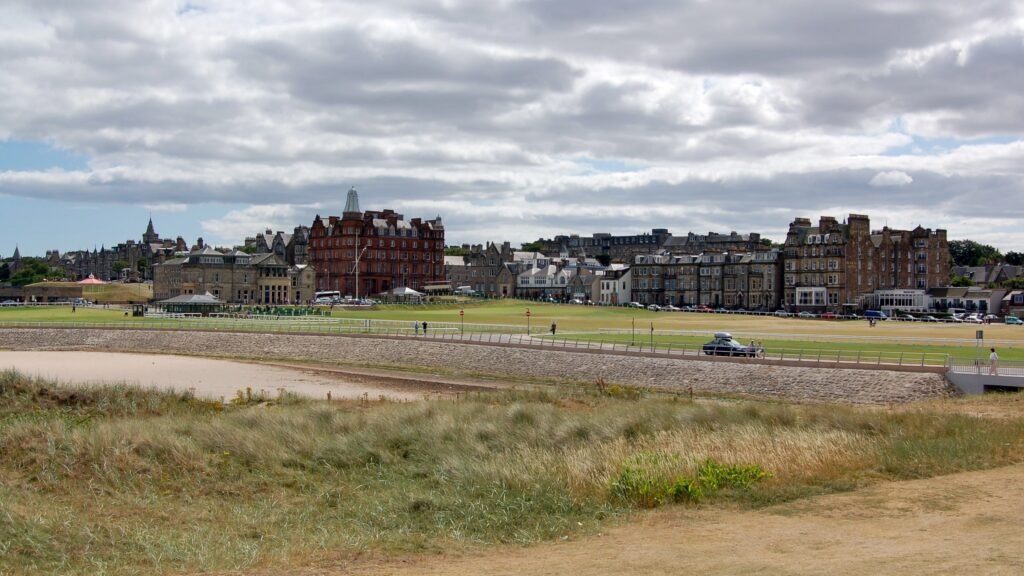
Golf is a sport in which players use clubs to strike a ball from a teeing area into a hole, over a round of 18 holes, in as few strokes as possible. It originated in Scotland, and its Rules are made and interpreted jointly by The R&A and the United States Golf Association (USGA). The Open Championship, first played in 1860, is regarded as golf’s original major.
History of golf
The earliest known written rules are the 13 Articles of 1744, drafted by the Gentlemen Golfers of Leith, who later became the Honourable Company of Edinburgh Golfers. They were written for a single day of competition. In 1754 the St Andrews golfers adopted their own code, which, for example, required a ball to be thrown at least six yards behind a water hazard when a player took relief.
In 1897 The R&A established its Rules of Golf Committee, which led to the first consolidated code in 1899. The R&A and the USGA issued the first truly unified code, effective January 1, 1952. The USGA says the playing rules in the two bodies’ codes have been essentially identical since 1968.
The Open was first played at Prestwick on October 17, 1860. Eight Scottish professionals played 36 holes in total, over three rounds of 12 holes. Old Tom Morris, Prestwick’s greenkeeper, was expected to be the favorite, but Willie Park Snr won.
Rules and how golf is played
The R&A describes the game in Rule 1 as played by striking a ball with a club from the teeing area into the hole, over a round of 18 holes under the Rules. The central principle is to play the course as you find it and play the ball as it lies.
Rule 3 sets out the forms of play. In match play a player competes against one opponent, winning, losing or tying each hole, and the match is won when a player leads by more holes than remain to be played. In stroke play all players compete on total strokes, including penalty strokes, and the player who completes all rounds in the fewest strokes wins.
Players can compete alone, with a partner in Foursomes or Four-Ball, or as part of a team. Scratch competitions use gross scores, and handicap competitions use net scores. A player must hole out at every hole, and a marker records each hole score and certifies the scorecard at the end.
Other forms of stroke play, including Stableford, Maximum Score and Par/Bogey, fall under Rule 21. In a tied match, extra holes are played one at a time until there is a winner, unless the terms of the competition say otherwise.
Equipment and venues
Rule 4 limits a player to 14 clubs, both at the start of a round and during it. A player must use a conforming club when it is new or when its playing characteristics have been changed, and must use a ball that conforms to the Equipment Rules. Making a stroke with a non-conforming club leads to disqualification. Clubs left behind by other players, or mistakenly placed in a bag, do not count toward the limit, but they must not be used.
The Rules of Golf refer to separate Equipment Rules for the detailed requirements of clubs and balls, so this entry does not list club or ball measurements.
Golf is played on courses rather than on a fixed rectangular field. The R&A organizes The Open, and its published venue list includes St Andrews in 2027, for the 155th Open, and Royal Lytham and St Annes in 2028. Prestwick hosted the first Open in 1860.
Governing bodies and major competitions
The R&A publishes The Rules of Golf, which is aimed mainly at people who administer golf competitions, and it directs players to The Player’s Rule Finder. The USGA’s own history of the Rules describes how the two bodies share the task of making and interpreting them.
The Open is organized by The R&A. Its trophy, the Claret Jug, is properly named the Golf Champion Trophy and is presented to the Champion Golfer of the Year. It was made by Mackay Cunningham and Company and hallmarked in 1873. The original has been kept at The R&A since 1927, and winners receive a replica.
Golf is also an Olympic sport, with the International Golf Federation (IGF) recording its history. The sport was added to the Paris 1900 program on May 27, 1899, and Charles Sands of the United States won the men’s event, ahead of Walter Rutherford and David Robertson, both of Great Britain, who took silver and bronze. In 1904 at St. Louis, George Lyon of Canada beat H. Chandler Egan of the United States 3 and 2 in the final.
Notable moments in golf history
Golf returned to the Olympics at Rio de Janeiro in 2016 after 112 years, with the first tee shot at 7:30 a.m. on August 11. The Tokyo Olympic golf events were held in 2021 because of the COVID-19 postponement, and Xander Schauffele and Nelly Korda, both of the United States, won the men’s and women’s titles.
The 1860 Open itself is a notable moment, since it started the championship tradition that still carries the Claret Jug.
Golf around the world
The sport’s rules began in Scotland, but the 1900 and 1904 Olympic results show how quickly it spread. Winners and medalists came from the United Kingdom, the United States and Canada within a few years.
Because the R&A and the USGA publish a single set of Rules, golfers worldwide play under the same code, with only local rules and the terms of each competition varying.
More in Sports Coaching and Performance
Key facts
- The earliest known written golf rules, the 13 Articles, were drafted in 1744 by the Gentlemen Golfers of Leith.1
- The R&A and USGA issued the first unified Rules of Golf, effective January 1, 1952.1
- A round of golf is played over 18 holes, and a player may carry no more than 14 clubs.24
- The first Open Championship was played at Prestwick on October 17, 1860, with eight professionals.5
- Golf returned to the Olympics at Rio 2016 after 112 years.6
Related concepts
Quick checkWho makes the Rules of Golf?Show answer
The R&A and the United States Golf Association make and interpret the Rules of Golf, which they have issued as a unified code since 1952.
Sources
- USGA, A Brief History of Revisions to the Rules of Golf: 1744 to Present, https://www.usga.org/rules-hub/rules-modernization/text/a-brief-history-1744-to-present.html
- The R&A, The Rules of Golf, https://www.randa.org/en/rog/the-rules-of-golf
- The R&A, Rule 3: The Competition, https://www.randa.org/en/rog/the-rules-of-golf/rule-3
- The R&A, Rule 4: The Player's Equipment, https://www.randa.org/en/rog/the-rules-of-golf/rule-4
- The Open, The very first Open Championship, https://thejourney.theopen.com/1860
- International Golf Federation, Olympic Golf: History, https://www.igfgolf.org/olympic-games/history
- The Open, About, https://www.theopen.com/about
Editorially reviewed by Specialty Digest Editorial TeamLast reviewed November 4, 2026Researched and drafted with AI assistanceReport an issue