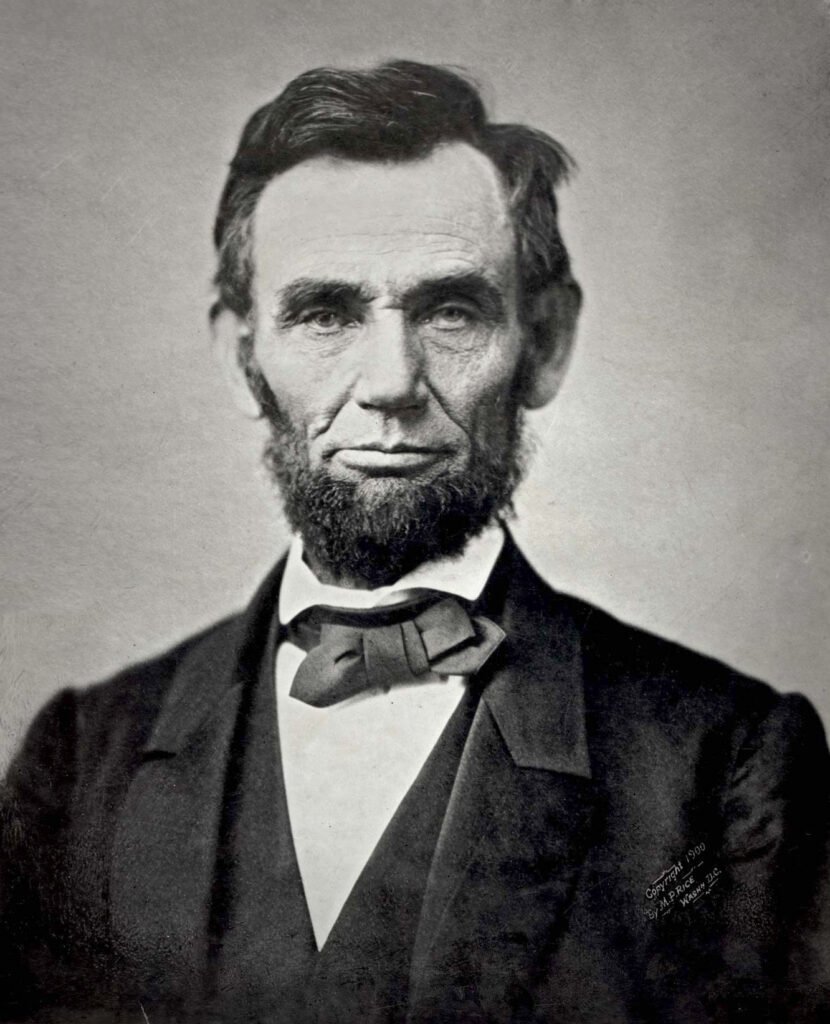
Abraham Lincoln (1809 to 1865) was the sixteenth president of the United States, serving from 1861 until his assassination in 1865. He led the country through the Civil War, issued the Emancipation Proclamation and supported the Thirteenth Amendment, which abolished slavery. He was shot on 14 April 1865 and died the next morning.
Early life of Abraham Lincoln
Lincoln was born on 12 February 1809 in a one-room log cabin near Hodgenville, Kentucky. His father, Thomas, was a farmer with almost no formal education, and his mother, Nancy Hanks, died of milk sickness in October 1818 when Abraham was nine. The family moved to Indiana in 1816 and to Illinois in about 1830, and Lincoln grew up doing physically demanding work such as plowing, clearing trees and splitting rails. His stepmother, Sarah Bush Johnson, encouraged his reading, and he read the Bible, Aesop’s Fables and the plays of William Shakespeare.
In 1831 he settled in New Salem, Illinois, where he worked as a shopkeeper, postmaster and surveyor. He served briefly in the state militia during the Black Hawk War of 1832, and he won election to the Illinois legislature in 1834, serving four terms. He was admitted to the bar in September 1836, moved to Springfield the next year and married Mary Todd on 4 November 1842. The couple had four sons, and only Robert lived to adulthood.
Career and major work of Abraham Lincoln
Lincoln won a seat in the United States House of Representatives in 1846 as a member of the Whig Party. In Congress he opposed the Mexican-American War and challenged President James K. Polk to identify the exact spot where Mexican forces were said to have shed American blood. His critics mocked him for the demand, and he left Congress in 1849 after a single term to return to his law practice.
Slavery drew him back into politics. In October 1854 he gave the Peoria speech, condemning slavery publicly for the first time. He helped organize the Republican Party in Illinois, and in 1858 he challenged Senator Stephen Douglas in a series of seven debates. He lost that election, but the debates made him known nationally, and a speech at Cooper Union in New York in February 1860 added to his reputation.
The Republican convention nominated him in May 1860, and he won the presidential election that year while receiving no votes in ten Southern states. South Carolina voted to secede on 20 December 1860, and six more states followed. Lincoln was inaugurated on 4 March 1861. When secessionists fired on Fort Sumter in April 1861, he called for 75,000 volunteers, and the Civil War began.
The war itself tested his leadership. He appointed George B. McClellan general-in-chief of the Union armies in late 1861, but later dismissed him after repeated disagreements over strategy, and in late 1863 he gave the post to Ulysses S. Grant. He ordered a blockade of Confederate ports and worked to keep European powers neutral. In the election of 1864 he ran under the National Union label, brought in Andrew Johnson as his running mate and defeated McClellan, the Democratic nominee. In his second inaugural address on 4 March 1865 he suggested that the war had been divine punishment for slavery.
Ideas and contributions of Abraham Lincoln
Lincoln’s first aim was to preserve the Union. He argued that slavery conflicted with the principles of the Declaration of Independence, but for much of his early career he sought to confine slavery to the places where it already existed and not to abolish it everywhere.
He signed the Emancipation Proclamation on 1 January 1863. The National Archives explains that it declared people held as slaves in the rebelling states to be free, but applied only to Confederate territory, left slavery untouched in the loyal border states and depended on Union military victory. It also announced that Black men would be accepted into the Union Army and Navy, and almost 200,000 Black soldiers and sailors served by the end of the war.
He then backed a constitutional amendment. The Senate passed the Thirteenth Amendment in April 1864, but the House did not until January 1865, when it voted 119 to 56 after Lincoln made passage a goal of his party and of his own reelection campaign. Lincoln approved the resolution sending it to the states on 1 February 1865, and the states ratified it on 6 December 1865. Lincoln was not alive to see it. His Gettysburg Address, delivered in 1863, described the nation as dedicated to the proposition that all men are created equal.
Legacy of Abraham Lincoln
General Robert E. Lee surrendered to Ulysses S. Grant at Appomattox on 9 April 1865, effectively ending the war. Five days later Lincoln was shot in the back of the head while watching a play at Ford’s Theatre in Washington by John Wilkes Booth, an actor who supported the Confederacy. Lincoln died at 7:22 the next morning, at the age of 56.
Historians often rank him among the greatest American presidents, and the nation’s constitutional order after the war rested on the amendments he had pressed Congress to pass. His career is a central topic in the study of American constitutional history, including constitutional law.
Criticism and controversies
Lincoln’s wartime record has drawn criticism. To contain the rebellion he suspended habeas corpus and had thousands of suspected Confederate sympathizers arrested, a use of executive power that critics at the time and since have questioned. His early opposition to the Mexican-American War led opponents to call him unpatriotic.
Scholars also point out that his early public position on slavery was limited to stopping its spread, and that the Emancipation Proclamation itself had limits, as the National Archives notes. Supporters answer that it changed the character of the war and strengthened the Union both militarily and politically.
More in History
Key facts
- Lincoln was born on 12 February 1809 near Hodgenville, Kentucky.1
- He was inaugurated on 4 March 1861 after winning the 1860 election.1
- He issued the Emancipation Proclamation on 1 January 1863.2
- The Thirteenth Amendment was passed by Congress on 31 January 1865 and ratified on 6 December 1865.3
- He was shot at Ford's Theatre on 14 April 1865 and died on 15 April at age 56.1
Related concepts
Quick checkDid the Emancipation Proclamation free all enslaved people?Show answer
No. It applied only to states in rebellion, left slavery in the loyal border states untouched, and depended on Union military victory. The Thirteenth Amendment abolished slavery nationwide in 1865.
Sources
- World History Encyclopedia, Abraham Lincoln: Preserver of the Union, https://www.worldhistory.org/Abraham_Lincoln/
- National Archives, The Emancipation Proclamation, https://www.archives.gov/exhibits/featured-documents/emancipation-proclamation
- National Archives, 13th Amendment to the U.S. Constitution: Abolition of Slavery (1865), https://www.archives.gov/milestone-documents/13th-amendment
Editorially reviewed by Specialty Digest Editorial TeamLast reviewed November 4, 2026Researched and drafted with AI assistanceReport an issue