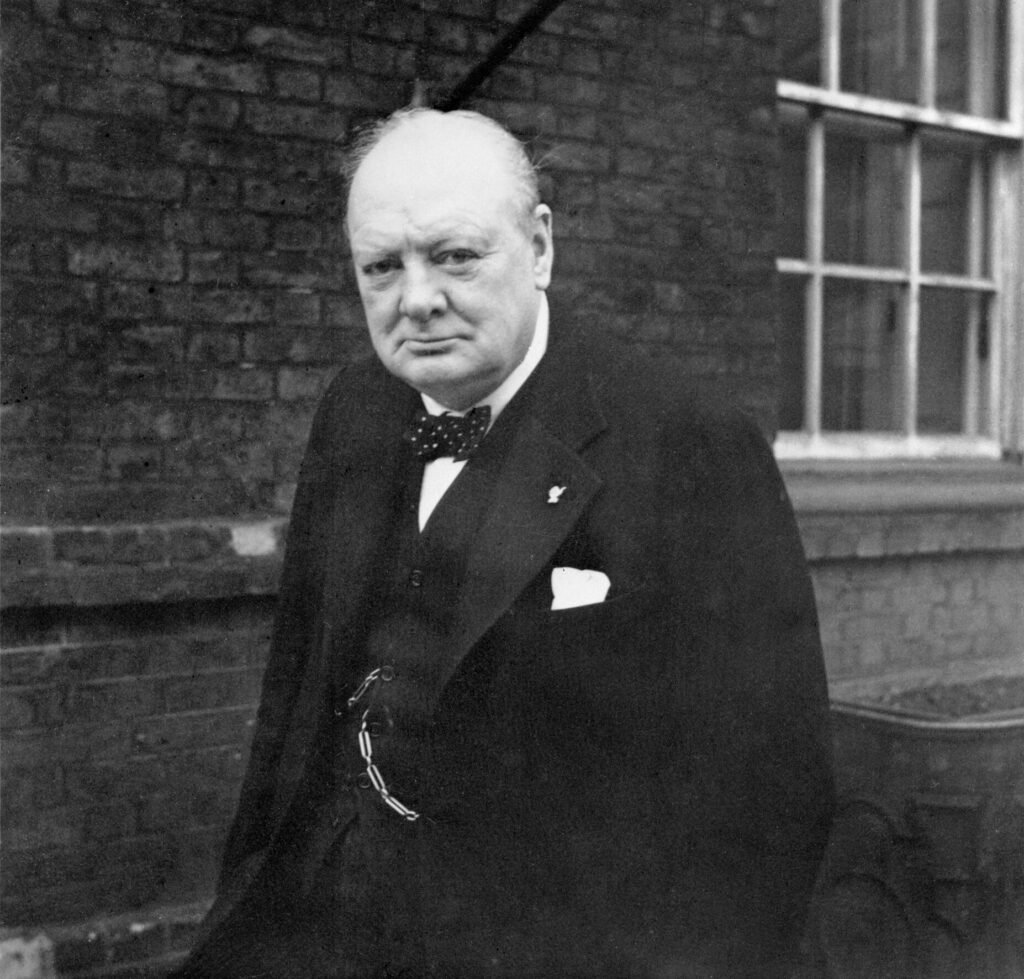
Winston Churchill (1874 to 1965) was a British statesman, writer and orator who served as prime minister of the United Kingdom from 1940 to 1945 and again from 1951 to 1955. He led Britain through most of the Second World War and won the 1953 Nobel Prize in Literature. He died in London on 24 January 1965 and received a state funeral.
Early life of Winston Churchill
Winston Leonard Spencer Churchill was born at Blenheim Palace in Oxfordshire on 30 November 1874. He was the son of Lord Randolph Churchill and his American wife, Jennie Jerome, and he came from an aristocratic family. He did poorly at school but was fascinated by military life. He was educated at Harrow and Sandhurst and joined the cavalry in 1895.
As a soldier and part-time journalist he traveled widely, with trips to Cuba, Afghanistan, Egypt and South Africa. His first books grew out of these campaigns, including The Story of the Malakand Field Force in 1898 and The River War, an account of the Sudan campaign and the Battle of Omdurman, in 1899.
His army career was brief but eventful. He later described his youth in an autobiographical book, My Early Life, published in 1930, and he held many senior posts in Liberal and Conservative governments during the first three decades of the century.
Career and major work of Winston Churchill
Churchill was elected Conservative member of Parliament for Oldham in 1900, then moved to the Liberal Party in 1904 and rose through the Liberal government over the next decade. He was First Lord of the Admiralty, the political head of the Royal Navy, from 1911 to 1915, and left that post after the disastrous Gallipoli campaign, which he had planned. He then went to the Western Front to serve in the First World War himself.
In the 1920s he returned to the Conservatives and served as Chancellor of the Exchequer from 1924. He lost his seat after the Conservative defeat of 1929 and spent about eleven years mostly outside office, writing and speaking. During this time he opposed Indian independence and warned against appeasing Nazi Germany.
When the Second World War began he returned to the Admiralty, and in May 1940, after Neville Chamberlain resigned, he became prime minister of an all-party coalition government and also Minister of Defence. His speeches in this period are credited with stimulating British morale in times of hardship. Labour leader Clement Attlee won the 1945 general election, and Churchill left office.
In a 1946 speech in the United States he said that an iron curtain had descended across the European continent and warned of the danger from the Soviet Union. He returned as prime minister after the Conservative victory of 1951. His second term was notable for his party’s acceptance of the welfare state that Labour had created, and his attempts to ease the developing Cold War through personal diplomacy produced few results. He resigned in 1955 because of failing health, and Anthony Eden succeeded him.
Ideas and contributions of Winston Churchill
Churchill wrote a large body of work. Besides his early campaign reports, he published a novel, Savrola, in 1900, a biography of his father in 1906 and a four-volume life of his ancestor, the Duke of Marlborough, between 1933 and 1938. His history of the First World War, The World Crisis, appeared in four volumes between 1923 and 1929, and his memoirs of the Second World War ran to six volumes between 1948 and 1954. After retirement he wrote A History of the English-Speaking Peoples, published in four volumes from 1956 to 1958. A gifted amateur painter, he also wrote Painting as a Pastime in 1948.
His speeches survive in a dozen volumes, among them The Unrelenting Struggle in 1942 and Victory in 1946. The Nobel Foundation counts the biography of his father, published six years after his only novel, as his first major work. The Nobel Prize committee recognized him in 1953 for his mastery of historical and biographical description and for brilliant oratory in defending exalted human values.
Legacy of Winston Churchill
The British government’s history of past prime ministers describes him as an inspirational statesman who led Britain to victory in the Second World War. He was knighted and invested with the Order of the Garter in 1953, and President John F. Kennedy made him an honorary citizen of the United States in 1963. He remained a member of Parliament until the general election of 1964, when he did not seek reelection. Among his many other honors, the Nobel Foundation singles out the honorary American citizenship as especially notable. The Churchill War Rooms in London hold archive material and film about his wartime leadership.
His war speeches and books continue to shape how the Second World War is remembered in Britain and elsewhere. The Nobel Foundation describes his books as marked by colorful narration and by objectivity, and it counts his wartime speeches among his most important written works. His government also passed the Education Act of 1944, which raised the school leaving age and introduced the 11-plus examination.
Controversies and criticism
Churchill’s record includes real setbacks and disputes. The Gallipoli campaign, which he created, was heavily criticized, and he resigned from the Admiralty as a result. As Chancellor he controversially took Britain back onto the gold standard. In the 1930s he was alone among major figures in his firm opposition to Indian independence, although his warnings against appeasement were proven right when war came in 1939.
By his return to office in 1951 he was aging and increasingly unwell, and he often worked from his bedside. His leadership then was less decisive than during the war, and his influence on domestic policy in his second term was limited.
More in History
Key facts
Related concepts
In the news
Quick checkWhy did Churchill win the Nobel Prize in Literature?Show answer
The 1953 prize recognized his mastery of historical and biographical description and his brilliant oratory in defending exalted human values.
Sources
- NobelPrize.org, Winston Churchill Facts and Biographical, https://www.nobelprize.org/prizes/literature/1953/churchill/biographical/
- GOV.UK, Past Prime Ministers: Sir Winston Churchill, https://www.gov.uk/government/history/past-prime-ministers/winston-churchill
Editorially reviewed by Specialty Digest Editorial TeamLast reviewed November 4, 2026Researched and drafted with AI assistanceReport an issue