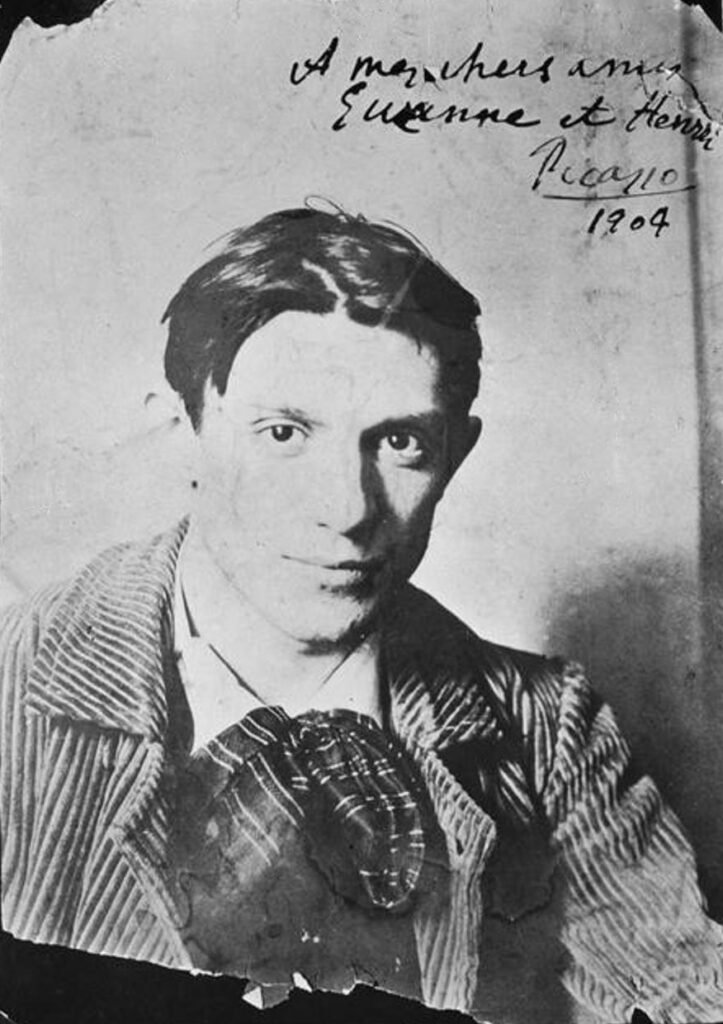
Pablo Picasso (1881 to 1973) was a Spanish painter, sculptor and printmaker who spent most of his working life in France and is best known as a founder of Cubism. He worked in a wide range of styles and materials over seven decades, from the blue-toned paintings of his early twenties to ceramics and large sculptures in later life. His 1937 painting Guernica is among the best-known artworks protesting war.
Early life of Picasso
Picasso was born on 25 October 1881 in Málaga, Spain, to the painter and art teacher José Ruiz Blasco and María Picasso López, according to the Musée Picasso in Paris. His father encouraged him to begin painting in 1888. In 1892 he began studying at the School of Fine Arts in La Coruña, where his father taught, and in 1895 the family moved to Barcelona, where he was admitted to the School of Fine Arts of La Lonja.
He entered the Royal Academy of Fine Arts of San Fernando in Madrid in 1897 and then returned to Barcelona. There he joined the avant-garde circle that met at the café Els Quatre Gats and became close to the painter Carles Casagemas. In 1900 Picasso made his first visit to Paris with Casagemas, and in 1904 he settled there.
Career and major works
Casagemas died by suicide in early 1901, and the loss threw Picasso into deep grief, according to the National Gallery in London. His themes turned to death, illness and suffering, and he entered the Blue Period, which lasted until about 1904. In 1904 he moved into the Bateau-Lavoir studio in Montmartre, and his palette warmed in what is called the Rose Period.
In 1907 he painted Les Demoiselles d’Avignon, now at the Museum of Modern Art in New York, and that year he met the painter Georges Braque. Together they developed Cubism, which broke objects into geometric planes seen from several viewpoints at once. The National Gallery describes the style as moving from Analytic Cubism to Synthetic Cubism, and the museum’s own Fruit Dish, Bottle and Violin of 1914 is its only Cubist work.
In 1912 he began making assemblages and constructions, including Still Life with Chair Caning, which brought everyday materials into the picture. In 1917 he designed sets and costumes for the ballet Parade, produced by Sergei Diaghilev’s Ballets Russes, and in 1918 he married the dancer Olga Khokhlova. During the 1920s and early 1930s he worked closely with the Surrealist circle in Paris while keeping his own independent direction. He also expanded into etching, sculpture and ceramics, so that his output covered nearly every medium available to a modern artist.
In 1937, during the Spanish Civil War, he painted Guernica for the Spanish Pavilion at the International Exhibition in Paris. It responds to the bombing of the Basque town of Guernica, and he worked on it quickly and intensively in his studio on the rue des Grands-Augustins. The painting was shown in the United States in 1939 and was moved to the Reina Sofía museum in Madrid in 1992. After the Second World War he settled in the south of France, took up ceramics in Vallauris, and continued to work until his death.
Ideas and contributions
Picasso’s central contribution was to break with the single viewpoint that had organized European painting since the Renaissance. Cubism showed a subject from several angles at once, and later collages and assemblages used pasted paper and found objects. These methods influenced the course of twentieth-century art, and the National Gallery calls him arguably the most famous artist of the century.
Some Cubist works were built partly from pasted paper, a technique that opened the way for collage as a serious art form. He also moved easily between figurative and abstract work. The same artist who painted the sorrowful figures of the Blue Period created playful ceramics and classical-looking portraits. This restlessness is why his career is usually described in named periods rather than as one continuous style, and the Musée Picasso divides his life into stages such as childhood, training, Cubism, the Ballets Russes years, Spanish War and Occupation, and the Mediterranean years.
Death of Picasso
Picasso died on 8 April 1973 in Mougins, in the south of France, at the age of 91. He left an enormous body of work. According to the Musée Picasso, the French state acquired the bulk of it through an acceptance in lieu arrangement, a scheme that lets heirs settle tax debts with works of art, and this collection became the basis of the national Picasso museum in Paris.
Legacy of Picasso
His works are held by major museums around the world, including the National Gallery in London and Tate, and the Musée Picasso in Paris keeps one of the largest collections of his paintings, sculptures and archives in the Hôtel Salé, a seventeenth-century mansion in the Marais district that was renovated for the purpose between 1979 and 1985. Guernica, now at the Reina Sofía, remains one of the most widely discussed paintings of the twentieth century, and a Spanish royal decree of 1995 used the year of Picasso’s birth, 1881, as the dividing line between the collections of the Prado and the Reina Sofía.
Controversies and criticism
Picasso’s politics drew strong reactions. He joined the French Communist Party in 1944, and the Musée Picasso records violent reactions against both his work and his political commitment at his major retrospective that year. In 1949 his Dove of Peace was chosen as the poster for the Paris Peace Congress, and the image became widely associated with the postwar peace movement.
His personal life has also drawn criticism. Over the decades he had long relationships with Fernande Olivier, Olga Khokhlova, Marie-Thérèse Walter, Dora Maar, Françoise Gilot and Jacqueline Roque, and later biographers and critics have debated how his treatment of the women in his life should affect the way his art is viewed.
More in Visual Arts
Key facts
- Picasso was born on 25 October 1881 in Málaga, Spain, to the painter and teacher José Ruiz Blasco.2
- He first visited Paris in 1900, and his Blue Period lasted from about 1901 to 1904.1
- He met Georges Braque in 1907, and together they developed Cubism.1
- He painted Guernica in 1937 for the Spanish Pavilion at the International Exhibition in Paris.2
- Guernica was moved to the Reina Sofía museum in Madrid in 1992.3
Related concepts
Quick checkWhich art movement did Picasso help found?Show answer
Cubism, which he developed with the painter Georges Braque from about 1907. It showed subjects from several viewpoints at once and moved from an Analytic to a Synthetic phase.
Sources
- National Gallery, London, Pablo Picasso (1881 - 1973), artist biography, https://www.nationalgallery.org.uk/artists/pablo-picasso
- Musée Picasso Paris, Picasso Timeline, https://www.museepicassoparis.fr/en/picasso-biography/timeline/
- Museo Nacional Centro de Arte Reina Sofía, Guernica transfer and collection pages, https://www.museoreinasofia.es/en/collection/artwork/guernica
Editorially reviewed by Specialty Digest Editorial TeamLast reviewed November 4, 2026Researched and drafted with AI assistanceReport an issue