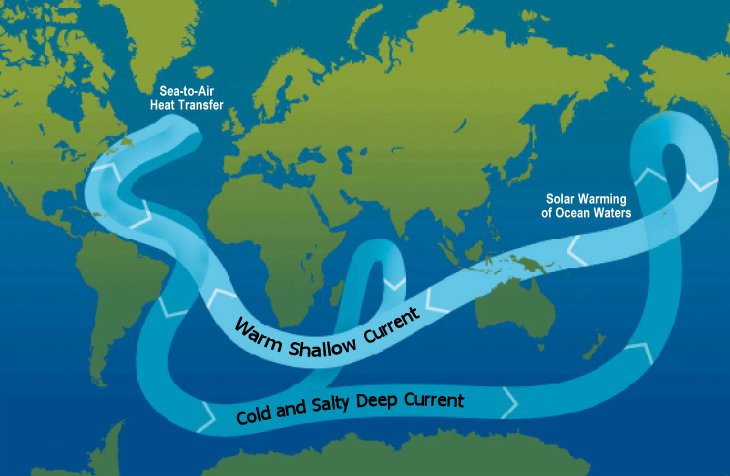
Thermohaline circulation is the large-scale movement of ocean water driven by differences in density, which in turn arise from variations in temperature and salinity, the two properties that give the process its name. Unlike wind-driven surface currents, thermohaline circulation operates throughout the full depth of the ocean, connecting surface and deep water masses across every major ocean basin in a slow, continuous global system.
Often described using the metaphor of a global conveyor belt, thermohaline circulation redistributes heat, salt, dissolved gases, and nutrients across the planet on timescales ranging from decades to many centuries, making it one of the most important yet least directly observable components of the earth’s climate system.
The Physics of Density-Driven Flow
Seawater density increases as temperature decreases and as salinity increases, meaning that cold, salty water is denser and tends to sink, while warm or relatively fresh water is less dense and remains closer to the surface. When surface water in certain regions becomes cold and salty enough, it becomes dense enough to sink to great depths, initiating deep circulation.
This sinking process occurs in only a small number of specific locations worldwide, primarily in the North Atlantic near Greenland and in the Southern Ocean around Antarctica, where intense cooling and, in some cases, sea ice formation that concentrates salt in the remaining liquid water, combine to produce sufficiently dense surface water.
Deep Water Formation Sites
In the North Atlantic, cold winds flowing off the Arctic and Greenland chill surface waters that have already become saltier than typical ocean water due to evaporation and the influence of the Gulf Stream, producing North Atlantic Deep Water that sinks and spreads southward at depth throughout the Atlantic basin.
Around Antarctica, extremely cold conditions and extensive sea ice formation produce Antarctic Bottom Water, among the densest water in the global ocean, which sinks to the seafloor and spreads northward beneath other deep water masses, eventually reaching far into the Atlantic, Pacific, and Indian Ocean basins.
The Global Conveyor Belt Concept
Oceanographers often illustrate thermohaline circulation as a single continuous loop, sometimes called the global conveyor belt, in which deep water formed in the North Atlantic travels southward, joins circulation around Antarctica, and eventually rises back toward the surface in the Pacific and Indian Oceans before slowly returning to the Atlantic as warmer surface and intermediate water.
While this simplified picture captures the broad pattern, actual ocean circulation is considerably more complex, involving multiple overlapping cells, mixing processes, and regional variations that modern oceanographic models continue to refine as observational data improves.
The Atlantic Meridional Overturning Circulation
The Atlantic Meridional Overturning Circulation, often abbreviated AMOC, is the specific component of thermohaline circulation operating in the Atlantic Ocean, encompassing the Gulf Stream’s northward flow of warm surface water and the return flow of cold, deep water sinking in the North Atlantic and traveling southward at depth.
AMOC plays an outsized role in regional climate, helping to keep Western Europe considerably warmer than other locations at similar latitudes, since the northward transport of warm water releases substantial heat into the atmosphere as it travels toward higher latitudes before eventually cooling and sinking.
Role in Global Climate Regulation
Beyond redistributing heat, thermohaline circulation transports dissolved carbon dioxide and oxygen into the deep ocean, where they can remain isolated from the atmosphere for centuries, making deep circulation an important long-term regulator of atmospheric carbon dioxide concentrations and a significant component of the broader global carbon cycle.
This deep carbon storage means that disruptions to thermohaline circulation could have consequences extending well beyond regional temperature patterns, potentially affecting how efficiently the ocean continues to absorb and sequester carbon dioxide released by human activities.
Concerns About Circulation Slowdown
Climate scientists have expressed concern that melting ice sheets and increased freshwater runoff in the North Atlantic could dilute surface salinity enough to weaken the sinking process that drives AMOC, since fresher water is less dense and less prone to sinking even when sufficiently cold.
Several studies using both historical observations and climate models suggest AMOC may have already weakened measurably over the past century, though substantial scientific debate continues regarding the precise magnitude of this trend and how quickly further weakening might occur under continued warming.
Paleoclimate Evidence and Past Disruptions
Evidence from ice cores, ocean sediments, and other paleoclimate records indicates that thermohaline circulation has shut down or dramatically weakened during past periods of rapid climate change, including events associated with large pulses of glacial meltwater entering the North Atlantic at the end of the last ice age.
These past disruptions were associated with abrupt regional cooling, particularly around the North Atlantic, providing a sobering historical analog that researchers now study closely for insight into how a modern slowdown might unfold and what climate consequences could follow.
FAQ
What is the difference between thermohaline circulation and wind-driven surface currents?
Thermohaline circulation is driven by density differences from temperature and salinity and operates through the full ocean depth over long timescales, while surface currents are driven mainly by wind and operate much faster in the upper ocean layer.
What is AMOC?
AMOC, or the Atlantic Meridional Overturning Circulation, is the Atlantic component of thermohaline circulation, including the Gulf Stream and the deep return flow of cold water sinking in the North Atlantic.
Could thermohaline circulation actually stop?
A complete shutdown is considered unlikely in the near term by most researchers, but studies suggest meaningful weakening is possible as melting ice adds freshwater to the North Atlantic, with past abrupt slowdowns documented in the paleoclimate record.
Editorially reviewed by Specialty Digest Editorial TeamLast reviewed November 4, 2026Researched and drafted with AI assistanceReport an issue