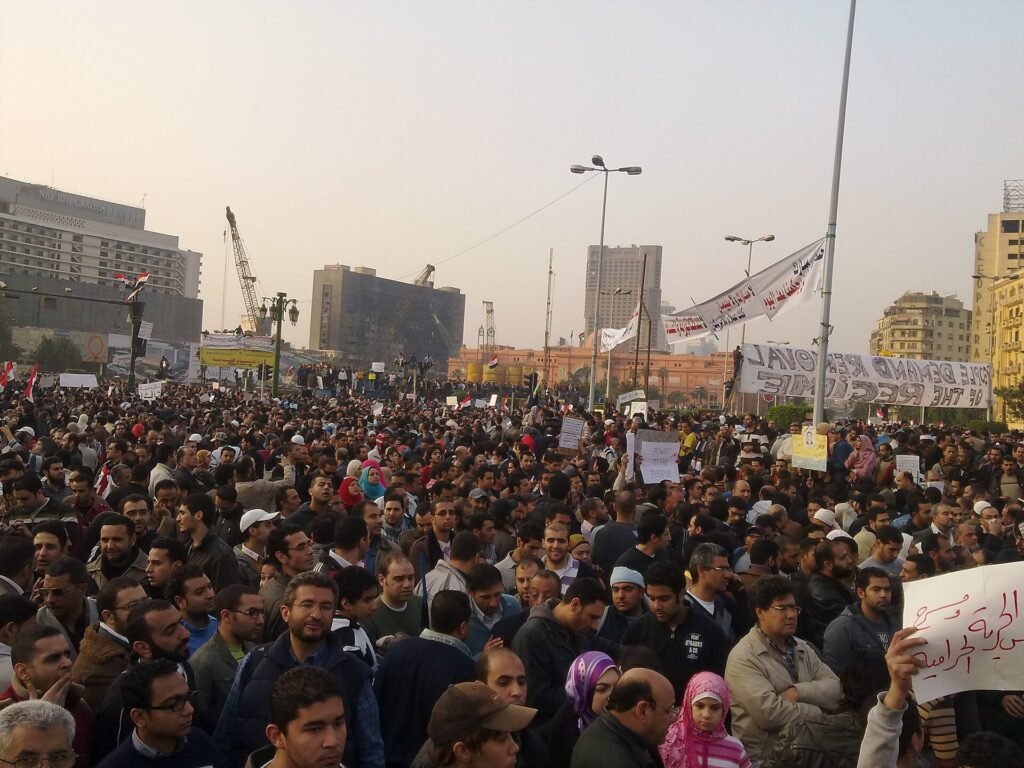
The Arab Spring was a wave of protests and uprisings against authoritarian governments that began in Tunisia in December 2010 and spread across the Middle East and North Africa in 2011. It removed long-serving rulers in Tunisia, Egypt, Libya and Yemen, and it led to civil wars in Libya, Yemen and Syria.
Background to the Arab Spring
The movement is usually traced to Sidi Bouzid, a small town in central Tunisia. According to the Wilson Center, on 17 December 2010 a government inspector demanded a bribe from Mohamed Bouazizi, a 26-year-old street vendor who supported his family by selling fruit from a cart. When he refused, the inspector seized his goods and equipment. Bouazizi tried to complain at government offices, was turned away, and set himself on fire in front of the provincial governor’s office.
His act set off protests in Sidi Bouzid that quickly spread across Tunisia. In Egypt, months of unrest over police abuse had grown after the death in detention of a young man named Khaled Said. Wilson Center chronologies link the Tunisian protests to official corruption and the Egyptian ones to police abuse.
Course of the uprisings
In Tunisia, police reportedly killed about 300 protesters between December and early January, and promises of reform by President Zine El Abidine Ben Ali did little to calm the country. On 14 January 2011 he fled with his family to Saudi Arabia, leaving Prime Minister Mohamed Ghannouchi in charge. The interim government legalized new parties and dissolved Ben Ali’s party, and elections in October 2011 were won by the moderate Islamist party Ennahda.
In Egypt, protesters organized on Facebook for a Day of Revolution on 25 January 2011, and tens of thousands rallied against President Hosni Mubarak. The government shut down the internet and blocked mobile phone networks. Police killed hundreds of protesters over the following weeks, yet crowds kept gathering in Cairo’s Tahrir Square. On 11 February 2011 Mubarak stepped down and handed power to a council of generals, the Supreme Council of the Armed Forces.
The wave then reached other countries. A Brookings Institution review in 2012 listed rulers ousted in Tunisia, Egypt, Libya and Yemen, civil uprisings in Bahrain and Syria, and major protests in Algeria, Iraq, Jordan, Kuwait, Morocco and Oman. In Libya a conflict lasting about five months followed a NATO intervention in mid-March 2011, ending with the capture of Tripoli and the removal of Colonel Muammar Gaddafi in mid-August. In Syria, fighting began in earnest in late November 2011 when opposition forces took the Baba Amr district of Homs. In Yemen, Tawakkol Karman received the 2011 Nobel Peace Prize for her role in supporting women’s rights during the protests.
Aftermath of the Arab Spring
The outcomes differed sharply. By 2014 the Wilson Center noted that Tunisia and Egypt were moving in different directions. Tunisia had adopted a constitution through a process that stayed reasonably democratic despite crises, while Egypt had returned to an authoritarian and repressive government, more openly military than any since the days of Gamal Abdel Nasser. The author attributed the difference to whether the old distribution of power broke down. The departure of Ben Ali created a power vacuum that no single group could fill, while the fall of Mubarak did not.
Even in Tunisia the transition was not smooth. The 2011 election was followed by deep divisions between Islamists and secularists, and the assassinations of two prominent secular politicians, Chokri Belaid and Mohamed Brahmi, in 2013 set off large protests. In October 2013 Ennahda handed power to an interim government to organize new elections, and secular parties edged out the Islamists at the polls the next year. In Egypt, the generals who took over from Mubarak opened the political arena slowly, and lawsuits were brought against Mubarak, his sons and members of his government.
In Libya, Syria and Yemen, the 2011 uprisings led almost at once to armed conflict. A 2022 analysis by the Wilson Center said that largely peaceful civilian protesters were quickly pushed aside, that armed groups took the place of political parties, and that none of the three conflicts looked likely to end in outright victory for one side.
The human cost was large. The Brookings review estimated that about two million people left their homes in the first year because of the upheavals, and at least 30 countries were directly affected by these movements of people. At one point, about 1,000 people per hour were fleeing Libya into Egypt and Tunisia. Large displacement happened mainly in Libya and Syria, where there was full-scale conflict. Libya had hosted about 2.5 million migrant workers at the start of the upheavals, and Syria hosted at least 100,000 Iraqi refugees.
Significance and legacy of the Arab Spring
The Arab Spring showed that long-standing governments in the region could be challenged by mass popular movements, and it changed political life even where it failed. Communications mattered a great deal. Egyptian protesters organized through Facebook, and the government responded by cutting internet and mobile phone service, a step that did not stop the crowds.
Assessments of the legacy have changed over time. In 2021, ten years after the uprisings, Brookings called Tunisia the lone success story of the Arab Spring, because it moved to democracy in 2011, approved a constitution and held free elections in 2014 and 2019. The same analysis stressed that Tunisian democracy was still a work in progress and that its early success rested on compromise among political groups, a weak security sector and strong civil society.
Scholars therefore disagree about whether the name “Arab Spring” still fits what happened. Some stress the hope of 2011 and the lasting demand for dignity and accountable government. Others point to civil war, state collapse, displacement and renewed authoritarian rule in several countries. Both views rest on facts, and the full picture includes successes, failures and developments that continue today.
This entry relies on sources published between 2012 and 2022, and events in the region after those dates may change some of the assessments summarized here.
More in Government & Politics
Key facts
- Mohamed Bouazizi set himself on fire in Sidi Bouzid, Tunisia, on 17 December 2010, which launched the protests.1
- Tunisian President Zine El Abidine Ben Ali fled on 14 January 2011.1
- Egypt's uprising began on 25 January 2011, and President Hosni Mubarak stepped down on 11 February 2011.2
- Rulers were ousted in Tunisia, Egypt, Libya and Yemen, and civil uprisings occurred in Bahrain and Syria.3
- About two million people were displaced in the first year, mostly from Libya and Syria.3
Related concepts
Quick checkWhere did the Arab Spring begin?Show answer
It began in Sidi Bouzid, Tunisia, in December 2010, after street vendor Mohamed Bouazizi set himself on fire to protest official abuse. The protests then spread across the Arab world in 2011.
Sources
- Wilson Center, Chronology: Tunisia (posted 28 December 2015), https://www.wilsoncenter.org/article/islamists/chronology-tunisia
- Wilson Center, Egypt chronology (Cyana Chilton and Garrett Nada), https://www.wilsoncenter.org/egypt-0
- Brookings Institution, Migration, Displacement and the Arab Spring: Lessons to Learn, https://www.brookings.edu/articles/migration-displacement-and-the-arab-spring-lessons-to-learn/
- Wilson Center, Egypt and Tunisia: Democratic Transitions and the Problem of Power (18 April 2014), https://www.wilsoncenter.org/article/egypt-and-tunisia-democratic-transitions-and-the-problem-power
- Brookings Institution, Ten years in, Tunisian democracy remains a work in progress, https://www.brookings.edu/articles/ten-years-in-tunisian-democracy-remains-a-work-in-progress/
- Wilson Center, War and Politics in Libya, Yemen, and Syria (Marina Ottaway, 6 January 2022), https://www.wilsoncenter.org/article/war-and-politics-libya-yemen-and-syria
Editorially reviewed by Specialty Digest Editorial TeamLast reviewed November 4, 2026Researched and drafted with AI assistanceReport an issue