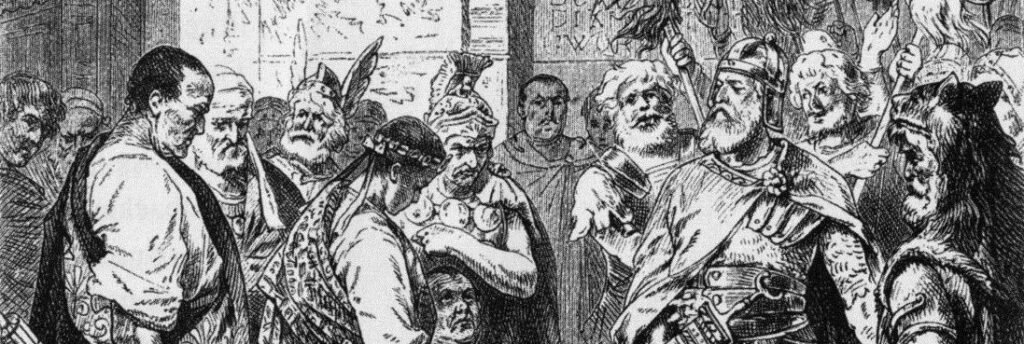
The Fall of the Western Roman Empire was the end of imperial rule in the western half of the Roman Empire, traditionally dated to 4 September 476, when the Germanic general Odoacer deposed the teenage emperor Romulus Augustulus. Odoacer then ruled Italy as a king rather than as an emperor. The eastern half of the empire, governed from Constantinople, survived for nearly another thousand years.
Background of the Fall of the Western Roman Empire
The Roman Empire had grown so large by the late third century that one ruler could no longer manage it. Around 285 or 286, the emperor Diocletian divided the empire into two halves with a co-emperor, Maximian. The Eastern Empire had its capital at Byzantium, later Constantinople, and the Western Empire was governed from Milan, with Rome as a ceremonial capital. Modern writers use the terms Western and Eastern Roman Empire, though the Romans themselves did not.
The two halves prospered together until the late fourth century, but pressure was building. The Crisis of the Third Century, from 235 to 284, saw about twenty emperors in roughly fifty years. In 378, at the Battle of Adrianople, the Gothic leader Fritigern defeated and killed the eastern emperor Valens, which many historians regard as the beginning of the end. In 410, the Gothic king Alaric sacked the city of Rome.
By the fifth century, much of the West had been overrun or settled by Germanic peoples. Real power in many former provinces rested with their kings and chieftains, even when they paid nominal respect to Rome. The empire had also come to depend on Germanic mercenaries for its army, and these soldiers were unreliable and often poorly treated.
Course of events in 475 and 476
The immediate crisis began with a general named Orestes. He had once served Attila the Hun, then rose to become master of soldiers under the western emperor Julius Nepos. Orestes led a coup against Nepos, promising land grants to his Germanic troops, and Nepos fled. Orestes placed his young son on the throne. The new emperor, crowned on 31 October 475, was named Romulus Augustulus. Romulus was the legendary first king of Rome and Augustus its first emperor, and the diminutive form Augustulus reflected that the boy was only a teenager, probably born around 461.
Real power stayed with Orestes, who failed to keep his promise to the soldiers. They found a new leader in Odoacer, a senior commander in the army. Orestes took refuge in Pavia, which fell after a siege, and he was executed in August 476. Odoacer then forced Romulus Augustulus to abdicate on 4 September 476. He did not kill the boy. Instead, Romulus was sent into exile near modern Naples with a generous annual pension, and he lived there until the early sixth century, although the exact date of his death is unknown.
Odoacer proclaimed himself king of Italy and did not take the title of emperor. The Roman senate approved his leadership and gave him the honorary rank of patrician. In form, he ruled in place of the deposed emperor Julius Nepos, who still held out in Dalmatia, and he accepted the overlordship of the eastern emperor Zeno.
Aftermath of the Fall of the Western Roman Empire
Odoacer’s kingdom did not last. Nepos was assassinated in 480, and some historians treat that year as the true end of the Western Empire. Odoacer then annexed Dalmatia, which alarmed Zeno, who also found that Odoacer had backed a rival general, Illus, in a revolt against him. Zeno turned to the Gothic leader Theodoric, who threatened Constantinople and the Balkans. The solution was for Theodoric’s Ostrogoths to move to Italy and remove Odoacer.
Theodoric invaded Italy in 488 and fought Odoacer for four years. A compromise brokered by the bishop of Ravenna set up joint rule in 493, but at the feast celebrating the peace Theodoric killed Odoacer and made himself king. Theodoric’s reign brought order, new laws and building projects, but his successors could not hold the kingdom together after he died in 526.
In the East, the empire continued under emperors who spoke Greek more than Latin. It is known today as the Byzantine Empire, and it lasted until the Ottomans captured its capital in the Fall of Constantinople in 1453.
Significance and legacy of the Fall of the Western Roman Empire
Historians do not agree on a single cause for the fall. A summary from the World History Encyclopedia lists many factors, including political instability, the self-interest of the two halves of the empire, barbarian invasions, government corruption, reliance on mercenary armies, over-dependence on slave labor, unemployment and inflation, and the rise of Christianity. That last point has been debated for centuries and remains contested. The same source stresses that there was no single cause and that a steady decline in power and prestige began well before 476.
The date itself is also a matter of convention. Odoacer’s deposition of Romulus Augustulus is traditionally treated as the end, but for practical purposes the empire in the West had been defunct for years. Because Odoacer officially ruled in place of Nepos, some scholars prefer to date the end to Nepos’s death in 480. This is why historians often speak of a long transformation, in which Roman institutions, law and culture continued under new rulers, rather than a sudden collapse.
The effects were lasting. The disappearance of imperial authority in the West left Italy to a series of kingdoms and later to a patchwork of smaller states, and the papacy eventually took control of Rome itself. The eastern half of the empire kept the Roman name and traditions alive for another millennium. For readers today, 476 serves as a marker used to divide ancient history from the early Middle Ages, even though people living at the time may not have recognized it as an ending.
Key facts
- Romulus Augustulus was crowned on 31 October 475 and deposed by Odoacer on 4 September 476.12
- Odoacer called himself king of Italy and ruled in place of the exiled emperor Julius Nepos.12
- Diocletian divided the empire into eastern and western halves around 285 or 286.2
- Theodoric the Ostrogoth invaded Italy in 488 and killed Odoacer in 493.2
- The Eastern Roman Empire survived until 1453, when Constantinople fell to the Ottomans.1
Related concepts
Quick checkWhy do some historians date the end of the Western Roman Empire to 480 instead of 476?Show answer
Because Odoacer officially ruled in place of the deposed emperor Julius Nepos, who was assassinated in 480.
Sources
- EBSCO Research Starters, Last Roman Emperor Is Deposed, https://www.ebsco.com/research-starters/history/last-roman-emperor-deposed/
- World History Encyclopedia, Western Roman Empire, https://www.worldhistory.org/Western_Roman_Empire/
- World History Encyclopedia, Odoacer, https://www.worldhistory.org/Odoacer/
Editorially reviewed by Specialty Digest Editorial TeamLast reviewed November 4, 2026Researched and drafted with AI assistanceReport an issue