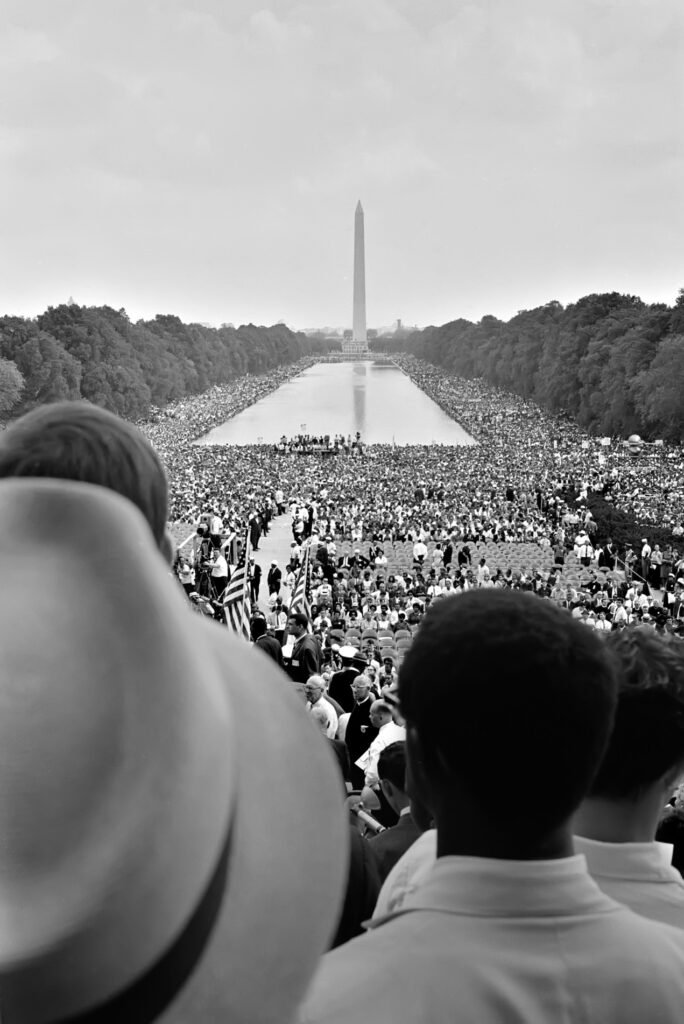
The March on Washington for Jobs and Freedom was a mass demonstration for civil rights and economic justice held in Washington, D.C., on 28 August 1963. More than 200,000 people took part, and the National Park Service puts the crowd at an estimated 250,000. It is best remembered for the “I Have a Dream” speech given by Martin Luther King Jr. at the Lincoln Memorial.
Background of the March on Washington
The idea had earlier roots. In 1941, A. Philip Randolph, founder of the Brotherhood of Sleeping Car Porters, called for a march on Washington to protest the exclusion of African Americans from jobs in the defense industry. The threat of 100,000 marchers pushed President Franklin D. Roosevelt to issue Executive Order 8802, which created the Fair Employment Practices Commission, and Randolph canceled the march. He proposed another march in the 1940s to protest discrimination in the armed forces, and it was called off after President Harry Truman signed Executive Order 9981 in 1948.
Other gatherings followed. Civil rights demonstrators met at the Lincoln Memorial in May 1957 for a Prayer Pilgrimage for Freedom, and in October 1958 for a Youth March for Integrated Schools. By 1963, the centennial of the Emancipation Proclamation, most of the goals of those protests were still unmet. The Stanford King Institute lists high Black unemployment, low wages, widespread denial of the vote and persistent segregation in the South as the grievances behind the new plan.
In March 1963, Randolph told King that his labor council was planning a march for Black job rights. In May, at the height of the Birmingham Campaign, King joined Randolph and the leaders of two other civil rights groups in calling for a national action later that year.
Planning and goals
The National Park Service says the march was organized in under three months. Randolph was its titular head, and his partner Bayard Rustin handled the daily planning, from training volunteer marshals in nonviolent crowd control to the sound system and the sanitation arrangements. Rustin directed a staff of over 200 organizers.
The sponsors, known as the Big Six, were Randolph, Roy Wilkins of the NAACP, Whitney Young of the National Urban League, King of the Southern Christian Leadership Conference, James Farmer of the Congress of Racial Equality and John Lewis of the Student Nonviolent Coordinating Committee. The group grew to include labor, Jewish, Protestant and Catholic leaders. Dorothy Height of the National Council of Negro Women took part in the planning, although she worked in the background.
The stated goals were a comprehensive civil rights bill to end segregation in public accommodations, protection of the right to vote, desegregation of all public schools in 1963, a federal program to train and place unemployed workers, and a federal fair employment law.
The march was not universally welcomed. Malcolm X criticized it as the Farce on Washington, though he attended, and the AFL-CIO executive board stayed neutral, although many of its member unions took part.
Events of 28 August 1963
People arrived by plane, train, car and bus from across the country. Organizers had expected over 100,000 people, and the National Park Service reports that the crowd was estimated at 250,000, about 190,000 of them Black and 60,000 white. Stanford gives a lower figure of more than 200,000, so estimates differ.
Officials feared violence, and President Kennedy worried that any trouble could damage the civil rights bill then moving through Congress. The District of Columbia mobilized 5,900 police officers, and the government assembled 6,000 soldiers and National Guard members. In the end, police reported no incidents.
Speakers and performers included Marian Anderson, Odetta, Joan Baez, Bob Dylan, Daisy Bates, Ossie Davis, Ruby Dee, Rabbi Joachim Prinz, Randolph, Walter Reuther of the United Auto Workers, Rustin, Wilkins, Young and John Lewis. Lewis softened parts of his prepared speech after other leaders objected to its militant tone. His original draft had called the administration’s civil rights bill too little and too late and threatened to march through the South. After a meeting with King, Randolph and others, he removed those phrases but still criticized both political parties for moving too slowly.
Young and Prinz spoke of justice and equal opportunity, and of full access to the American Dream promised by the Declaration of Independence and reaffirmed by the 13th, 14th and 15th Amendments. The sponsors also issued a list of ten demands that included a fair living wage, fair employment policies and the desegregation of school districts.
King spoke near the end of the program. His address, which became known as the “I Have a Dream” speech, moved the audience at the Lincoln Memorial and viewers watching on live television. King later said that as television carried the image of the gathering across the oceans, everyone who believed in human capacity to improve had a moment of inspiration and confidence in the future.
Aftermath and legacy
After the march, King and other leaders met President John F. Kennedy and Vice President Lyndon B. Johnson at the White House to discuss the need for bipartisan support of civil rights legislation. The Stanford King Institute notes that the march helped pressure the Kennedy administration to push a strong civil rights bill in Congress.
The Civil Rights Act of 1964 and the Voting Rights Act of 1965 were passed after Kennedy’s death, and, according to Stanford, their provisions reflect the demands of the march.
The event also remains a model of organized, peaceful mass protest. The National Park Service stresses that the people themselves made it a success: some dressed for church, others in work clothes, and many began to march before their leaders arrived from meetings on Capitol Hill.
More in History
Key facts
- The March on Washington for Jobs and Freedom took place on 28 August 1963.1
- Stanford gives an attendance of more than 200,000, and the National Park Service estimates 250,000.12
- A. Philip Randolph was the titular head and Bayard Rustin handled the planning.2
- The sponsors known as the Big Six were Randolph, Wilkins, Young, King, Farmer and Lewis.2
- Police reported no incidents among the crowd.2
Related concepts
Quick checkHow many people attended the March on Washington?Show answer
Estimates differ. The Stanford King Institute says more than 200,000, and the National Park Service says about 250,000, on 28 August 1963.
Sources
- Martin Luther King, Jr. Research and Education Institute, Stanford University, March on Washington for Jobs and Freedom, https://kinginstitute.stanford.edu/march-washington-jobs-and-freedom
- National Park Service, March on Washington for Jobs and Freedom, https://www.nps.gov/subjects/civilrights/march-on-washington.htm
Editorially reviewed by Specialty Digest Editorial TeamLast reviewed November 4, 2026Researched and drafted with AI assistanceReport an issue