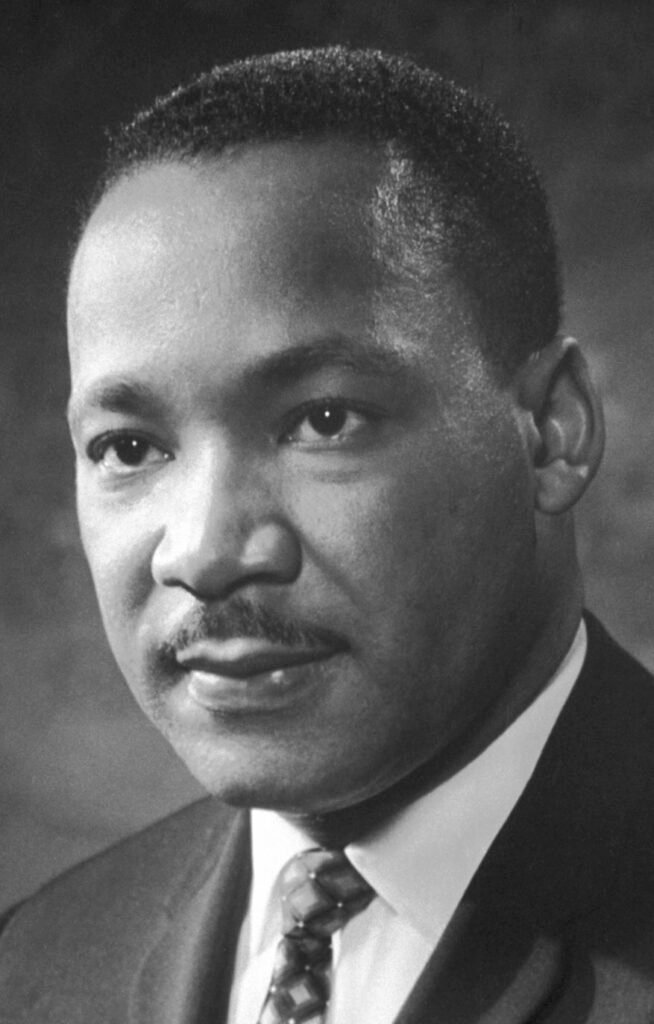
Martin Luther King Jr. (1929 to 1968) was an American Baptist minister and the most prominent leader of the nonviolent civil rights movement in the United States. He led the Montgomery bus boycott, helped direct the 1963 March on Washington, and received the Nobel Peace Prize in 1964. He was assassinated in Memphis, Tennessee, on 4 April 1968.
Early life of Martin Luther King Jr.
King was born in Atlanta, Georgia, on 15 January 1929. He was first named Michael Luther King Jr., and the name was later changed to Martin. His grandfather began the family’s long tenure as pastors of Ebenezer Baptist Church in Atlanta in 1914, and his father served the church after him. From 1960 until his death King was co-pastor there himself, so his work in the pulpit and his work in public life were closely joined.
He attended segregated public schools in Georgia and graduated from high school at fifteen. In 1948 he received a bachelor’s degree from Morehouse College, the Atlanta institution that both his father and grandfather had attended. At Crozer Theological Seminary in Pennsylvania he was elected president of a mostly white senior class and earned a divinity degree in 1951. He then studied at Boston University, completed his residence for the doctorate in 1953 and received the degree in 1955. In Boston he met and married Coretta Scott, and the couple had two sons and two daughters.
Career and major work of Martin Luther King Jr.
In 1954 King became pastor of Dexter Avenue Baptist Church in Montgomery, Alabama, and he already sat on the executive committee of the National Association for the Advancement of Colored People. In December 1955 he accepted leadership of the Montgomery bus boycott. The boycott lasted 382 days and ended on 21 December 1956, after the United States Supreme Court declared the laws requiring segregation on buses unconstitutional. During it King was arrested, his home was bombed and he faced personal abuse.
In 1957 he was elected president of the Southern Christian Leadership Conference, an organization formed to guide the growing civil rights movement. Its ideals came from Christianity, and its working methods came from Gandhi. Between 1957 and 1968, according to the Nobel Foundation, King traveled more than six million miles, spoke over twenty-five hundred times and wrote five books.
His campaigns during these years included a mass protest in Birmingham, Alabama, which inspired his Letter from a Birmingham Jail, and voter registration drives in Alabama. In 1963 he directed the march on Washington, D.C., where about 250,000 people heard his address known as I Have a Dream. He was arrested upward of twenty times and assaulted at least four times, and Time magazine named him Man of the Year in 1963.
King also conferred with President John F. Kennedy and campaigned for President Lyndon Johnson. By the end of this period he had received five honorary degrees and had become the symbolic leader of Black Americans and a figure known around the world.
Ideas and contributions of Martin Luther King Jr.
King’s strategy rested on nonviolent resistance to segregation and discrimination. He followed the philosophy of Mahatma Gandhi and combined it with a faith-based argument rooted in Christianity. He wanted Americans to be judged by their personal qualities and not by the color of their skin.
The Southern Christian Leadership Conference gave this strategy an organizational base. Its method was to confront injustice in public through marches, boycotts and peaceful protest, and to accept arrest and abuse instead of answering with force. The Montgomery boycott showed that the approach could end a legal practice, because the Supreme Court ruling that followed made integrated buses the law.
Nonviolent protest often drew a violent response from segregationists, and the public attention that followed helped build support for federal action. The Civil Rights Act, signed by President Lyndon Johnson on 2 July 1964, outlawed segregation in businesses such as theaters, restaurants and hotels, banned discriminatory employment practices and ended segregation in public places such as swimming pools, libraries and public schools. The National Archives describes it as the most sweeping civil rights legislation since Reconstruction. It passed only after supporters overcame a delaying committee in the House and a long filibuster by Southern opponents in the Senate.
Legacy of Martin Luther King Jr.
In 1964, at the age of thirty-five, King became the youngest person to receive the Nobel Peace Prize, which the committee awarded for his nonviolent struggle for civil rights. When he learned of his selection he said he would give the prize money of $54,123 to the civil rights movement. The prize and the laws passed during his lifetime are the most direct records of his influence, and his speeches and letters remain widely read in the United States and abroad.
On the evening of 4 April 1968, King was shot while standing on the balcony of his motel room in Memphis. He was in the city to lead a march in support of striking sanitation workers. He was thirty-nine years old. The Nobel Foundation records that the movement he led had pressed since 1955 for the federal government to declare racial discrimination in the Southern states unlawful, and that the law of 1964 was the most visible result of that effort.
Criticism and opposition
King had powerful opponents during his lifetime. The director of the Federal Bureau of Investigation, J. Edgar Hoover, had him placed under surveillance on the suspicion that he was a communist. When King spoke against the administration’s policy in Vietnam, he also fell out of favor with President Johnson. These conflicts show the pressure that civil rights leaders faced from within the federal government itself, in addition to violence from segregationist groups.
More in History
Key facts
- King was born in Atlanta on 15 January 1929 and died in Memphis on 4 April 1968.12
- The Montgomery bus boycott he led lasted 382 days and ended on 21 December 1956.2
- About 250,000 people joined the 1963 March on Washington, where he gave the I Have a Dream address.12
- The Civil Rights Act was signed on 2 July 1964.3
- At age 35 he became the youngest Nobel Peace Prize winner up to that time.2
- He gave the $54,123 prize money to the civil rights movement.2
Related concepts
Quick checkWhat did the Civil Rights Act of 1964 do?Show answer
It prohibited discrimination in public places, provided for integration of schools and public facilities and made employment discrimination illegal.
Sources
- NobelPrize.org, Martin Luther King Jr. Facts, https://www.nobelprize.org/prizes/peace/1964/king/facts/
- NobelPrize.org, Martin Luther King Jr. Biographical, https://www.nobelprize.org/prizes/peace/1964/king/biographical/
- National Archives, Civil Rights Act (1964), https://www.archives.gov/milestone-documents/civil-rights-act
Editorially reviewed by Specialty Digest Editorial TeamLast reviewed November 4, 2026Researched and drafted with AI assistanceReport an issue