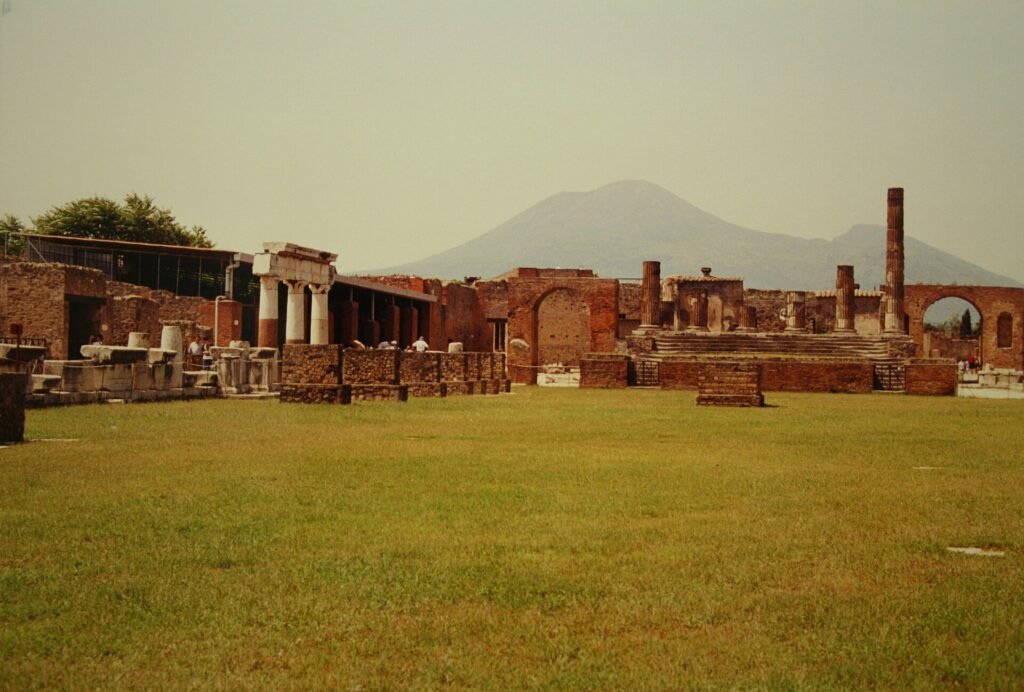
The discovery of Pompeii was the gradual rediscovery of a Roman town near Naples that was buried by the eruption of Mount Vesuvius in 79 AD. Extensive excavations began in 1748 under Charles of Bourbon, and work at the site has continued ever since.
Pompeii is valued because it preserves a Roman town and its daily life at a single moment. It is part of a UNESCO World Heritage site that also covers Herculaneum and Torre Annunziata.
Background to the discovery of Pompeii
Before the eruption, Pompeii was a prosperous town on the Bay of Naples. The World History Encyclopedia estimates its population at 10,000 to 12,000, about one third of them enslaved, with many more people living in surrounding farms and villas.
A violent earthquake damaged the town in 62 AD. Nobody suspected that it signaled renewed activity from Vesuvius, which had been dormant for more than 300 years.
The great eruption began on the afternoon of 24 August 79 AD, according to the traditional date. Pumice gravel fell on Pompeii for about eighteen hours, and then waves of hot ash and gas swept down the mountain and buried the town under roughly three meters of pumice and ash.
Excavated houses show how people experienced those hours. At least ten people sheltered in the House of Polibius and did not leave. On the morning of 25 August boulders from crumbled masonry destroyed the front of the building, and the survivors retreated to two rear rooms, where the waves of ash and gas finally reached them.
The eruption is described in more detail in the entry on the eruption of Mount Vesuvius in 79 AD.
The discovery
Pompeii was found in stages. In the sixteenth century the architect Domenico Fontana cut through some of the city’s buildings while digging a canal from the River Sarno, but nobody recognized the remains as the town buried in 79 AD.
The turning point came in 1748, when extensive campaigns began on the initiative of Charles of Bourbon, the ruler of Naples. They uncovered the Herculaneum Gate and the Via dei Sepolcri, a street lined with tombs.
More discoveries followed. Between 1760 and 1770 teams brought to light the Great Theatre, the Odeion and the Triangular Forum, together with the Temple of Isis, whose Egyptian decorations caused a great stir. In 1770 the monumental Villa of Diomedes was unearthed.
Later digs focused on the civic heart of the town. Between 1806 and 1815 the Forum was explored, and in 1830 the House of the Faun with its fine mosaics emerged.
How the discovery was confirmed
Confirmation grew as the excavations exposed streets, public buildings and houses that matched a Roman town. In 1863 Giuseppe Fiorelli was named superintendent of the excavations and revealed neighborhoods along the Via Stabiana.
Fiorelli also defined the method of making plaster casts in the cavities that victims’ bodies had left in the hardened ash. The casts gave faithful images of the people who died, and they remain among the best-known results of the work.
Archaeologists continued to find individual houses. The House of the Centenary with its household shrine was excavated in 1879 and 1880, the House of the Silver Wedding in 1884, and the House of the Vettii, with its exceptional collection of wall paintings, in 1894.
Scientific study of the remains has added detail. Skeletal remains and the plaster casts show that bad teeth were a common problem, for example, because enamel was worn away by stone chips in bread, and tuberculosis, brucellosis and malaria were also widespread.
The soil layers themselves are evidence. The layer of pumice and ash lies over the town in a clear sequence, and study of its stratigraphy helps researchers reconstruct the order of the eruption.
Impact and legacy of the discovery
The discovery gave the world its fullest picture of an ordinary Roman town. In 1997 the UNESCO World Heritage Committee added the archaeological areas of Pompeii, Herculaneum and Torre Annunziata to the World Heritage List, describing them as complete, living evidence of a society and its everyday life at a precise moment.
The site shaped taste and scholarship from the eighteenth century onward. The finds of wall paintings, mosaics and household objects fed public interest in Roman life, and the methods used to record them helped shape modern excavation.
Pompeii also shows how quickly volcanic hazards can unfold. By the account of the Museo Galileo, the town was buried under pumice and ash over roughly a day, after a warning earthquake years earlier that nobody understood.
The park’s UNESCO office records that the listing rests on criteria (iii), (iv) and (v), and the committee described the sites as evidence without parallel elsewhere in the world.
Scholars have used the town to study ordinary life as well as monuments. The World History Encyclopedia notes that the site provides data on diet, health, housing and work, including evidence that a large share of the population was enslaved.
Today the site is managed as an archaeological park with its own scientific committee and director, and research on the town, its inhabitants and its buildings continues.
Disputes over dating
Even the date of the eruption is debated. The traditional date of 24 August 79 AD comes from ancient accounts, but the World History Encyclopedia notes that a partial inscription found at the site in 2018 suggests the eruption may have taken place in mid-October.
Credit for the discovery is also not simple. The early finds of the sixteenth century were not understood, and the systematic work that identified the town began under the patronage of Charles of Bourbon in 1748, with later superintendents such as Fiorelli changing how the site was recorded.
Researchers continue to refine the story, and new rooms, objects and findings keep appearing as more of the town is studied.
More in Archaeology
Key facts
- Pompeii was buried by the eruption of Vesuvius, traditionally dated to 24 August 79 AD, under about three meters of pumice and ash.1
- Extensive excavations began in 1748 on the initiative of Charles of Bourbon.1
- Giuseppe Fiorelli became superintendent of the excavations in 1863 and defined the method of making plaster casts of victims.1
- The World History Encyclopedia notes an inscription found in 2018 that suggests an eruption in mid-October.3
- UNESCO added the archaeological areas of Pompeii, Herculaneum and Torre Annunziata to the World Heritage List in 1997.2
Related concepts
Quick checkWhen was Pompeii rediscovered?Show answer
Parts of it were hit by chance in the sixteenth century without being recognized, and systematic excavations began in 1748 under Charles of Bourbon.
Sources
- Museo Galileo, Homo Faber: The eruption of Vesuvius and the history of the archaeological excavations, https://mostre.museogalileo.it/homofaber/en/introduction.html
- Archaeological Park of Pompeii, Unesco Office, https://pompeiisites.org/en/archaeological-park-of-pompeii/unesco-office/
- World History Encyclopedia, Pompeii, https://www.worldhistory.org/Pompeii/
Editorially reviewed by Specialty Digest Editorial TeamLast reviewed November 5, 2026Researched and drafted with AI assistanceReport an issue