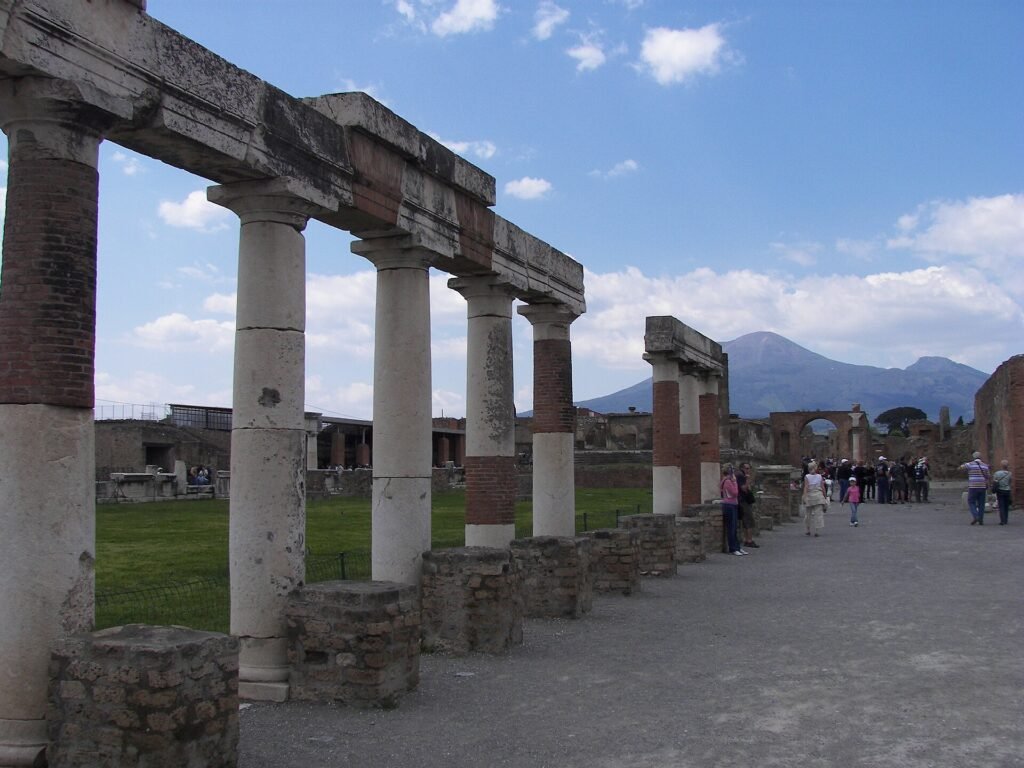
The eruption of Mount Vesuvius in 79 AD was a major explosive volcanic event in southern Italy that buried the Roman towns of Pompeii and Herculaneum in ash and volcanic debris. UNESCO dates it to 24 August AD 79. The disaster is unusually well known because a Roman eyewitness, Pliny the Younger, described it in letters, and because the buried towns preserved much of daily Roman life.
Background to the eruption
Vesuvius stands beside the Bay of Naples, and the nearby city of Naples still lies in its shadow. Oregon State University’s Volcano World describes it as a stratovolcano, a steep cone built from layers of ash and lava, that grew after an older volcano called Somma collapsed about 17,000 years ago. It sits above a subduction zone, where the African plate is pushed slowly beneath the Eurasian plate, a process explained under plate tectonics.
The region had suffered earthquakes before 79 AD. Oregon State notes that damaged stonework in Pompeii may record an earthquake in 62 AD that preceded the eruption. In that period the fertile slopes supported farms and vineyards, and wealthy Romans built seaside villas along the coast. Pliny the Elder, author of the encyclopedic Natural History, called the area Campania felix, or happy Campania, because of its rich soil.
Oregon State notes that Vesuvius had already produced two of the largest known eruptions in Europe, in about 5960 BC and 3580 BC, long before Rome existed. By 79 AD those events were far in the past, and the mountain looked like an ordinary tree-covered peak above the Campanian plain.
Course of the eruption
Our best account comes from Pliny the Younger, who was 17 at the time. According to a summary from the U.S. Naval Academy’s Nimitz Library, he was staying at Misenum with his uncle, Pliny the Elder, who commanded the Roman fleet there. Pliny the Younger later described what he saw in two letters to the historian Tacitus.
At about one in the afternoon, his mother pointed out a huge cloud shaped like an umbrella pine. Pliny the Elder ordered a boat to investigate, then received a plea for rescue from a woman named Rectina, whose home lay at the foot of the mountain. He set out around three o’clock with warships. Ash and pumice fell onto his vessels, and he turned toward Stabiae, where he landed at about six in the evening. The ground shook through the night, and in the morning he died on the shore, either from natural causes after his exertions or from the effects of a pyroclastic flow, as the Naval Academy summary puts it. Pliny the Younger stayed at Misenum, reading, and survived.
Oregon State says this was the first volcanic eruption ever described in detail. Pliny the Younger watched from about 30 kilometers away and recorded the earthquakes before the eruption, the rising column, falling ash and pumice, effects on people, pyroclastic flows and even a tsunami. Volcanologists now call a sustained, high-column explosive eruption plinian in his uncle’s honor. At times the ash column is estimated to have risen about 32 kilometers, and roughly 4 cubic kilometers of ash were erupted in about 19 hours.
Aftermath at Pompeii and Herculaneum
UNESCO states that the eruption engulfed the two flourishing towns of Pompeii and Herculaneum and many wealthy villas nearby. At Pompeii, according to Oregon State, about 3 meters of tephra, the general term for airborne volcanic fragments, fell and buried everything except the roofs of some buildings. The city was abandoned and its location was later forgotten.
Herculaneum met a different fate. The same source reports that it was buried under about 23 meters of material laid down by a pyroclastic flow, a fast-moving cloud of hot gas and rock. About 5,000 people lived there. Because the deposits sealed the town, Herculaneum survived in better condition than Pompeii, which UNESCO describes as larger and commercial, while Herculaneum was a smaller holiday resort.
The human toll is hard to state precisely. Oregon State’s summary gives about 3,360 deaths from ash falls and flows, but this is an estimate rather than a census, and the number of people who fled is unknown.
Rediscovery and archaeology
Oregon State reports that excavations found artifacts at Pompeii in 1595, and that centuries of looting followed. UNESCO says the buried towns have been progressively excavated and opened to the public since the mid-18th century. Plaster casts of voids left by decayed bodies, and wall paintings such as those at the Villa Oplontis in Torre Annunziata, give a vivid picture of life in the early Roman Empire. Oregon State notes that these remains reveal how people lived and died during the eruption, including the cast of a dog that was chained to a post.
Significance and legacy
The eruption shaped how scientists think about explosive volcanoes. Pliny’s letters supplied the first detailed observations of an eruption, and the word plinian is still used in volcanology. The ruins also became one of the most important archaeological sites in the world, and UNESCO lists the Archaeological Areas of Pompei, Herculaneum and Torre Annunziata as a World Heritage property.
Vesuvius remains dangerous. Oregon State counts about three dozen eruptions since 79 AD, the most recent in the cycle from 1913 to 1944, and it records that mudflows and lava from the 1631 eruption killed 3,500 people. That 1990s-era summary also reports that about one million people lived and worked in the zone within roughly 7 kilometers of the crater, and that about three million could be seriously affected by a future eruption. Authorities treat planning for such an event as a question of disaster preparedness, which is why the 79 AD record still matters to modern monitoring.
More in Earth Sciences
Key facts
- Vesuvius erupted on 24 August AD 79 and engulfed Pompeii, Herculaneum and many nearby villas.1
- Pliny the Younger described the eruption in two letters to Tacitus, and the term plinian eruption honors this account.2
- About 3 meters of tephra buried Pompeii, while a pyroclastic flow buried Herculaneum under about 23 meters of material.3
- The ash column at times rose an estimated 32 kilometers, and about 4 cubic kilometers of ash were erupted in about 19 hours.3
- Pliny the Elder, commander of the Roman fleet at Misenum, died on the shore at Stabiae during the eruption.2
- The site is a UNESCO World Heritage property, excavated progressively since the mid-18th century.1
Related concepts
Quick checkWho described the 79 AD eruption of Vesuvius?Show answer
Pliny the Younger, who watched from Misenum, wrote two letters to the historian Tacitus describing the eruption and the death of his uncle, Pliny the Elder.
Sources
- UNESCO World Heritage Centre, Archaeological Areas of Pompei, Herculaneum and Torre Annunziata, https://whc.unesco.org/en/list/829
- U.S. Naval Academy Nimitz Library Special Collections, The Eruption of Mount Vesuvius, AD 79, https://usna.edu/Library/sca/blog/posts/vesuvius_i.php
- Oregon State University, Volcano World: Vesuvius, https://volcano.oregonstate.edu/vesuvius
Editorially reviewed by Specialty Digest Editorial TeamLast reviewed November 4, 2026Researched and drafted with AI assistanceReport an issue