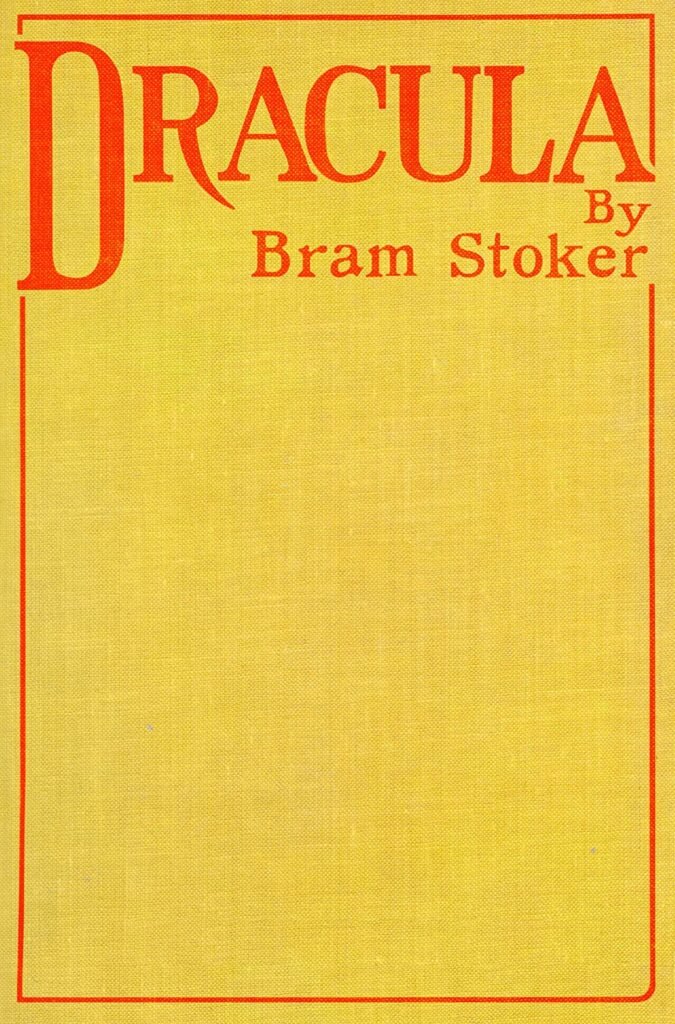
Dracula is a Gothic horror novel by the Irish writer Bram Stoker, first published in London in 1897. It follows a vampire from Transylvania, Count Dracula, who moves to England and is hunted by a small group of allies led by Professor Abraham Van Helsing. The story is told through letters, diary entries and newspaper articles, a format that makes the reader piece together the threat alongside the characters.
Background and creation of Dracula
Bram Stoker (1847 to 1912) earned his living in the theater rather than as a full-time novelist. He helped manage the Lyceum Theatre in London and traveled with its productions, including on tours of the United States. He wrote Dracula during the 1890s, alongside that demanding job.
About 100 pages of his research and planning notes survive at the Rosenbach Museum and Library in Philadelphia. Some are written on stationery from a Philadelphia hotel, which suggests that he sketched parts of the plot while on the road. The Rosenbach notes that one set of hotel pages deals with the chapter in which Mina and Van Helsing travel to Transylvania. The notes matter because they show how much of the book was assembled from reading and careful planning.
Place mattered as well. Stoker stayed in the seaside town of Whitby on the northeast coast of England, and the sight of its ruined abbey above the sea inspired him to make it the spot where Dracula comes ashore. Older vampire beliefs supplied the rest of the toolkit, including the protective power of garlic and the stake driven through the heart.
The first edition was issued by Archibald Constable and Company in a mustard-yellow cover with the title in red. The exact publication date is unknown, though most scholars place it in late May or early June of 1897. Two earlier texts also survive: Stoker’s notes and the typescript that went to the publisher.
Plot of Dracula
The novel opens with Jonathan Harker, a young English solicitor, traveling to the Carpathian Mountains in Transylvania, a region that is now part of Romania. He has come to help Count Dracula buy property in England. Harker gradually realizes that his host is not human and that he himself is a prisoner in the castle.
Dracula travels to England by ship, hidden in boxes of soil from his homeland, and the vessel runs aground at Whitby. There he preys on Lucy Westenra, a friend of Harker’s fiancée, Mina Murray. Lucy’s mysterious decline baffles her doctor, John Seward, who calls in his former teacher, Van Helsing. Despite blood transfusions and protective measures, Lucy dies and returns as a vampire, and her former suitors, together with Van Helsing, release her by driving a stake through her heart.
The group then turns to Dracula himself. When he attacks Mina, the hunters trace his boxes of soil across London and pursue him back toward his castle. The chase ends in a fight on a Transylvanian road, where the Count is killed and the American Quincey Morris dies of his wounds.
Because the narrative is built from documents, the reader sees events only through the characters’ records, including Harker’s journal, Seward’s phonograph diary, Mina’s typed transcripts and a ship’s log. Dracula never gives his own account of events. That absence keeps him mysterious and makes the evidence of his power feel scattered and hard to assemble.
Closer to home, the Count finds an ally in Renfield, a patient in Seward’s asylum who eats insects and small animals in the belief that he can absorb their life force. Renfield gives the story an unsettling second storyline inside the English medical system, and Seward records his behavior with the same scientific care he applies to Lucy.
Themes in Dracula
Critics have read the novel as a story about fear of invasion. A foreign aristocrat settles in the heart of London and spreads his influence through the population, and some scholars link this to British anxieties about outsiders and national decline in the 1890s. Others point out that the English heroes depend on foreign expertise, from a Dutch professor and an American, to protect their country.
Another recurring theme is the clash between modern methods and older beliefs. The heroes use typewriters, phonographs, telegrams, railway timetables and blood transfusion, yet they succeed only after accepting folklore that rational Victorian science would have dismissed. The story neither rejects modernity nor trusts it fully.
Gender and sexuality have drawn the most commentary. Lucy and Mina are shaped by Victorian expectations of purity and duty, and the vampire’s attacks are often read as a violation of those norms. Scholars disagree about whether the book reinforces these expectations or exposes the anxieties behind them. Religion matters too, since crucifixes and consecrated objects work as real protections in the story.
Reception and legacy of Dracula
Early reviews of the book were mixed, and Stoker was better known in his lifetime for his theater work than for fiction. Academic interest stayed slight until the early 1970s. Since then, Dracula has become a standard text in courses on Gothic fiction and has been studied for its treatment of empire, science, gender and religion.
Its influence on popular culture has been far wider than its readership. F. W. Murnau’s silent film Nosferatu (1922) adapted the story without permission, and the 1931 Hollywood film starring Bela Lugosi fixed an image of the Count that audiences still recognize. Stage plays, television series, comics and novels have retold the story many times, and Count Dracula remains the best-known vampire in fiction.
Libraries and museums keep the book’s history in view. In 2022 the Rosenbach marked the 125th anniversary of publication with programs built around Stoker’s notes and rare early editions. In 2020 it had also run “Sundays with Dracula,” a live-streamed series of 27 weekly talks, each covering one chapter, which averaged about 100 live viewers per episode.
More in Literature
Key facts
- Dracula was written by the Irish author Bram Stoker (1847 to 1912) and published in 1897.1
- The story is told through letters, diary entries and newspaper articles.1
- The first edition was issued by Archibald Constable and Company in May or June 1897, in a mustard-yellow cover with the title in red.3
- About 100 pages of Stoker's research notes are held by the Rosenbach Museum and Library in Philadelphia.2
- Stoker took Whitby, on the northeast coast of England, as the place where Dracula arrives in England.2
- Academic interest in the novel was slight until the early 1970s.3
Related concepts
Quick checkWho wrote Dracula, and in what year did it appear?Show answer
Bram Stoker wrote it, and it was published in 1897.
Sources
- Project Gutenberg, Dracula by Bram Stoker (ebook 345), https://www.gutenberg.org/ebooks/345
- WHYY, Philly celebrates Dracula's 125th anniversary (Mutter Museum and Rosenbach), https://whyy.org/articles/dracula-125th-anniversary-mutter-rosenbach-philadelphia/
- CESNUR, Introduction: Dracula, the Text (bibliography of editions of Dracula), https://cesnur.org/2003/dracula/intro.htm
Editorially reviewed by Specialty Digest Editorial TeamLast reviewed November 5, 2026Researched and drafted with AI assistanceReport an issue