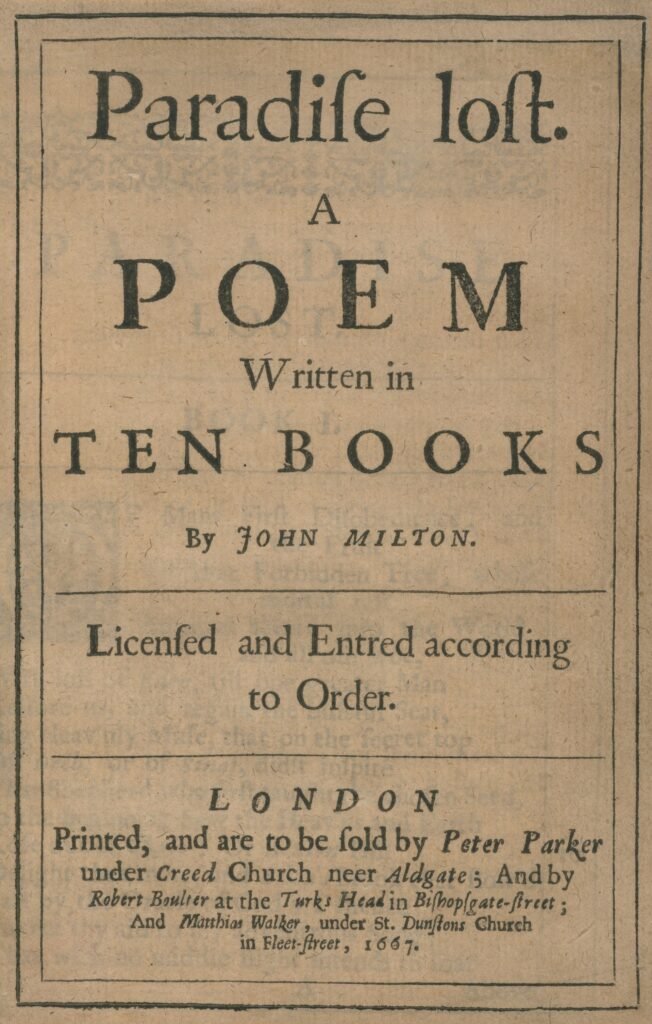
Paradise Lost is an epic poem in blank verse by the English poet John Milton (1608 to 1674). First published in 1667, it retells the biblical story of the Fall of Man, in which Adam and Eve disobey God in the Garden of Eden. In its final form the poem runs to more than ten thousand lines in twelve books, and it remains a standard text in the study of English literature.
Background and writing of Paradise Lost
Milton first conceived the work around 1640. At that stage he pictured a five-act tragedy titled Adam Unparadised, not a long narrative poem.
He wrote the epic in its present form mostly between 1658 and 1665. Those years took in the decline of the English Republic, the return of the monarchy in 1660 and the collapse of Milton’s own political hopes.
His aim was a Christian poem that could stand beside the pagan epics of Homer and Virgil. He borrowed several marks of the epic tradition, including extended heroic similes, an invocation of a Muse, and a plot that begins in the middle of events, a device known by the Latin phrase in medias res.
Publication and editions of Paradise Lost
The first edition appeared in London in 1667 as a poem in ten books. About 1,300 copies were printed across 1667 and 1668.
The poem sold slowly at first. Its publisher, Samuel Simmons, reissued the printed sheets several times with new title pages and extra material to stimulate sales. The earliest title page omits his name, which may reflect worry about reprisals, since Milton was politically unpopular after the Restoration.
A revised edition of 1674, the year Milton died, is the basis of the familiar twelve-book text. The change gave the poem the same number of books as Virgil’s Aeneid.
Reprints became frequent from 1674 onward. Large illustrated folios and eighteenth-century editions with explanatory notes, a treatment earlier given mainly to classical authors, helped fix the poem’s place as a canonical work.
Summary of Paradise Lost
The poem opens with Satan and his army of rebel angels falling into Hell after a failed revolt against God. Milton then moves back in time to tell of Lucifer’s rebellion, the war in Heaven and the creation of Adam, Eve and their earthly home.
In Book 1 Satan rallies the fallen angels from a burning lake, and they raise the palace of Pandaemonium for a council. In Book 4 Satan reaches the edge of Eden and sees Adam and Eve for the first time.
The climax comes in Book 9. Satan, disguised as a serpent, persuades Eve to eat fruit from the forbidden tree, and Adam, seeing that she has sinned, knowingly eats it too.
Their disobedience leads to expulsion from Paradise. Before they leave, Adam is shown a vision of human history that ends with the possibility of redemption through the future sacrifice of Christ. Milton wrote his own short summaries for each book, which he called Arguments, and printed them at the start of the books.
Style and structure of Paradise Lost
Milton wrote in blank verse, which means unrhymed lines of ten syllables. The form gave him a flexible line that could carry both long argument and vivid description.
The poem is divided into books on the model of the classical epic. Its long sentences, learned vocabulary and Latin-influenced word order give the verse a formal tone that readers often find demanding at first.
Characters in Paradise Lost
The central figures are Satan, Adam and Eve. Satan begins as the leader of the rebel angels and acts as the tempter in Eden, while Adam and Eve are the first humans, created to live in the garden under a single prohibition.
God, the Son and the loyal angels appear in Heaven, and the fallen angels, with names drawn from older traditions, gather in Hell. Milton gives most of these characters long speeches, so much of the poem is built from debate and persuasion rather than from action alone.
Themes in Paradise Lost
The best-known theme is theodicy, the attempt to explain and justify God’s ways to humankind. Milton turned the old martial epic into a vehicle for that Christian argument, drawing on the Bible for his story.
Closely tied to this is free will. Early in Book 10 the narrator stresses that God did not hinder Satan’s attempt on humankind, because humans had been armed with free will and could resist.
Satan is the most debated figure. In Book 1 he speaks with rhetorical force, and readers see a proud, tortured leader who is both tragic and heroic. Critics have long argued about whether Milton meant this appeal as a trap for the reader or whether it escaped his control, and the poem supports more than one reading.
The poem also reflects its political moment. Milton wrote as a defeated supporter of the Republic, and later readers, especially the Romantic poets, looked to him as an example of political conviction as well as poetic skill.
Reception and legacy of Paradise Lost
After its slow start, the poem grew steadily in reputation. In his Life of Milton, Samuel Johnson judged Milton to be, of all poets, the one least indebted to his predecessors, even though later writers owed him a great deal.
Romantic writers admired him in particular. William Blake had a close but often argumentative relationship with Milton’s work, and William Wordsworth opened a sonnet by calling for Milton to return to an England in need of him.
Artists also took up the poem. Illustrators from the late seventeenth century through the eighteenth century, among them J. B. Cipriani, produced images of its scenes, and composers and later writers have drawn on its characters and imagery. In Mary Shelley’s Frankenstein, for example, the creature reads the poem and compares his own situation with those of Adam and Satan.
Today Paradise Lost is read as a landmark of English poetry and as a major source for how English speakers picture Satan, Eden and the Fall. Several libraries and colleges, among them Christ’s College, Cambridge, where Milton studied, keep early copies and run exhibitions on it.
More in Literature
Key facts
- Paradise Lost is an epic poem by John Milton (1608 to 1674) on the biblical Fall of Man.1
- Milton first conceived it around 1640 and wrote it in its present form mostly between 1658 and 1665.1
- The first edition of 1667 had ten books, and about 1,300 copies were printed in 1667 and 1668.2
- The poem runs to more than ten thousand lines in twelve books in its familiar later form.3
- Reprints became frequent from 1674 onward, and annotated and illustrated editions followed.1
Related concepts
Quick checkWhen was Paradise Lost first published?Show answer
It first appeared in 1667 as a ten-book poem. A revised edition in 1674 produced the familiar twelve-book text.
Sources
- Christ's College, Cambridge, Paradise Lost (exhibition page), https://www.christs.cam.ac.uk/paradise-lost
- Christ's College, Cambridge, Milton exhibition item on the first edition of 1667, https://www.christs.cam.ac.uk/node/419
- Darkness Visible, Christ's College, Cambridge, Paradise Lost plot summaries, https://darknessvisible.christs.cam.ac.uk/plot-summaries
- The John Milton Reading Room, Dartmouth College, Paradise Lost (Arguments and text), https://milton.host.dartmouth.edu/reading_room/pl/book_4/text.shtml
- Poetry Foundation, Paradise Lost: Book 10 (1674 version), https://www.poetryfoundation.org/poems/45746/paradise-lost-book-10-1674-version
Editorially reviewed by Specialty Digest Editorial TeamLast reviewed November 5, 2026Researched and drafted with AI assistanceReport an issue