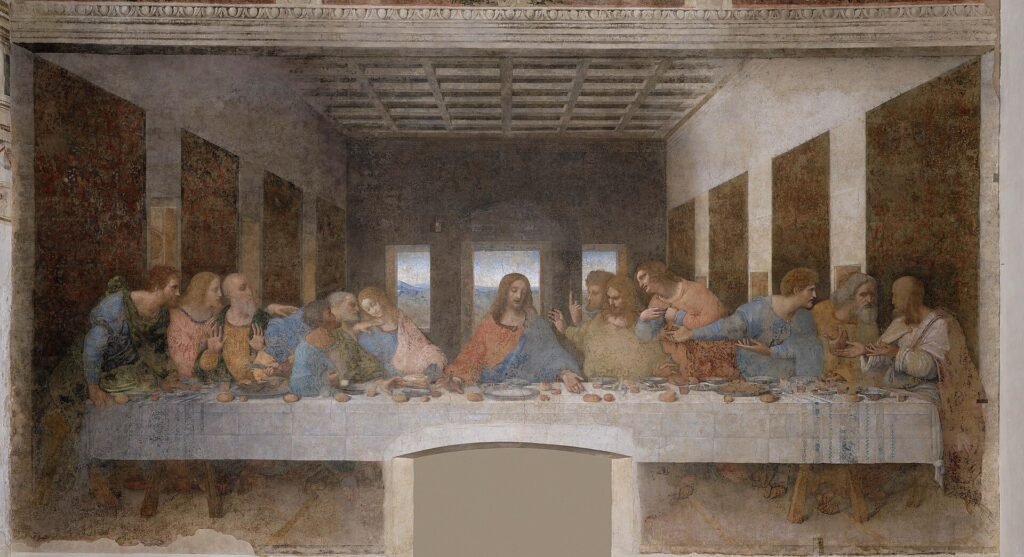
The Last Supper is a mural by Leonardo da Vinci, painted in the 1490s on the north wall of the refectory of the Dominican convent of Santa Maria delle Grazie in Milan, Italy. It shows Jesus at his final meal with his twelve apostles and measures 460 by 880 centimeters. Because Leonardo painted on dry plaster instead of using traditional fresco, the work began to decay within decades and has needed repeated restoration.
Background and creation of The Last Supper
Leonardo arrived in Milan in 1482 and stayed at the court of Ludovico Sforza, known as Ludovico il Moro, until 1499. The museum that now cares for the painting says he was employed there as an artist, a designer of spectacles and stage sets, an engineer and a sculptor.
Toward the end of the 15th century, Ludovico wanted Santa Maria delle Grazie to celebrate his power and to serve as his family mausoleum. He financed major work in the complex, including the rebuilding of the church’s tribune by Donato Bramante. He also asked Leonardo to decorate the refectory with a painting of Christ at the Last Supper with the twelve apostles. UNESCO notes that the refectory belongs to an architectural complex begun in 1463 and reworked by Bramante at the end of the century.
Sources give slightly different dates for the painting. UNESCO states 1495 to 1497, the museum’s artwork page gives 1495 to 1498, and the same page elsewhere says it was painted between 1494 and the beginning of 1498. A range from the mid-1490s to early 1498 is the safest summary.
Description and technique of The Last Supper
The painting fills the north wall of the refectory, the room where the friars met to eat, pray and meditate during their meals. In the Tuscan tradition that Leonardo drew on, such a room had been called a cenacolo since the 14th century. From the early 16th century Italians also used that word for the paintings of the Last Supper that usually decorated refectories, which is why the site is known as the Cenacolo Vinciano.
Christ sits at the center of a long table, with the apostles arranged on either side in four groups of three. The composition is built so that every figure reacts to the others, and the whole scene reads as a single moment of shared movement rather than a row of separate portraits.
Leonardo did not use fresco, the usual wall-painting method, in which pigment goes onto wet plaster. Fresco requires quick work and allows no changes once the plaster dries. He chose instead to paint on dry plaster, a method called a secco. He applied his pigments over a white preparatory layer, using a tempera made by mixing the pigments with egg yolk.
This approach let him work slowly, revise what he had done and refine every detail across the whole surface, as he would on a wooden panel. It also produced intense tones and subtle effects of light. The same choice left the paint poorly bonded to the wall.
Themes and interpretation of The Last Supper
The museum stresses that in the last decade of the 15th century Leonardo was studying light, sound, movement and human emotion. These interests shaped the painting. More than in almost any other work, he tried to show what he called the motions of the soul through posture, gesture and facial expression.
Early commentary already focused on this quality. Giorgio Vasari, writing in 1550, called the painting beautiful and marvelous. He praised the majesty and beauty of the apostles’ heads, and he said Leonardo left the head of Christ unfinished because he doubted it was possible to give it the divinity the subject demanded.
UNESCO describes the painting as an unrivaled masterpiece that heralded a new era in the history of art. In its justification for listing the site, quoted by the museum, UNESCO adds that the work shaped both the development of an iconographic theme and the course of painting.
Conservation of The Last Supper
The dry technique, together with poor environmental conditions in the room, caused paint to flake off in the years right after the painting was finished. In 1517 the canon Antonio de Beatis wrote that it was beginning to decay. In 1568 Vasari said that nothing could be made out beyond a glowing stain, and in 1625 Cardinal Federico Borromeo referred to falling flakes of paint.
The museum counts nine recorded restoration attempts since the early 18th century, and traces of earlier ones have also been found. For a long time restoration meant reconstructing and completing missing parts, which often involved repainting whole sections and changed the look of the work. By the 20th century the aim shifted toward preserving and consolidating what survived and leaving the gaps visible.
The church and refectory were damaged by Allied bombing in 1943. The most recent major campaign, led by the restorer Pinin Brambilla Barcilon, ran from 1977 to 1999. For the first time it sought to recover the paint Leonardo himself applied, which earlier overpainting had hidden. The museum cautions that little of the original remains and that the image seen today is only a faint memory of what Leonardo’s contemporaries saw.
Since 1999 the focus has been on preventing further loss. The air in the refectory is carefully controlled, and automatic doors that open and close in turn filter the air entering from outside. Visits are by reservation only, in groups of up to 40 people for 15 minutes. On 3 December 2024 the museum came under the management of the Pinacoteca di Brera.
Reception and legacy of The Last Supper
UNESCO inscribed the church, the convent and the painting as a World Heritage property in 1980. The museum quotes the assessment that the painting opened a new era in art history, and it maintains a section on copies and derivations of the work, which reflects how widely the composition was imitated.
The painting is closely tied to the career of Leonardo da Vinci, who also painted the Mona Lisa, and to the artistic culture of the Renaissance. Its fragile state has made it as much a conservation case as an artwork, and the strict visiting rules at Santa Maria delle Grazie are a direct result of Leonardo’s choice of materials.
More in Visual Arts
Key facts
- The Last Supper is a wall painting by Leonardo da Vinci on the north wall of the refectory of Santa Maria delle Grazie in Milan.1
- It measures 460 by 880 centimeters and was painted between about 1495 and 1498, a span that sources give slightly differently.12
- Leonardo used egg-yolk tempera on dry plaster instead of fresco, which left the paint fragile.3
- The museum records nine restoration attempts since the early 18th century, and the last major campaign ran from 1977 to 1999.3
- Visits are by reservation only, in groups of up to 40 people for 15 minutes.4
Related concepts
Quick checkWhy is The Last Supper so fragile?Show answer
Leonardo painted on dry plaster with egg-yolk tempera instead of using fresco, so the paint sat on the wall rather than bonding with it and began to flake within decades.
Sources
- UNESCO World Heritage Centre, Church and Dominican Convent of Santa Maria delle Grazie with The Last Supper by Leonardo da Vinci, https://whc.unesco.org/en/list/93
- Museo del Cenacolo Vinciano, The Last Supper, Leonardo da Vinci (artwork page), https://cenacolovinciano.org/en/museum/the-works/the-last-supper-leonardo-da-vinci-1452-1519/
- Museo del Cenacolo Vinciano, Backstage: conservation of the Last Supper, https://cenacolovinciano.org/en/museum/backstage/
- Museo del Cenacolo Vinciano, History, and visitor information on the museum home page, https://cenacolovinciano.org/en/history/
Editorially reviewed by Specialty Digest Editorial TeamLast reviewed November 5, 2026Researched and drafted with AI assistanceReport an issue