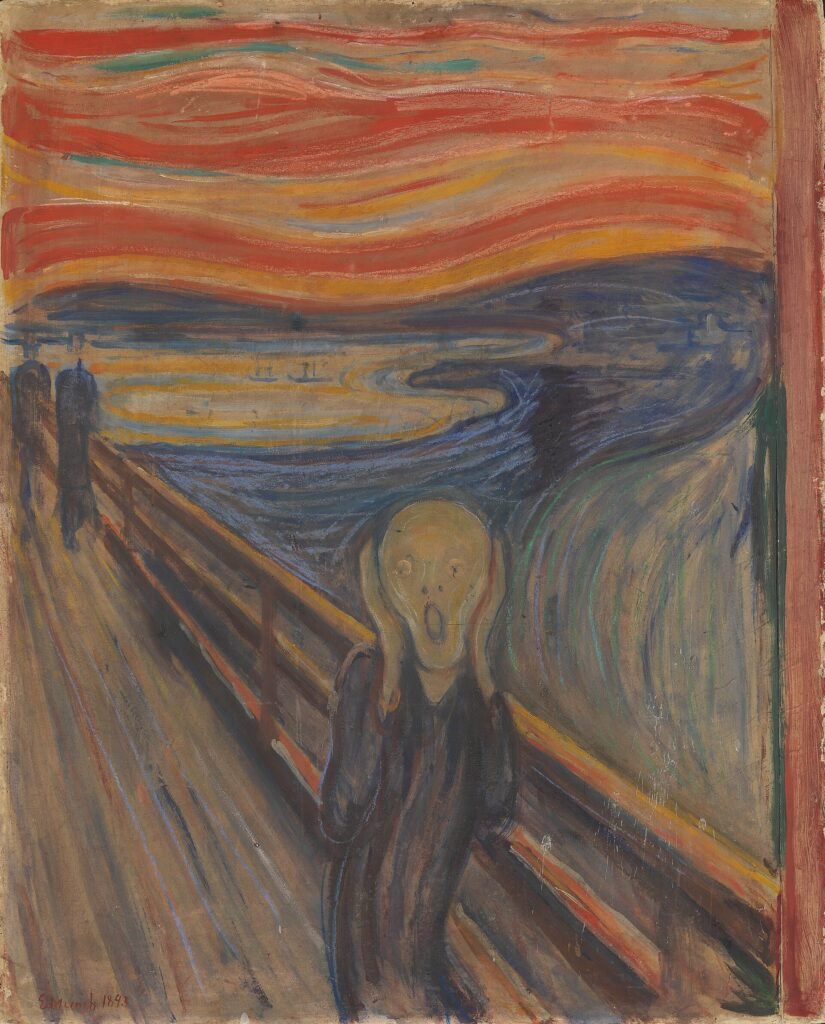
The Scream is a composition by the Norwegian artist Edvard Munch, made in several versions between 1893 and about 1910. The version in the National Museum of Norway in Oslo, painted in 1893 in tempera and wax crayon on cardboard, is considered the first. It shows a distorted figure on a road beneath a blood-red sky and has become a widely recognized symbol of anxiety.
Background and creation of The Scream
Munch described the origin of the image in a notebook entry dated 22 January 1892. He wrote that he had been walking along a road with two friends at sunset when the sky suddenly turned blood red. He stopped, leaned against a fence, exhausted, and felt a great, unending scream passing through nature, while his friends walked on.
The Munch Museum adds that Munch recorded the experience in his diary as a poem while staying in Nice on the French Riviera in the winter of 1892. According to curator Ute Kuhlemann Falck, the motif took shape first as a text and only then as an image. Munch turned it into pictures in the same year.
The words stayed attached to the image. When he sold one of the pastel versions, Munch fixed a short version of the prose poem to the front of the frame. The lithograph was printed with a short quotation in German. In 1928 he published the full text in a booklet about his lifelong project, The Frieze of Life, and eight further versions of the text survive in his unpublished notes and diaries.
Versions of The Scream
There is no single Scream. The Munch Museum counts four versions in paint and drawing, two in tempera and two in crayon or pencil, and says Munch made them partly to satisfy clients and partly to keep one for himself. Two of the four stayed in his possession and are now in the Munch collection.
The National Museum’s painting dates from 1893 and is made of tempera and wax crayon on cardboard. The Munch Museum owns a painting in tempera and oil on unprimed cardboard, probably from 1910, together with a crayon drawing from 1893 and six lithographs from 1895.
Munch also made the motif as a lithograph in 1895. The museum cannot say how many impressions were printed but estimates about 30, with six in its own collection, including one that Munch colored by hand. Altogether the museum holds eight versions of the motif.
Description of The Scream
A thin, hollow-faced figure stands in the foreground with both hands raised to the sides of its head and its mouth open. Behind it a straight road, or bridge, runs back into the picture, and two small upright figures walk along it with their backs mostly turned. Beyond them lie a blue-black fjord and the dark shapes of a city.
The sky is a band of orange, red and yellow, drawn in long curving lines that repeat the outline of the shore and the figure’s body. The National Museum notes that these blood-red lines have been compared with sound waves, as though Munch were trying to paint the sound of a scream through nature.
The figure is not clearly a man or a woman. The National Museum calls it universal and genderless, which lets viewers of any age or background identify with it.
Themes and interpretation of The Scream
The Munch Museum calls The Scream a riddle in both content and form. There is no single interpretation of the figure in the foreground. A viewer may ask whether the figure is screaming or reacting to a scream, and whether it is a real person or a symbol.
The two figures in the background seem to hold the key, according to the museum. They talk or think to themselves, walk on without turning, and follow a perfectly straight road. The museum reads the scene as a case of miscommunication: one situation, two opposite reactions, and no exchange between the people involved.
Munch’s own words point in a related direction. He described the scream as passing through nature rather than coming from a person. One reading is therefore that the figure is reacting to the landscape, and that the anxiety belongs to the whole scene as much as to the individual in it.
Reception and legacy of The Scream
The printed version spread first. Reproductions of the lithograph appeared in the French journal La Revue blanche in 1895 and in the American magazine M’lle the following year. In 1908 the image was used as the cover illustration of a book on psychological disorder and art, which shows how early it was linked with ideas about the mind.
The Munch Museum says the motif has a double life. The simple, strong printed image was picked up by the media and reproduced almost at once, and its popular status has been renewed in recent decades by countless adaptations of the main figure. The raised-hands gesture is generally understood as an expression of horror, which makes it easy to use in caricature and in personal messages.
The picture’s fame has also made it a target. The Scream was stolen from the National Museum in Oslo in 1994 and from the Munch Museum in 2004. In 2012 a version sold at Sotheby’s for an auction record. The image even has its own emoji.
Every version is fragile, because the paint, crayon and paper contain unstable materials. The National Museum keeps the lighting dim around its painting to stop it from disintegrating. The Munch Museum has built a rotation system based on scientific testing, including microfading research, so that no version is exposed for too long.
The work is closely tied to Norway and its capital Oslo, and it is often cited as a forerunner of Expressionism.
Key facts
- The Scream exists in several versions by Edvard Munch, including paintings, drawings and lithographs.1
- The National Museum of Norway version dates from 1893, uses tempera and wax crayon on cardboard, and is considered the first.2
- Munch recorded the experience behind the work in a notebook entry dated 22 January 1892.2
- The Munch Museum estimates that about 30 impressions of the 1895 lithograph exist.1
- The Scream was stolen from the National Museum in 1994 and from the Munch Museum in 2004.1
Related concepts
Quick checkHow many versions of The Scream are there?Show answer
Munch made several. The Munch Museum counts four in paint and drawing, plus a lithograph printed in about 30 impressions, and its own collection holds eight versions of the motif.
Sources
- Munch Museum (MUNCH), 5 things you should know about The Scream, by Ute Kuhlemann Falck, https://munch.no/en/our-collection/5-things-you-should-know-about-the-scream/
- National Museum of Art, Architecture and Design (Nasjonalmuseet), The Scream, collection guide Room 60, https://www.nasjonalmuseet.no/en/guide/collection/60/228/
Editorially reviewed by Specialty Digest Editorial TeamLast reviewed November 5, 2026Researched and drafted with AI assistanceReport an issue