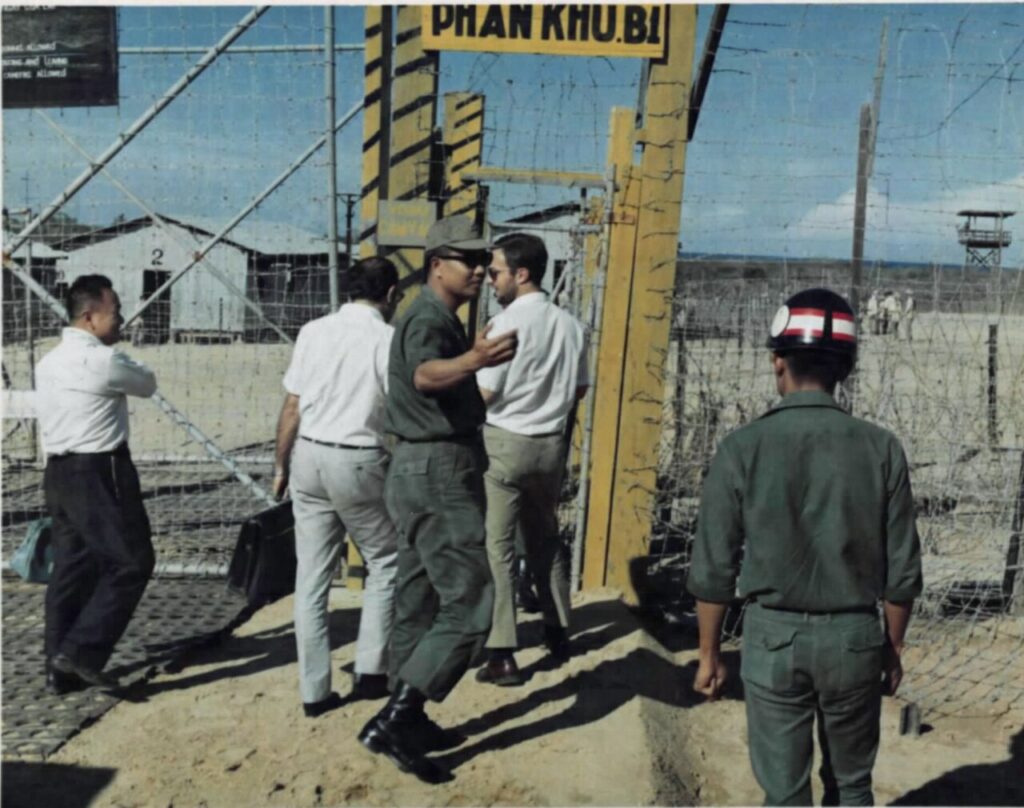
The Geneva Conventions are four treaties, adopted on 12 August 1949, that set rules for protecting people in war. According to the International Committee of the Red Cross (ICRC), each convention protects people who do not take part in hostilities, such as civilians and medical personnel, or people who no longer do, such as the wounded, the sick, the shipwrecked and prisoners of war.[1] Together with three later protocols, they form the core of international humanitarian law, so the question of what are the Geneva Conventions is largely a question of whom they protect and whom they bind.
The first Geneva Convention dates from 1864 and was signed by 16 European nations, according to the United Nations.[2] The 1949 treaties replaced and widened earlier versions after the Second World War. The ICRC describes the failure to apply existing rules, rather than a lack of rules, as the main cause of suffering in armed conflict.[3]
| First convention signed | 22 August 1864, Geneva |
|---|---|
| Current four conventions | Adopted 12 August 1949; in force 21 October 1950 |
| Additional Protocols | I and II (8 June 1977); III (2005) |
| States party to Protocol I | 174 (ICRC report, June 2024) |
| States party to Protocol II | 169 (ICRC report, June 2024) |
| States party to Protocol III | 79 (ICRC report, June 2024) |
History
From Solferino to 1949
The treaties trace to 1859, when the Swiss businessman Henry Dunant tended wounded soldiers after the Battle of Solferino. His work led to the founding of the ICRC, which held its first meeting on 17 February 1863 and took its present name in 1876.[2][4] Switzerland convened a diplomatic conference, and the first convention was adopted on 22 August 1864. Switzerland then became the depositary state, keeping the original texts and registering ratifications.[4]
The rules were revised in 1906 and again on 27 July 1929, when a separate convention on prisoners of war was added after the First World War.[1][4]
The 1949 conference
Preparation for a new treaty on civilians began before the Second World War. The ICRC presented the “Tokyo Draft” in 1934, and Switzerland planned a diplomatic conference for early 1940, but the war prevented it.[5] The ICRC announced in February 1945 that it would revise the conventions, and consultations followed in 1946, 1947 and 1948.[5]
The diplomatic conference met in Geneva from 21 April to 12 August 1949, with representatives of 64 countries, and worked through three commissions: one for the wounded, sick and shipwrecked, one for prisoners of war and one for civilians.[5][6] Eighteen delegations signed on 12 August, and a second signing ceremony took place on 8 December 1949. The ICRC notes that delegates used the same table on which the 1864 convention had been signed. The conventions entered into force on 21 October 1950, after the first two ratifications.[6]
The four conventions
Each of the four treaties covers one group of people.[1]
- First Convention: wounded and sick members of armed forces in the field.
- Second Convention: wounded, sick and shipwrecked members of armed forces at sea.
- Third Convention: prisoners of war.
- Fourth Convention: civilians.
Most provisions apply only to international armed conflicts, meaning wars between states.[1] The ICRC cites the civilian toll of the Second World War, including the Nazi concentration camps, as a key motive for the 1949 revision and for the Fourth Convention.[6]
Common Article 3
Article 3 is identical in all four conventions and is often called a “mini-convention.” It was the first set of international rules to apply to armed conflicts that are not between states, such as civil wars.[1] It requires humane treatment of everyone in enemy hands and care for the wounded, sick and shipwrecked. It prohibits violence to life and person, hostage-taking, humiliating treatment and executions without a proper court judgment.[6][7] It lets the ICRC offer its services to the parties.[6] The International Court of Justice has described it as a reflection of “elementary considerations of humanity,” according to the ICRC.[6]
The Additional Protocols
Two protocols were adopted at a diplomatic conference in Geneva on 8 June 1977, largely in response to the wars of decolonization. A third followed in 2005.[1][4][8]
- Protocol I covers international armed conflicts and entered into force on 7 December 1978. Article 48 requires parties to distinguish between civilians and combatants and between civilian and military objects. Article 51 prohibits indiscriminate attacks, including disproportionate ones.[8]
- Protocol II supplements Common Article 3 for conflicts inside a country.[1]
- Protocol III introduced a third protective emblem, the red crystal, alongside the red cross and red crescent.[6]
Only states that are party to the 1949 conventions may join Protocol I.[8] Article 90 created the International Humanitarian Fact-Finding Commission. States must accept its competence by declaration, and 76 had done so by June 2024. The commission received its first mandate in 2001.[9][8]
Who is bound
By 2009 the ICRC counted 194 states party to the conventions, and its president described them in August 2025 as universally ratified.[6][10] The protocols have fewer parties. According to the ICRC’s June 2024 report to the United Nations, Protocol I had 174 states parties, Protocol II had 169 and Protocol III had 79.[9]
Some rules bind all states regardless of treaty membership. One legal commentary on Protocol I notes the view that Article 75, which sets minimum protections for anyone in the hands of a party to an international armed conflict, also represents customary international law.[8] In 2005 the ICRC published a study, begun in 1996, that identified 161 rules of customary humanitarian law. The study says these rules apply in both international and non-international conflicts and fill gaps left by treaty law.[11]
Enforcement and grave breaches
The conventions single out the most serious violations as “grave breaches.” For wounded and sick persons on land (Article 50 of the First Convention) and at sea (Article 51 of the Second), the list includes willful killing, torture or inhuman treatment, willfully causing great suffering or serious injury, and extensive unlawful destruction or appropriation of property.[12] Article 130 of the Third Convention adds forcing a prisoner of war to serve in the enemy’s forces, and Article 147 of the Fourth adds unlawful deportation and hostage-taking.[12]
Protocol I (Article 85) adds willfully making civilians the object of attack and perfidious use of protective emblems.[12] According to the United Nations, serious violations are war crimes, and all states must criminalize them and investigate and prosecute those responsible.[2] Under Article 146 of the Fourth Convention, parties undertake to enact penal legislation for people who commit grave breaches.[7]
International courts can also try such crimes. The International Criminal Court, established under the Rome Statute and operating since 2002, is independent of the United Nations, although the Security Council can refer cases to its prosecutor.[2] The Security Council Report research organization notes that China, Russia and the United States are not parties to the court.[7]
Principles in practice
UN officials summarize the law of armed conflict through three principles that bind every warring party: distinction, proportionality and precaution. Parties must not target civilians, must minimize civilian harm and must give civilians sufficient warning before an attack.[2] The ethics behind them are discussed under just war theory. The rules sit within the wider body of international law, which includes separate treaties banning certain weapons.[2]
The rules apply as soon as an armed conflict begins, according to the UN human rights office.[2] The International Committee of the Red Cross, based in Geneva, draws its humanitarian mandate from the 1949 conventions.[10]
Compliance and criticism
The conventions are widely accepted, but compliance is a persistent concern. At the 75th anniversary in August 2024, ICRC official Balthasar Staehelin said that the main cause of suffering in armed conflict remains the failure to implement existing norms, and that the law “cannot be merely the law on paper, it must be the law in action.” He noted that more than 120 armed conflicts were ongoing.[3] ICRC president Mirjana Spoljaric said on the 76th anniversary, in 2025, that “the rules remain, but the commitment to uphold them is weakening.”[10]
UN data point the same way. Security Council Report cited a 2024 brief from the UN humanitarian office that found the gap between the legal framework and civilians’ reality had “remained, if not widened,” over five years. It also cited the UN count of 33,443 civilian deaths in armed conflict in 2023, a 72 percent increase over 2022.[7] Not all observers are pessimistic. UN human rights official Eric Mongelard said in 2023 that international humanitarian law is “more often respected than not,” while noting that measuring its effect is difficult.[2]
Attacks on aid workers are one measure: the UN reported 116 aid workers killed in 2022.[2] In response, in September 2024 the ICRC and six states (Brazil, China, France, Jordan, Kazakhstan and South Africa) launched a global initiative to renew political commitment to the law, and more than 70 states had joined by August 2025.[10]
Scope of this article
This article describes what the treaties say and how officials characterize their application. It does not judge whether any particular country is following them in a given war.
FAQs
How many Geneva Conventions are there? There are four, adopted on 12 August 1949. Three additional protocols followed: two in 1977 and one in 2005.
Who do the Geneva Conventions protect? They protect people who do not take part in the fighting, such as civilians and medical staff, and people who can no longer fight, such as wounded, sick and shipwrecked troops and prisoners of war.
Do the Geneva Conventions apply to civil wars? Partly. Common Article 3 and Protocol II apply to conflicts inside a country, while most other rules apply only to wars between states.
Has every country signed the Geneva Conventions? The ICRC describes the four conventions as universally ratified. The protocols have fewer parties: 174 for Protocol I, 169 for Protocol II and 79 for Protocol III as of June 2024.
What is a grave breach? It is a serious violation listed in the conventions, such as willful killing, torture or hostage-taking. States must criminalize grave breaches and prosecute those responsible.
More in Society
- ICRC Casebook, Geneva Conventions
- UN News, Explainer: What is international humanitarian law?
- ICRC, 75th anniversary of the Geneva Conventions: reaffirm commitment to IHL (12 August 2024)
- Swissinfo, Geneva Conventions ushered in respect for rules
- ICRC, Drafting history of the 1949 Geneva Conventions
- ICRC, The Geneva Conventions of 1949: origins and current significance
- Security Council Report, The Geneva Conventions at 75: Much Work to be Done
- UN Audiovisual Library of International Law, Protocol Additional to the Geneva Conventions (Protocol I)
- ICRC, Report to the UN General Assembly Sixth Committee (June 2024)
- ICRC, The next 76 years of the Geneva Conventions will be shaped by the choices leaders make today
- ICRC, Customary international humanitarian law
- ICRC, How grave breaches are defined in the Geneva Conventions and Additional Protocols
Photo: National Archives and Records Administration / Wikimedia Commons / Public domain