Science is often pictured as something that happens behind laboratory doors, reported in journals most people never open. Yet the questions science answers are everyone’s questions: what is in our water, how a vaccine works, why the climate is changing. The International Day of Engagement in Science for Sustainable Development, observed on November 27, asks a simple thing of the world: bring people into science, and bring science to people. It is a new day, and 2026 is its first year, which makes it a good moment to understand why it exists.
A new day with deep roots
UNESCO describes the Day as proclaimed by its General Conference in 2025. It celebrates the role of science, and of public participation in science, in building a more sustainable, inclusive and resilient future. The first observance falls on November 27, 2026, and UNESCO has invited people everywhere to organize local activities and share them under the hashtag #ScienceSpeaksHere, alongside a global inaugural webinar hosted by UNESCO.
The Day did not appear from nowhere. On November 23, 2021, UNESCO member states adopted the Recommendation on Open Science at the General Conference’s 41st session in Paris. Then, on August 25, 2023, the United Nations General Assembly declared 2024 to 2033 the International Decade of Sciences for Sustainable Development, with UNESCO designated to lead it. The new Day contributes to that Decade, so it is best read as one step in a longer effort to make science a shared enterprise.
What “engagement” actually means
UNESCO lists four aims for the Day. It seeks to promote science as a common good, to foster inclusive participation through open science and shared initiatives, to strengthen the links between science and society by bridging gaps between research, policy and public understanding, and to support science education and capacity building, particularly among young people.
Engagement is therefore more than announcing results. It means dialogue that runs in both directions. Scientists explain, and citizens ask, test, contribute data and challenge assumptions. The Recommendation on Open Science names this directly: among its pillars it lists open scientific knowledge, open science infrastructures and science communication, plus open engagement of societal actors and open dialogue with other knowledge systems. For the Day, UNESCO suggests everything from public talks and workshops to citizen science projects, school experiments, science cafes and online events.
Example 1: the science cafe. Suppose a town library invites a local hydrologist to talk with 40 residents about a river that floods each spring. Residents bring photographs and old flood dates, and the hydrologist adds them to her records. The numbers are round and illustrative, but the exchange shows the point: the scientist learns something, and so do the neighbors. It echoes the link between science and daily needs seen in World Water Day.
The numbers: who does science, and where
Engagement matters partly because research is unevenly spread. According to the UNESCO Science Report published in 2021, the world had 8.854 million full-time equivalent researchers in 2018, up from 7.790 million in 2014. The ratio of research spending to gross domestic product was 1.79 percent in 2018, up from 1.73 percent in 2014. Only 37 countries spent 1 percent or more of their GDP on research and development in 2018.
- 8.854 millionfull-time equivalent researchers worldwide, 2018
- 1.79%of global GDP spent on research and development, 2018
- 37countries spent 1% or more of GDP on R&D, 2018
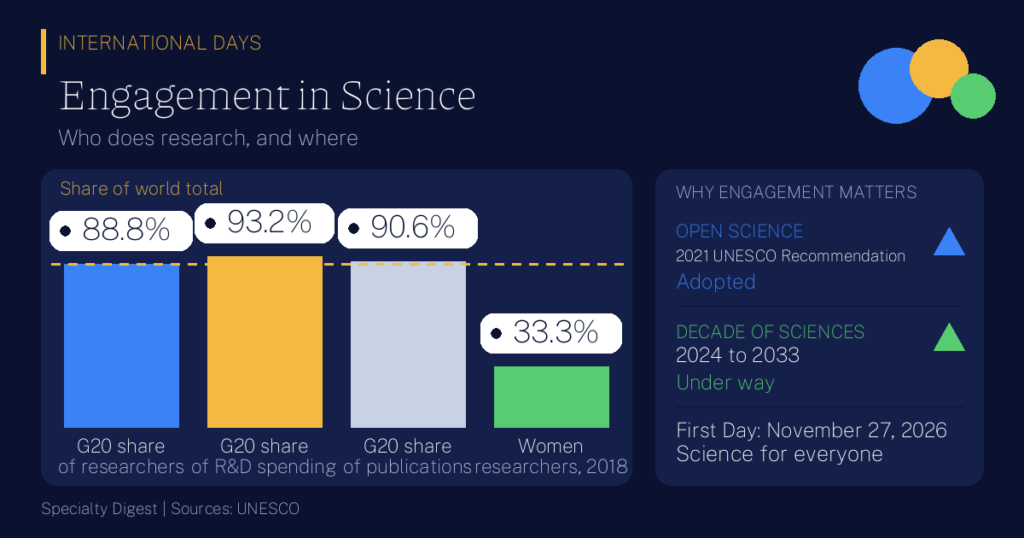
- 33.3%of researchers were women, 2018 (107 countries)
The same report shows how concentrated the work is. The G20 countries account for 88.8 percent of researchers, 93.2 percent of research spending and 90.6 percent of scientific publications. When so much knowledge is produced in so few places, the case for sharing it widely, and for inviting more voices in, becomes clear.
Who is left out of the lab
Women represented 33.3 percent of researchers in 2018, up from 28.4 percent in 2013, based on data for 107 countries. That is progress, but it still means two of every three researchers were not women. Growth in researcher numbers was fastest where it started lowest: researcher density rose by 36 percent in low-income countries between 2014 and 2018. Public engagement is one way to widen the circle further, because a student who sees a scientist at a school fair, or joins a citizen science project, can begin to imagine a career in the field.
Example 2: the school project. Imagine a school of 120 students where six classes each count insects in the schoolyard for a month and upload their tallies to a shared regional database. No one student produces a discovery, yet together they supply a map of local biodiversity that no single team of scientists could afford to collect. The figures are made up for illustration, but this is the logic of citizen science.
Open science and the Decade
The Decade of Sciences lists five expected outcomes. They include a global community empowered through scientific literacy, actionable scientific knowledge used to advance the Sustainable Development Goals in line with human rights, basic sciences advanced through collaborative research, open science used widely and equitably, and national innovation systems that respond better to scientific and societal needs. The Day is a yearly, visible reminder of those aims, aimed at ordinary people rather than only at ministries.
A related observance, World Science Day for Peace and Development on November 10, highlights the role of science in society and the need to engage the wider public in debates on emerging scientific issues. Together the two days bracket a busy autumn of science outreach.
How to take part
For 2026, organizers who register with UNESCO commit to hold an activity on November 27, share it as #ScienceSpeaksHere, and send photos and a short testimonial afterward; activities may be featured as good practice in a digital brochure. Individuals do not need an institution. A parent can visit a museum with a child, a teacher can run a simple experiment, and a scientist can answer questions at a library.
Example 3: an hour of a researcher’s year. Suppose a lab of 20 people each gives two hours to a public event. That is 40 hours, about one working week, spent speaking with the people who fund and live with the results. It is a small, round, illustrative sum, and the return is trust.
Key Takeaways
- The Day is new. UNESCO’s General Conference proclaimed it in 2025, and the first observance is November 27, 2026.
- Engagement runs both ways. Scientists explain, and the public asks, tests and contributes.
- It rests on open science. The 2021 Recommendation on Open Science set the shared framework for open knowledge and open engagement.
- It serves a Decade. The Day contributes to the 2024 to 2033 International Decade of Sciences for Sustainable Development.
- Research is concentrated. The G20 produced 88.8 percent of researchers, 93.2 percent of spending and 90.6 percent of publications in the 2021 report.
- The workforce is changing. Women were 33.3 percent of researchers in 2018, up from 28.4 percent in 2013.
- Anyone can join. A talk, a classroom experiment or a citizen science project all count.
How solid is this? The date, aims and first-year plans come from UNESCO’s pages for the Day. The research statistics come from the 2021 UNESCO Science Report and describe data up to about 2018, so newer figures may differ. The three worked examples use round, made-up numbers. Read more in the International Days hub and the International Days Calendar.
More in Science
- UNESCO, International Day of Engagement in Science for Sustainable Development
- UNESCO, First International Day of Engagement in Science for Sustainable Development: Submit an activity
- International Decade of Sciences for Sustainable Development 2024-2033
- UNESCO, Recommendation on Open Science (2021)
- UNESCO Science Report 2021: The Race Against Time for Smarter Development
- UNESCO, World Science Day for Peace and Development