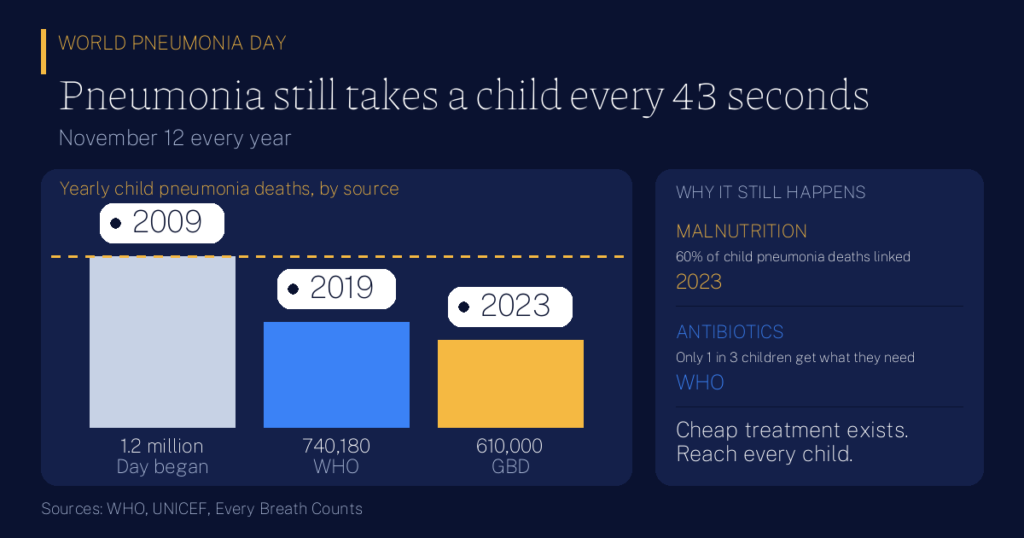
Pneumonia is an infection that fills the tiny air sacs of the lungs with fluid or pus, so that every breath becomes a struggle. It is common, it is often curable with an inexpensive medicine, and yet it still takes more lives of children under five than any other infectious disease. World Pneumonia Day, observed every year on November 12, exists to close the gap between what the world knows and what it does. It is a health awareness day rather than a formal United Nations observance, and it fits naturally beside World Toilet Day, because unsafe sanitation, dirty air and poor nutrition feed the same cycle of childhood illness.
How a coalition started a day
In 2009, a diverse group of clinicians, advocates, academics, UN officials and business people came together and launched the first World Pneumonia Day that November. At the time, pneumonia was killing about 1.2 million children each year, according to the Every Breath Counts coalition, the network that still hosts the day. No single founder is named. Unlike days created by a General Assembly resolution, this one grew from the ground up, which is why WHO, UNICEF, hospitals and charities all mark it without any one of them owning it.
Each year carries a campaign theme. The 2026 theme is “A New Era of Pneumonia Control,” which recognizes progress in vaccines, diagnostics and treatments, and asks the world to turn that progress into protection for every child.
What pneumonia is, and how it is caught
Pneumonia can be caused by bacteria, viruses or fungi. According to WHO, Streptococcus pneumoniae is the most common bacterial cause, Haemophilus influenzae type b (Hib) is second, and respiratory syncytial virus is the most common viral cause. The germs spread through airborne droplets, and newborns can be infected through the blood around the time of birth. Babies born too early, undernourished children and children with HIV are the most vulnerable.
The warning signs are a cough, fever and trouble breathing. In clinics without X-ray machines, a trained health worker simply counts how many breaths a child takes in a minute and looks for the chest pulling inward. That low-tech step is the entry point to a very effective treatment path.
The numbers behind the day
WHO reports that pneumonia killed 740,180 children under five in 2019, which was 14 percent of all deaths in that age group. More recent estimates drawn from the Global Burden of Disease and cited by Every Breath Counts put under-five pneumonia deaths at 610,000 in 2023, within a total of 2.5 million pneumonia deaths at all ages. UNICEF says deaths of children under five from pneumonia have fallen 54 percent since 2000, yet it still counts at least one child lost every 43 seconds. These figures come from different years and different modeling teams, so read them as a direction of travel rather than a single exact series.
- 54%fall in under-five pneumonia deaths since 2000, per UNICEF
- 1 in 3children with pneumonia receive the antibiotics they need, per WHO
- Under 50 centstypical cost of a full antibiotic course for serious respiratory infection, per UNICEF
- 18 millionmore health workers needed by 2030, per UNICEF
Example 1: the gap in the clinic. Imagine a district where 300 children develop pneumonia in a season. If only one in three gets the antibiotics they need, 100 children are treated and 200 are not. Closing that gap means reaching 200 more children, and each course is a small, low-cost medicine. The numbers are round and illustrative, but the ratio is the one WHO reports.
Why it still kills
Pneumonia is rarely only a lung problem. Every Breath Counts reports that 60 percent of child pneumonia deaths are attributable to malnutrition, and UNICEF names wasting as the leading risk factor. UNICEF also says almost half of all pneumonia deaths are attributable to air pollution, and indoor smoke is the larger danger for small children. More than 40 percent of the world population cooks with solid fuels, which almost doubles a child’s risk of a respiratory infection, while chimney stoves can cut household air pollution by half. WHO adds measles, symptomatic HIV, crowded homes and parental smoking to the list.
Example 2: the child who is never seen. Suppose 100 children in a region show signs of a serious chest infection in one season. UNICEF reports that globally 62 percent of children with such symptoms are taken to a health provider, so in this round-number case 62 are seen and 38 are not. In sub-Saharan Africa the share is under half, which would leave more than 50 unseen. The numbers are illustrative, but they show why reaching families early matters as much as the medicine.
Protection that works: vaccines, food and clean air
WHO calls immunization against Hib, pneumococcus, measles and pertussis the most effective way to prevent pneumonia. UNICEF reported that 71 million children missed the recommended three doses of the pneumococcal vaccine in 2018, and calls for routine coverage above 90 percent. Every Breath Counts says more than seven in ten infants were protected with three doses in 2025. Exclusive breastfeeding for the first six months, adequate nutrition, handwashing with soap and cleaner cooking fuels complete the picture. UNICEF notes that exclusive breastfeeding could prevent nearly one third of respiratory infections in low- and middle-income countries.
The disease is not only a childhood problem. Every Breath Counts reports that more than one in four pneumonia deaths among adults over 70 are attributable to air pollution and smoking, and WHO notes that older people and those with chronic conditions are also at risk.
How the day is marked
Governments, clinics, schools and charities hold events, share testimonies and press for action. WHO’s 2025 message asks countries to equip health workers, to monitor gaps in vaccine access, oxygen and care, and to make sure every health facility has reliable medical oxygen, pulse oximetry and trained staff. For families, the day is a prompt to check vaccination cards, to learn the warning signs, and to ask where the nearest clinic is that can treat a child with trouble breathing.
Example 3: what $100 can do. UNICEF says a full antibiotic course for serious respiratory infection typically costs less than 50 cents. Using 50 cents as a ceiling, $100 would cover at least 200 courses. The figure is a round, illustrative calculation that leaves out delivery and health worker costs, but it shows why medicine price is not the main barrier. Reaching the child is.
Key Takeaways
- Pneumonia is still the top infectious killer of young children. WHO counted 740,180 under-five deaths in 2019, and later estimates are 610,000 for 2023.
- Progress is real. UNICEF reports a 54 percent fall in under-five pneumonia deaths since 2000.
- Treatment is cheap but often missed. Only one in three children with pneumonia gets the antibiotics they need, per WHO.
- It is tied to hunger and dirty air. Malnutrition and air pollution sit behind most deaths.
- Vaccines are the best shield. Hib, pneumococcal, measles and pertussis vaccines prevent illness before it starts.
- Health workers and oxygen matter. Counting breaths, pulse oximeters and oxygen supplies save children with severe disease.
- Know the signs. Cough with fast breathing or a pulled-in chest needs prompt care from a health worker.
How solid is this? Pneumonia death counts are modeled estimates, and different years and teams give different totals, so the 2019 WHO figure and the 2023 Global Burden of Disease figure are not strictly comparable. The 2009 figure of about 1.2 million is as stated by the Every Breath Counts coalition. The three worked examples use round, made-up numbers. See also World Toilet Day, the International Days hub and the International Days Calendar.
More in Health