For a large part of modern history, much of the world was governed from far away by powers that the people living there had not chosen. Within living memory, that arrangement touched nearly a third of humanity. The International Day against Colonialism in All its Forms and Manifestations, observed every December 14, asks the world to remember how that system came to an end for most peoples, and to take seriously what remains. It is one of the newest days on the United Nations calendar, created in 2025, yet it rests on one of the most consequential texts of the postwar era. It sits comfortably beside Human Rights Day, because the freedom to decide one’s own political future is a human rights question at its core.
A day born from a landmark declaration
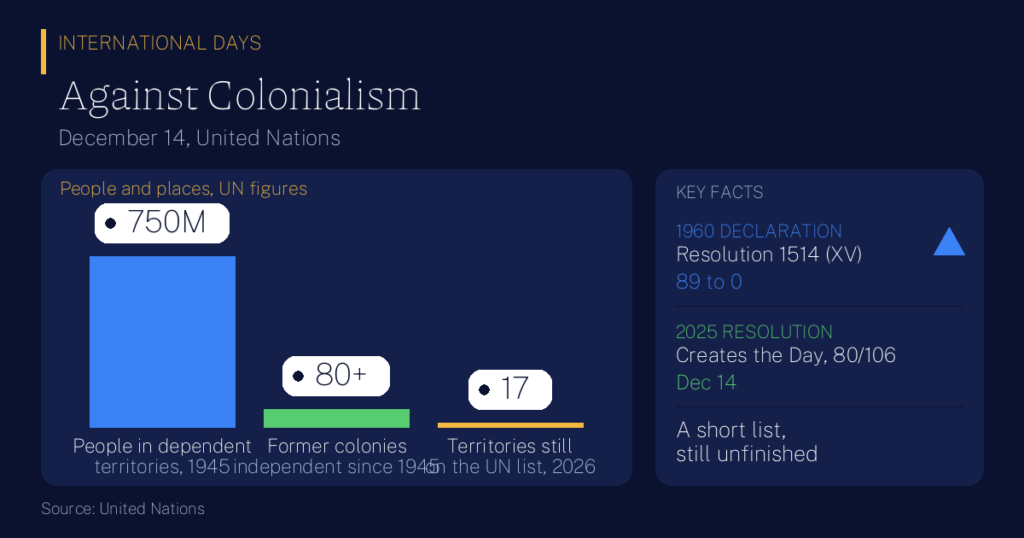
The date points back to December 14, 1960. On that day the General Assembly adopted the Declaration on the Granting of Independence to Colonial Countries and Peoples, known as resolution 1514 (XV). The vote was 89 to 0, with 9 abstentions. UN summaries describe the Declaration as affirming the right of all peoples to self-determination and as proclaiming that colonialism should be brought to a speedy and unconditional end.
The timing mattered. The UN’s own historical notes record that the numerical breakthrough came in 1955, when 16 new states were admitted in one step, bringing the total membership to 76. In 1960 alone, 19 new states were admitted. The Declaration gave that wave of independence a shared statement of principle.
The Day itself is far younger. In 2025, with the adoption of resolution A/RES/80/106, the United Nations established December 14 as the International Day against Colonialism in All its Forms and Manifestations. The first observance took place in December 2025, at a General Assembly meeting marking the sixty-fifth anniversary of the Declaration.
What the title covers
The title of the Day is wide on purpose. “Colonialism in all its forms and manifestations” reaches beyond flags and governors to the lasting effects of colonial rule and to the unfinished political business of the territories still on the UN list. At the opening of the 2026 session of the Special Committee on Decolonization, a message delivered on behalf of the Secretary-General said: “This Organization was created as a place where nations could meet as equals, not as rulers and ruled.”
Two questions sit side by side. One is formal and legal: has the people of a territory exercised its right to self-determination? The other is reflective: how do societies deal with the long shadow that history leaves? The UN’s formal machinery focuses on the first, and the Day gives room for the second.
The numbers behind the day
When the United Nations was founded in 1945, some 750 million people, nearly a third of the world’s population, lived in territories that were dependent on colonial powers. Since the UN was created, more than 80 former colonies have gained their independence. Today, 17 Non-Self-Governing Territories remain on the UN list, and fewer than 2 million people live in them.
- 750 millionpeople in dependent territories when the UN was founded, 1945
- 80+former colonies independent since 1945
- 17Non-Self-Governing Territories remain, 2026
- < 2 millionpeople live in them
Example 1: the class of 30. Picture the world of 1945 as a class of 30 students. Nearly a third means about 10 of them would stand for people in dependent territories. Today, the same comparison would need a class of many thousands before even one student stood for a person in a territory still on the list. The figures are round and illustrative, but they show how far the picture has changed.
How the UN built the machinery
The UN Charter set up an International Trusteeship System to monitor 11 specific Trust Territories, which were subject to separate agreements with administering states. The Trusteeship Council, with no more territories to administer, suspended its operations on November 1, 1994. Palau, the last of the territories, became independent that year and became the 185th member state of the United Nations. The Council still exists as an organ of the UN and meets when necessary.
For other territories the key body is the Special Committee on Decolonization, often called the C-24, which the General Assembly established in 1961 under resolution 1654 (XVI). The Assembly has also proclaimed successive International Decades for the Eradication of Colonialism. The current one, the Fourth, runs from 2021 to 2030 under resolution 75/123.
Example 2: reading a vote. Imagine a council of 98 members that votes 89 yes, 9 abstain and 0 no. About 91 percent voted yes, and nobody voted no. An abstention is not opposition, which is why historians describe the 1960 outcome as adopted without a single expressed dissent. The council here is made up, but the arithmetic mirrors the real tally.
Who is still affected
The 17 territories still on the list are mostly small island territories in the Caribbean and the Pacific, with Western Sahara as the African example, according to UN News. Tokelau, for instance, has been on the list since 1946. These are small communities, and their futures are decided through processes that the United Nations describes as part of its ongoing mandate. Debates about the pace and the method are active every year in the General Assembly, and this article reports what UN texts say without taking a side.
At the 2026 session of the Special Committee, the Secretary-General’s message named three priorities: inclusive dialogue, the central role of young people, and the urgency of climate action. The last one matters for small islands in particular, where one storm can strain the finances of a whole community.
Example 3: the cost of one storm. Suppose an island territory of 10,000 people faces $50 million in storm repairs. Spread evenly, that is $5,000 per person, far more than a household could cover without outside help. The numbers are made up and rounded, but they show why climate action sits beside self-determination on the UN agenda.
How the day is marked
The United Nations marks the Day with meetings of the General Assembly and statements from the Secretary-General. Beyond New York, it is a good moment for schools, libraries and communities to look at their own history. You can read the 1960 Declaration, which is short and written in plain language, ask what your own region’s path to self-government looked like, and learn which territories are still on the UN list and what their residents have said they want.
Key Takeaways
- The date is a date in history. December 14 recalls the 1960 Declaration, adopted 89 to 0 with 9 abstentions.
- The Day is new, the cause is old. The General Assembly created it in 2025 through resolution A/RES/80/106.
- The scale of change is large. More than 80 former colonies have gained independence since 1945.
- The list is short but not empty. 17 Non-Self-Governing Territories remain, home to fewer than 2 million people.
- The UN has standing machinery. The C-24 has worked since 1961, and the Fourth Decade for the Eradication of Colonialism runs to 2030.
- Self-determination meets today’s risks. UN officials link decolonization with dialogue, youth participation and climate action.
How solid is this? Figures come from UN pages and documents published in 2025 and 2026, and the list of territories can change as peoples exercise their right to self-determination. UN pages frame the 750 million figure in slightly different ways, so this article uses the wording of the UN Decolonization overview. The three worked examples use round, made-up numbers to show an idea. See also the International Days hub and the International Days Calendar.
More in History
- United Nations, International Day Against Colonialism in All Its Forms and Manifestations
- United Nations, Global Issues: Decolonization
- UN News, UN chief urges renewed push to complete decolonization as 17 territories remain (February 2026)
- UN Office of Legal Affairs, Declaration on the Granting of Independence to Colonial Countries and Peoples, Historic Archives
- United Nations General Assembly, A/RES/80/106 (December 2025)
- UN Press, Special Committee on Decolonization opens its 2026 session