Almost everything you own has crossed a border, or contains parts that did. The phone in your pocket, the coffee in your cup and the medicine in your cabinet all passed through a quiet system of officers, codes and checkpoints that most people never think about. International Customs Day, observed every year on January 26, is the day the world’s customs services step out of the background. It was created to honor the people who work in them, to explain to the public what customs is for, and to encourage decision makers to back the work.
A day that began with one meeting
The date is not random. The World Customs Organization, which leads the observance, explains that it commemorates the inaugural session of the Customs Co-operation Council, which took place on January 26, 1953. That council is the body that later became the WCO. The organization is based in Brussels, Belgium, and its Secretary General since January 1, 2024 has been Ian Saunders.
Each year the WCO chooses a theme and invites its members to hold events. In its own words, the day is a chance for member customs administrations to honor the dedication of their staff, educate the public on customs’ mission and role, and mobilize decision makers. It is an observance led by the WCO and celebrated by its members, not a day created by a United Nations General Assembly resolution.
What customs actually does
Customs is often pictured as an officer opening a suitcase. The real work is wider. A customs service collects the duties and taxes owed on imported goods, makes sure the goods match their paperwork, enforces rules on safety, health and the environment, and watches for smuggling and counterfeits. At the same time, it is expected to move legitimate trade quickly, because every hour a truck waits at a border adds cost. Doing both jobs well is the central balancing act of the profession.
The numbers behind the day
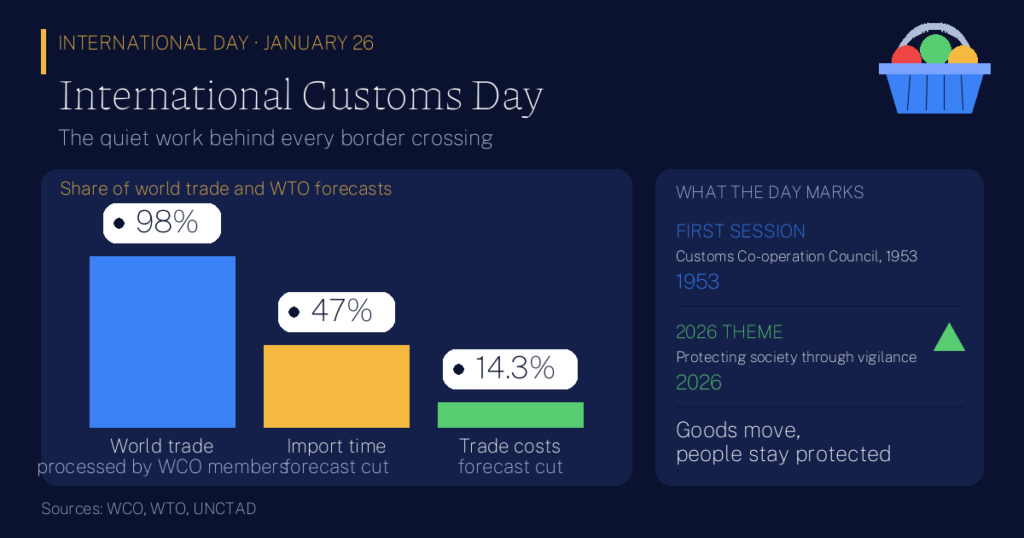
The scale is large. The WCO describes itself as representing 186 customs administrations that together process approximately 98 percent of world trade, a figure reported by the WTO in January 2025. That reach is possible because customs services speak a common language. The Harmonized System, maintained by the WCO, gives every traded product a six digit code. According to the WCO, it is used by more than 200 countries and economies, covers more than 5,000 commodity groups, and classifies over 98 percent of the merchandise in international trade. It is updated every five to six years.
Why does a code matter? Because it decides which rules and which tariff apply. Two officers in two countries who read the same code know they are talking about the same product.
Example 1: what a code can change. Imagine a shipment of goods worth $20,000. If one code carries a 5 percent duty, the bill is $1,000. If a different code carries 10 percent, it is $2,000. The percentages and values are round and illustrative, but they show why accurate classification is serious work and why disputes over codes are common.
Faster borders, lower costs
Customs also sits at the center of global efforts to make trade cheaper. The WTO’s Trade Facilitation Agreement entered into force on February 22, 2017, after the WTO received its 110th acceptance, which was two thirds of its 164 members at the time. The agreement sets rules for simpler, more transparent border procedures. The WTO estimates that full implementation would cut global trade costs by an average of 14.3 percent and reduce the average time needed to import by 47 percent, with the largest gains expected in least-developed and African countries.
Example 2: a faster crossing. Suppose goods now take 10 days to clear and reach a buyer. A 47 percent cut would bring that to about 5.3 days. The numbers are illustrative, but a shorter wait means fresher food, lower storage fees and fewer missed orders.
Progress takes time. By February 2019, UNCTAD reported that 141 of the 164 WTO members had ratified the agreement, and that the remaining 22 were all developing countries, half of them least-developed. Technology helps close the gap. UNCTAD reported in 2022 that its ASYCUDA customs software supports customs offices in over 100 countries and territories, with 77 WCO members using its latest version.
Protecting society at the border
The WCO has dedicated 2026 to customs protecting society through vigilance and commitment. That theme reflects the quieter half of the job. Customs officers are often the last line of defense against goods that should never arrive, from counterfeits and unsafe products to illicit trade in protected wildlife or stolen heritage. For a closer look at one such threat, see the International Day against Illicit Trafficking in Cultural Property. In January 2025, the WTO and the WCO signed a memorandum of understanding on customs-related cooperation, covering topics such as technical assistance, tariff classification and combating illicit trade.
Example 3: the cost of a delay. Suppose a shipment carries $200 of trade costs such as fees, storage and delay. If better procedures cut those costs by 14.3 percent, the bill falls to about $171.40. Multiplied across thousands of shipments, even small savings add up. The figures are round and illustrative, and real savings vary widely.
The themes of recent years
The yearly theme shows what customs services have been asked to focus on. Together, these themes sketch a profession moving from paper to digital tools, from working alone to working with partners, and from collecting revenue to protecting people.
- 2021Customs bolstering Recovery, Renewal and Resilience
- 2022Scaling up Customs Digital Transformation
- 2023Nurturing the next generation
- 2024Customs Engaging Traditional and New Partners with Purpose
- 2025Customs Delivering on its Commitment to Efficiency, Security and Prosperity
- 2026Customs protecting society through vigilance and commitment
You can mark the day in simple ways. Read what your own country’s customs service publishes about its work, notice the next time a parcel arrives with a customs label, or thank the people who keep goods flowing and dangerous ones out.
Key Takeaways
- The date has a history. January 26 marks the first session of the Customs Co-operation Council in 1953.
- Customs does two jobs at once. It protects society and collects revenue while keeping legitimate trade moving.
- A shared code makes trade work. The Harmonized System covers over 98 percent of traded merchandise.
- The reach is nearly global. WCO members process about 98 percent of world trade.
- Smoother borders save money. The WTO forecasts a 14.3 percent cut in trade costs and a 47 percent cut in import time from full implementation.
- Protection is the 2026 focus. The theme highlights vigilance against illicit and unsafe goods.
How solid is this? Membership and coverage figures are the WCO’s own descriptions as reported in January 2025 and may change. The 14.3 percent and 47 percent figures are WTO forecasts of full implementation, not measured results, and the ratification counts date from 2017 and 2019. The three worked examples use round, made-up numbers to show an idea. See also the International Days hub and the International Days Calendar.
More in Society
- WCO, International Customs Day 2026
- WCO, Secretariat celebrates International Customs Day 2023
- WCO, International Customs Day previous editions
- WCO, What is the Harmonized System?
- WTO, Trade Facilitation Agreement introduction
- WTO, Heads of WTO and WCO sign agreement (January 2025)
- UNCTAD, Analysis shows positive but patchy progress in WTO pact (2019)