Long before smartphones, a small box of wire and glass could carry a human voice across a mountain range. It still can. World Radio Day, observed every February 13 and led by UNESCO, celebrates the medium that reaches more people, in more places, at lower cost than almost any other. The United Nations describes radio as the mass medium with the widest audience in the world. The day asks a simple question: who is still left out of the conversation, and can radio help bring them in? In 2026 it also asks a newer one, now that artificial intelligence is entering the studio.
From a Spanish proposal to a UN day
The day began with a proposal from Spain. UNESCO’s General Conference proclaimed World Radio Day in 2011, and the UN General Assembly approved it the following year, 2012, as resolution A/RES/67/124. February 13 was chosen because United Nations Radio was established on that date in 1946. In those early days it sent news bulletins from UN Headquarters in New York in five languages. Eighty years later, UN News publishes in 10 languages and reaches audiences in more than 170 countries, according to its own report in February 2026.
The aims are practical. The day raises public awareness of radio, encourages decision makers to use it to widen access to information, and strengthens cooperation among broadcasters. Hundreds of stations join in each year, according to the UNESCO Courier, and in 2017 UNESCO counted more than 500 activities around the world.
Why radio, of all media
Radio is cheap, portable and simple. A battery set needs no subscription and no data plan, and it does not require the ability to read. The UN says radio is especially suited to reach remote communities and vulnerable people, and that it gives people a platform to join public debate regardless of their level of education. UN News reported in 2013 that radio can reach up to 95 percent of the world’s population. Treat that as a statement of potential reach, not a count of listeners.
Radio also keeps working when other systems fail. When storms or floods knock out phone lines and internet connections, a transmitter running on a generator can be the last dependable link, as UN News described in 2026. That is why the UN counts radio as central to emergency communication and disaster relief.
Example 1: the flood warning. Suppose a farming district has 100,000 residents. Mobile internet covers the towns and reaches 40,000 of them, while one FM station covers all 100,000. A warning pushed through an app reaches 40,000 people. The same warning on air can reach everyone with a working set. The numbers are round and illustrative, but the logic is the reason the day exists.
The numbers behind the day
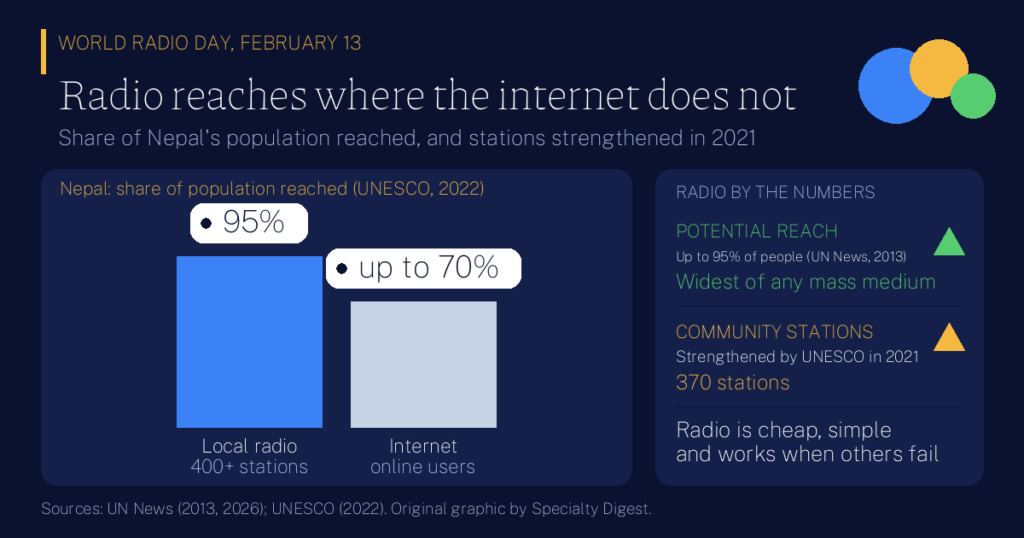
Global listener counts are hard to pin down, and UNESCO’s own pages do not give one, so the best evidence comes from specific places. In Nepal, a network of more than 400 local stations reaches 95 percent of the population, against up to 70 percent online, according to UNESCO’s 2022 article on community radio. Radio is not a relic there. It is the wider road.
- 95%of the world’s people within potential reach of radio (UN News, 2013)
- 370community stations strengthened by UNESCO’s programme in 2021
- 128countries took part in World Radio Day 2021, a record
- 10languages in which UN News now publishes (2026)
Community radio: the station down the road
Community radio is owned and run by the people it serves. It speaks local languages and carries weather, market prices and health advice. Since 2018, UNESCO’s Multi-Donor Programme has supported community media in eight countries: Bangladesh, Burundi, Gambia, Mongolia, Myanmar, Nepal, South Sudan and Tunisia. In 2021 alone it strengthened 370 community stations, 270 of them in Nepal. During the COVID-19 pandemic, one million listeners heard UNESCO’s health messages in Nepal. The same logic powers public health days such as World Toilet Day: advice works when people can actually hear it.
Example 2: one health message. Imagine a village station with 20,000 listeners that airs a short clinic reminder twice a day for a week. If one listener in four acts on it, that is 5,000 people reached through a few minutes of airtime. The figures are round and made up, but they show why a low-cost broadcast can outwork a printed flyer.
Radio where information is scarce
Radio’s role is clearest where information is hard to get. According to UN News in February 2026, 23 local radio stations operated across Gaza before October 7, 2023, and following the war every station was destroyed. The same report says Zaman FM has resumed broadcasting and describes itself as the only station transmitting on FM from inside the Strip. It also reports that in Afghanistan, UNESCO backs 10 stations that reach as many as 20 million listeners, about 40 percent of them women and girls. These are accounts reported by UN News, and conditions on the ground change. Journalists and broadcasters working under threat can look to UNESCO’s work on the safety of journalists and to national press-freedom groups for support.
2026: radio in the age of AI
This year’s observance turns to artificial intelligence. UNESCO’s article is titled Strengthening Radio in the Age of AI, with the tagline “Innovation that empowers. Ethics that inspire. Trust that endures.” UNESCO’s list of past editions gives the theme as “AI is a tool, not a voice.” Its message is that AI can become an ally in strengthening audience trust, but technology alone does not build trust. Broadcasters do.
UNESCO names practical uses: scheduling, voice-tracking, weather and sports updates, fact-checking, source verification and rediscovering archives. It advises stations to adopt a strategy covering ethical policies, privacy, generative audio, staff skills, and legal and security checks. UNESCO Director-General Khaled El-Enany put it this way: “Together, let us ensure that AI serves the public, and not the other way around.” Radio Udaan, which launched in India in 2014, reports a reach of 125,000 listeners across 120 countries and calls AI a game-changing technology.
Example 3: the archive search. A station holds 40 hours of recorded interviews. Finding a useful clip by ear might take an editor 20 hours. An AI transcript might cut that to one hour, but an editor must still check every clip before it airs. The numbers are round and illustrative. The tool speeds the search, and the human keeps the responsibility.
- 2014Radio and Gender Equality
- 2016Radio in Times of Emergency and Disaster
- 2019Dialogue, Tolerance and Peace
- 2022Radio and Trust
- 2025Radio and Climate Change
- 2026AI is a tool, not a voice
Key Takeaways
- Radio is the widest road. The UN says it reaches the widest audience of any mass medium, with potential reach of up to 95 percent of people.
- The date has a history. February 13 marks the founding of UN Radio in 1946, and the day was proclaimed by UNESCO in 2011 and the UN in 2012.
- Low cost is the strength. No data plan and no reading skill are needed, so radio reaches remote and vulnerable communities.
- Local voices matter. UNESCO strengthened 370 community stations in 2021, and in Nepal radio reaches 95 percent against up to 70 percent for the internet.
- It works when others fail. In storms, floods and conflict, radio can be the last dependable link.
- AI needs human judgment. The 2026 message is that AI is a tool, and trust still comes from broadcasters.
How solid is this? The 95 percent figure is a 2013 statement of potential reach from UN News, not a measured audience, and no worldwide listener count is cited because the sources do not give one. Some figures from UN News and UNESCO carry no stated year. The three worked examples use round, made-up numbers to show an idea. See also the International Days hub and the International Days Calendar.
More in Society
- United Nations, World Radio Day observance page
- UNESCO, World Radio Day 2026: Strengthening Radio in the Age of AI (February 13, 2026)
- UNESCO, World Radio Day past editions (themes)
- UNESCO Courier, Why we mark World Radio Day
- UN News, From war zones to outer space, radio remains essential (February 12, 2026)
- UN News, UN officials spotlight power of radio in shaping the world (February 13, 2013)
- UNESCO, Community Radio Matters (2022)