It is easy to think of a forest as scenery. It is better to think of it as infrastructure. Forests hold carbon, filter and release water, shelter most of the animals, plants and insects that live on land, and supply food, fuel and income to well over a billion people. The International Day of Forests, observed every year on March 21, exists to remind the world that these services are not free and not guaranteed. The 2026 theme, “Forests and economies,” with the tagline “Forests mean business,” asks us to count what forests are worth before they are gone.
How the day came to be
The General Assembly proclaimed March 21 as the International Day of Forests on December 21, 2012, in resolution A/RES/67/200. The day invites countries to organize local, national and international activities that raise awareness of forests and trees, from planting campaigns to school lessons. Each year the Collaborative Partnership on Forests, a group of international organizations with forest mandates, chooses the theme, and the UN Forum on Forests and the Food and Agriculture Organization (FAO) both host pages for the day. The 2026 theme turns to jobs, trade and economic resilience.
What counts as a forest, and how much is left
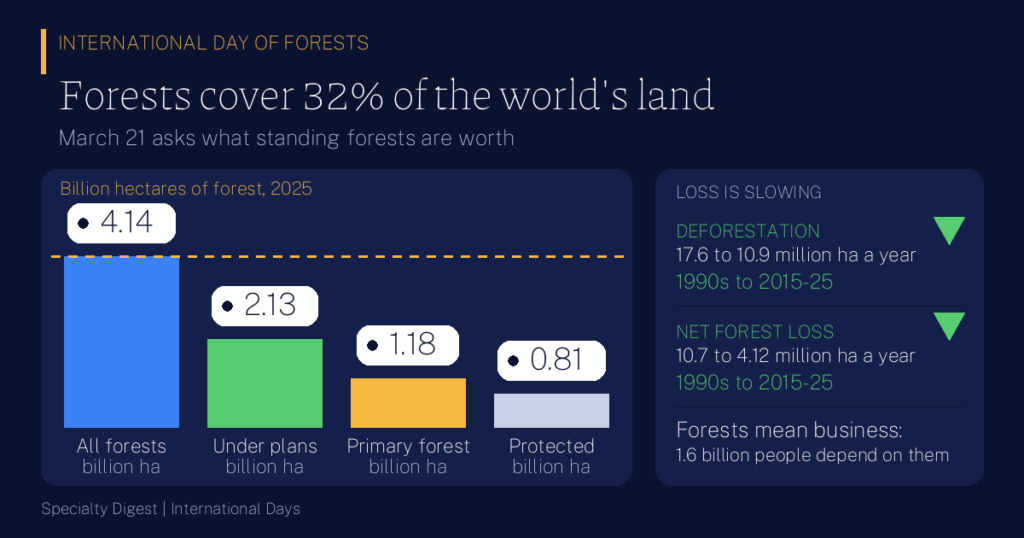
FAO’s Global Forest Resources Assessment 2025, which covered 236 countries and areas, found that forests cover 4.14 billion hectares. That is 32 percent of the world’s land, or about 0.5 hectares for every person. Nearly half of those forests are in the tropics. Primary forests, the oldest and least disturbed kind, cover at least 1.18 billion hectares, about one third of reported forest area. Naturally regenerating forests make up 92 percent of the total, and planted forests about 8 percent, or 312 million hectares.
Example 1: gross versus net. Imagine a region that clears 100 hectares of forest in a year while 60 hectares of new forest grow in elsewhere. Deforestation is 100 hectares, but net loss is only 40. The numbers are round and illustrative. They show why the two figures in FAO’s report differ, and why a falling net loss does not mean the cutting has stopped.
The numbers behind the day
The trend is better than it was, though not good enough. Deforestation slowed to 10.9 million hectares a year in 2015 to 2025, down from 17.6 million in 1990 to 2000. The annual net loss fell from 10.7 million hectares in the 1990s to 4.12 million hectares. Expansion of forest area also slowed, from 9.88 million hectares a year in 2000 to 2015 to 6.78 million in 2015 to 2025. Forest carbon stocks have grown, reaching 714 gigatonnes. Fire still touches an average of 261 million hectares of land a year, nearly half of it forested.
Protection and planning are part of the story. About 20 percent of forests, 813 million hectares, lie in legally established protected areas, up 251 million hectares since 1990. More than half, 2.13 billion hectares or 55 percent, are under management plans, up 365 million hectares since 1990. Ownership matters too: 71 percent of forests are publicly owned and 24 percent are private.
Why forests matter to everyone
The UN reports that around 1.6 billion people depend on forests for their livelihoods, including more than 2,000 Indigenous cultures. Forests are the most biologically diverse ecosystems on land, home to more than 80 percent of terrestrial species of animals, plants and insects. Watersheds, many of them forested, supply 75 percent of the world’s fresh water. That makes this day a close cousin of World Water Day, since the water in a tap often begins under a canopy.
The economic case is larger than most people expect. FAO says demand for forest products is at an all-time high, with about 4 billion cubic meters of wood produced a year. Fuelwood and charcoal provide energy for more than 2 billion people. A UN DESA interview published in May 2026 put the formal forest economy at about 1.5 trillion US dollars a year.
Example 2: a village and its fuel. Suppose a village of 200 households each burns about 2 tons of wood a year for cooking, 400 tons in all. If the nearby forest regrows 500 tons a year, the supply holds. If it regrows only 300, the forest shrinks every year and walking times for firewood grow longer. The figures are made up and rounded, but the logic is the one behind sustainable forest management.
Who is affected, and who is left out
Forest loss does not fall evenly. People who rely on forests directly, including Indigenous peoples and rural families, feel it first, because the fuel, food, medicine and income they gather disappear with the trees. The UN notes that 2 billion people use wood fuel for cooking and heating, so a shrinking forest quickly becomes a household problem of time, cost and health.
Example 3: two ways to earn. A community owns 1,000 hectares of forest. Clear it once and it earns, say, 500,000 dollars, then nothing. Manage it so that 20 hectares are harvested each year and it might earn 30,000 dollars a year, every year, while the rest keeps storing carbon and holding soil. After about 17 years the steady income has caught up. The numbers are illustrative, but the pattern explains why “Forests mean business” argues for lasting value.
How the day is marked, and what progress needs
Around March 21, governments, schools, cities and community groups hold tree planting, exhibitions and talks, and the UN Forum on Forests Secretariat hosted a special event at UN Headquarters on March 24, 2026. The UN has also set a target of increasing global forest area by 3 percent by 2030. The assessment’s message is that slowing loss is possible, since it has already happened, and that the next step is to keep standing forests worth more alive than dead, so that communities and countries earn more from keeping them.
Key Takeaways
- Forests are working infrastructure. They hold carbon, supply water and shelter most land species.
- The world has 4.14 billion hectares of forest. That is 32 percent of land, or about 0.5 hectares per person.
- Loss is slowing but not over. Deforestation fell from 17.6 to 10.9 million hectares a year between 1990 to 2000 and 2015 to 2025.
- Gross and net are different. Net loss of 4.12 million hectares a year counts regrowth, so cutting still continues.
- People depend on forests. About 1.6 billion people rely on them for their livelihood, and more than 2 billion use wood fuel.
- Protection and planning help. About 20 percent of forests are legally protected and 55 percent are under management plans.
- Value standing forests. The 2026 theme argues that lasting income from healthy forests beats a single harvest.
How solid is this? Forest area, loss and protection figures come from FAO’s Global Forest Resources Assessment 2025, as reported by FAO in October 2025, and rest on national reports that are revised each cycle. Livelihood and biodiversity figures are UN estimates, and the USD 44 trillion figure is an FAO estimate. The three worked examples use round, made-up numbers to show an idea. See also World Water Day, the International Days hub and the International Days Calendar.
More in Nature
- FAO, Global deforestation slows, but forests remain under pressure (Global Forest Resources Assessment 2025), October 2025
- United Nations, Forests (Department of Economic and Social Affairs), including resolution A/RES/67/200
- FAO, 2026 International Day of Forests: Forests and economies
- UN Forum on Forests Secretariat, International Day of Forests 2026, March 2026
- UN DESA, Forests are running out of time. How can we save them? May 2026
- UN DESA, 5 things you should know about how forests benefit people and planet, May 2023