Every weather forecast you have ever checked rests on a quiet, worldwide habit of measuring the sky, the ocean and the land, then sharing the results across borders. World Meteorological Day, observed every year on March 23, honors that habit and the organization built to sustain it, the World Meteorological Organization (WMO). It is also a reminder that forecasts are not a convenience alone. They are a safety system. This article explains where the day comes from, what meteorology actually does, and why the numbers on weather, climate and water hazards make a strong case for investing in observation and early warning. It pairs naturally with World Water Day, since floods and droughts are water hazards too.
A day that marks an agreement
Unlike many observances that began with a vote in the General Assembly, this one marks a treaty. Every March 23, WMO commemorates the coming into force of the Convention establishing the World Meteorological Organization on March 23, 1950. That convention gave countries a permanent framework for cooperating on weather, climate and water, because storms and rivers do not stop at borders and no single nation can observe the whole planet alone.
WMO sets a theme for the day each year. Its list of past themes runs back to 1961, and the theme for 2027 has already been announced. The national meteorological and hydrological services of WMO members carry the message in their own countries, in their own languages.
What meteorologists actually do
The word meteorology covers far more than rain forecasts. National services, working together through WMO, deal with weather, climate and water. Their work follows a chain, shown below. It starts with observation by weather stations, satellites, radar, ocean buoys and aircraft. Computer models turn those readings into forecasts. Forecasts become warnings when they are tied to who is at risk and what they should do. The last link is action, when families, farmers, pilots and officials respond in time.
Example 1: the value of a day. Suppose a coastal town of 5,000 people gets a credible storm warning 48 hours ahead instead of 6 hours ahead. With two days, a fleet of 40 fishing boats can reach harbor, the school can close and the clinic can move its supplies to upper floors. With six hours, only some of that is possible. The numbers are round and made up, but they show that lead time is what turns a forecast into protection.
The numbers behind the day
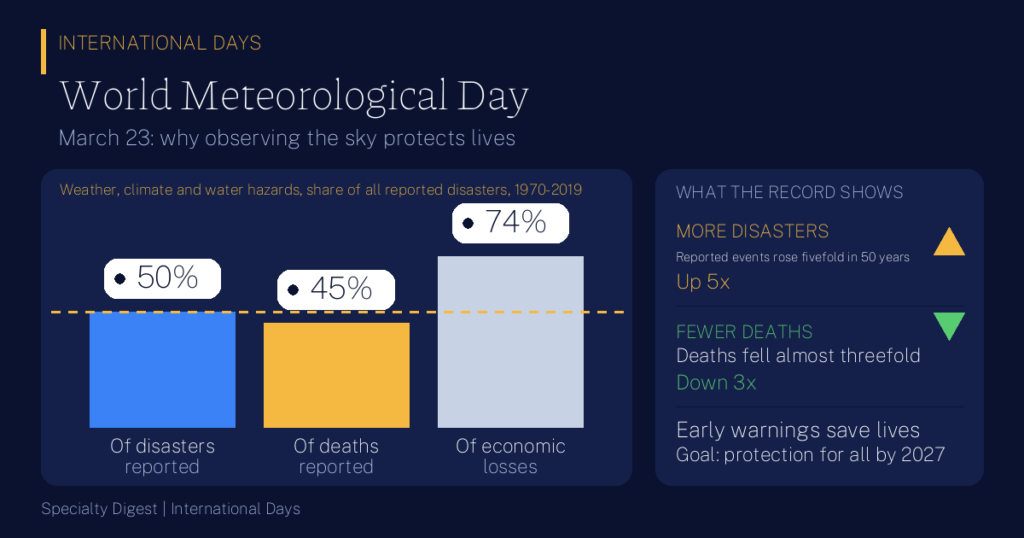
WMO’s major disaster review, released in 2021 and covering 1970 to 2019, counted more than 11,000 reported disasters from weather, climate and water hazards. They caused just over 2 million deaths and US$ 3.64 trillion in economic losses. On average, that works out to a disaster every day, with 115 deaths and US$ 202 million in losses each day. More than 91 percent of the deaths occurred in developing countries, using the UN country classification.
The trend has two sides. Over those 50 years the number of reported disasters rose by a factor of five, and losses grew sevenfold from the 1970s to the 2010s. Yet deaths fell almost threefold. WMO’s own reporting on these findings stresses that early warnings save lives.
- 11,000+reported weather, climate and water disasters, 1970 to 2019
- 91%+of those deaths were in developing countries
- 119countries report a multi-hazard early warning system, 2025
- 1.44 °Cglobal temperature above the 1850-1900 average, 2025
The global goal: early warnings for all
In 2022, UN Secretary-General António Guterres launched Early Warnings for All, an initiative with the goal of protecting everyone on Earth from hazardous weather, water or climate events through early warning systems by the end of 2027. Its executive action plan for 2023 to 2027 calls for US$ 3.1 billion over five years. WMO’s Global Status of Multi-Hazard Early Warning Systems report, published in November 2025, found that 119 countries, or 60 percent, report having such a system. WMO describes that as a 113 percent increase over the past 10 years.
Example 2: a warning that does not arrive. Imagine a river town of 10,000 people. A flood warning is issued, but only 5,000 people receive it, because the rest have no phone signal or live outside the alert area. Raising the reach to 9,000 would not change the river, but it would change how many families move to higher ground. The figures are round and illustrative. The lesson is that a warning has to reach the last mile.
Who is still left behind
Progress is uneven. Only 43 percent of small island developing States report having a multi-hazard early warning system, according to the 2025 report. The UN Early Warnings for All page adds that 48 percent of least developed countries and 57 percent of small island developing states lack adequate systems. These places often face the sharpest exposure to cyclones, floods, drought and sea level rise, while holding the fewest forecasters, instruments and funds. Because more than 91 percent of the deaths in the 1970 to 2019 review were in developing countries, these figures suggest that closing the gap is among the most direct ways to reduce the human toll.
The long view: a warming climate
Meteorology also tracks the slow changes behind daily weather. WMO’s consolidated analysis of eight datasets, published in January 2026, put the 2025 global average surface temperature at 1.44 degrees Celsius above the 1850 to 1900 average, with a margin of 0.13. Two datasets ranked 2025 as the second warmest year in a 176-year record, and the other six ranked it third. WMO’s wording is therefore that 2025 was one of the three warmest years on record. The 2023 to 2025 average was 1.48 degrees above pre-industrial levels, and 2015 through 2025 are the 11 warmest years in all eight datasets.
Example 3: why several datasets help. Imagine three independent teams estimate a year’s warming at 1.42, 1.44 and 1.46 degrees. None is exactly right, but their average, 1.44, is steadier than any single estimate, and the year’s ranking can differ slightly from team to team. That is the logic behind combining eight datasets. These numbers are illustrative and are not real results.
How the day is marked
The 2026 theme is Observing Today, Protecting Tomorrow. WMO’s campaign page says that accurate, timely and accessible data underpin resilience, that artificial intelligence and advanced computing can support forecasting and impact-based warnings while complementing, not replacing, national meteorological and hydrological services, and that investment in science education and youth opportunities matters. Its closing line reads that when we observe today, we do not just predict the weather, we protect tomorrow. You can mark the day in a simple way: learn which warnings your local weather service issues, check that you actually receive them, and tell a neighbor who might not.
- 2026Observing Today, Protecting Tomorrow
- 2027Trusted Science. Better Forecasts. Safer World.
Key Takeaways
- The day marks a treaty. It commemorates the WMO Convention coming into force on March 23, 1950.
- Forecasts are a safety system. Observation, forecasting, warning and action only protect people when every link works.
- The toll is large. From 1970 to 2019, WMO counted more than 11,000 disasters, just over 2 million deaths and US$ 3.64 trillion in losses.
- Warnings save lives. Reported disasters rose fivefold over those 50 years while deaths fell almost threefold.
- Coverage is growing but incomplete. 119 countries report multi-hazard early warning systems, and the goal is protection for everyone by the end of 2027.
- The burden is uneven. More than 91 percent of those deaths were in developing countries, and only 43 percent of small island developing States report a system.
- Check your own warnings. Find out how your local weather service alerts you, and help a neighbor sign up.
How solid is this? The disaster totals come from a WMO review covering 1970 to 2019 and rely on reported events, so they are likely to undercount. Early warning coverage is self-reported by countries in the 2025 status report. The temperature figure is WMO’s consolidated 2025 estimate and carries a stated margin. The three worked examples use round, made-up numbers to show an idea. See also World Water Day, the International Days hub and the International Days Calendar.
More in Science
- WMO, World Meteorological Day
- WMO, World Meteorological Day 2026: Protecting Tomorrow
- WMO, Weather-related disasters increase over past 50 years, causing more damage but fewer deaths (2021)
- WMO, Global Status of Multi-Hazard Early Warning Systems 2025
- WMO, WMO confirms 2025 was one of the warmest years on record (January 2026)
- United Nations, Early Warnings for All