On April 26, 1986, an explosion and fires at the Chernobyl nuclear power plant in Ukraine, then part of the Soviet Union, caused what the World Health Organization calls the largest uncontrolled radioactive release in the history of the civil nuclear industry. Every year on the same date, the United Nations asks the world to pause, to remember the people whose lives were upended, and to keep faith with communities that are still living with the consequences. This article explains what happened, what the best international evidence says about the harm, and why a disaster from the last century remains a living question of cooperation. It is a companion to the International Day for Disarmament and Non-Proliferation Awareness, another observance about the careful stewardship of nuclear science.
A spring night and the days after
The accident happened at the Number Four reactor, an RBMK type, at a plant in northern Ukraine. Explosions and a fire released radioactive material that was carried by wind over Belarus, the Russian Federation and Ukraine and, to a lesser extent, over parts of Europe. According to the World Health Organization, more than 200,000 square kilometers of Europe received contamination from the major releases.
The response began within hours and was costly in human terms. Of about 600 workers on the site in the early morning of April 26, 134 received very high doses of radiation, and 28 of them died in the first three months, according to the WHO. The nearby town of Pripyat, home to 49,360 people, was completely evacuated about 36 hours after the accident, and the International Atomic Energy Agency reports that tens of thousands more were relocated in the following weeks and months. A zone of 30 kilometers around the plant became an exclusion zone, and the IAEA notes that 187 small communities inside it remain virtually abandoned.
How the United Nations made it a day
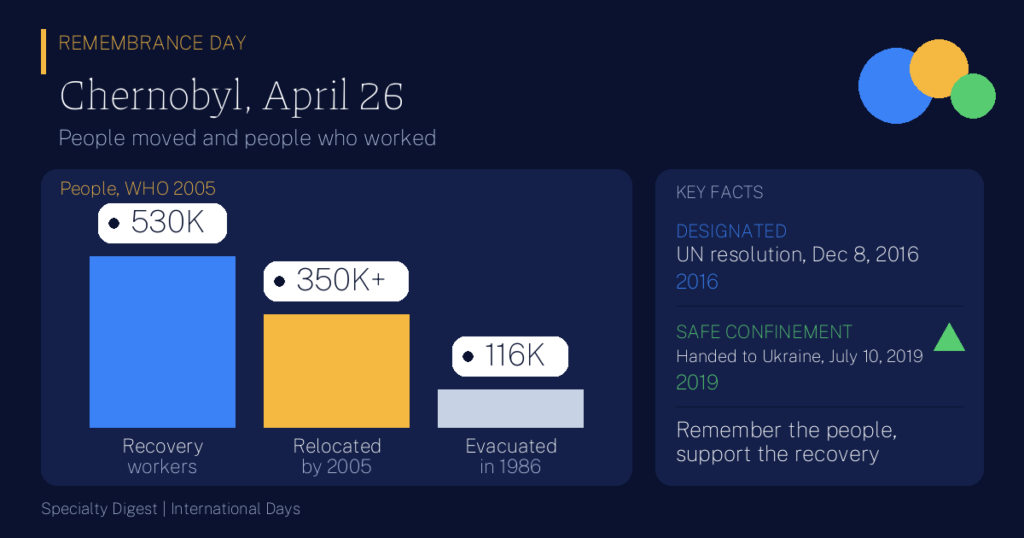
Remembrance came thirty years on. On December 8, 2016, the General Assembly adopted a resolution designating April 26 as International Chernobyl Disaster Remembrance Day. In it, the Assembly recognized that three decades after the disaster there remain persistent, serious long-term consequences and that affected communities have continuing needs. It invited member states, United Nations agencies, other international organizations and civil society to observe the day.
The decision was not about assigning blame. It was about attention. Governments, scientists and aid agencies had worked on recovery for years, but long-term needs tend to fade from the headlines. A fixed date keeps them in view, and gives affected families, many of whom were children in 1986, a moment of recognition.
The numbers: who was moved and who worked
The scale of the human response is one of the most important facts about Chernobyl. In its 2005 assessment, the WHO reported that more than 350,000 people were relocated away from the most severely contaminated areas, including 116,000 immediately after the accident. It described relocation as a deeply traumatic experience for those who went through it. The same assessment estimated that about 5 million people were living in contaminated areas of Belarus, Russia and Ukraine at that time. Separately, about 530,000 people were registered as recovery operation workers between 1986 and 1990, according to the WHO.
Example 1: an evacuation by bus. Imagine a town of 50,000 people that must leave in a day and a half. If each bus carries 50 people, that is 1,000 full bus trips before a single belonging is considered. The numbers are round and illustrative, but they show why evacuation planning is as much about logistics as about science.
What the health evidence says
Few topics are as surrounded by confusion as the health effects of Chernobyl, so it helps to separate what is documented from what is projected. Among the people who responded in the first hours, the toll was immediate. About 50 emergency workers died of acute radiation syndrome, according to the WHO’s 2005 report. Among the general population, the clearest effect has been thyroid cancer, mainly in people who were children or adolescents in 1986 and who were exposed to radioactive iodine. By 2005, more than 6,000 thyroid cancer cases had been diagnosed in the affected groups, and the United Nations Scientific Committee on the Effects of Atomic Radiation reports that 15 of them have been fatal. Thyroid cancer is usually treatable, and the WHO reported survival rates of almost 99 percent.
Projections of future deaths are harder, and they are estimates, not counts. In 2005, the WHO said up to 4,000 people among the most exposed groups could eventually die of radiation exposure, while stressing that fewer than 50 deaths had been directly attributed to radiation at that point.
Example 2: reading a screening result. Suppose a clinic screens 1,000 people exposed as children and finds 20 thyroid cancers. That is a rate of 2 percent, which tells doctors where to focus follow-up care. Because most thyroid cancers are treatable, early detection is what turns a frightening diagnosis into a manageable one. The numbers are made up to show the idea.
The harm that radiation did not cause
One of the most striking conclusions of the 2005 WHO assessment is that mental health was the largest public health problem created by the accident. Relocation, loss of home and livelihood, and fear about invisible risks weighed heavily. The WHO’s later review noted that exposed populations showed anxiety symptoms at twice the level of comparison groups. The same report warned that poverty, lifestyle-related illness and mental health problems posed a far greater threat to local communities than radiation exposure itself.
This is why the day is also about care, not only about science. Anyone who is struggling with anxiety or distress, whether linked to a disaster or not, can speak with a local health professional or a national helpline.
Making the site safe
The broken reactor was first covered in an emergency structure often called the sarcophagus. A far larger arch, the New Safe Confinement, was built to enclose it. Its placement was completed in 2019, and on July 10, 2019 it was handed over to the Government of Ukraine, according to the United Nations. The project was funded by more than 45 donor nations with a total of 2.2 billion euros.
- 30 kmradius of the exclusion zone around the plant
- 6,000+thyroid cancer cases diagnosed by 2005, 15 of them fatal
- 45+donor nations behind the New Safe Confinement
- 2.2 billioneuros contributed to the confinement
Example 3: sharing the bill. If 2.2 billion euros came from 45 donors in equal shares, each would give about 49 million euros. Real contributions were not equal, so this is only an illustration, but it shows how international cooperation can carry a burden no single country should face alone.
How the day is marked and what progress needs
The resolution invites everyone to observe the day, and the United Nations has long coordinated its work on Chernobyl across its agencies. Observance usually takes the form of memorial events, commemorations of the workers and families, scientific briefings and appeals for continued support to affected regions. Progress now depends on steady attention to health care, mental well-being, safe management of the contaminated land and honest, plain information. Trust in public information is itself a lesson of the disaster, because uncertainty and silence made the human burden heavier.
Key Takeaways
- The day honors people first. It remembers workers, evacuees and families affected by the April 26, 1986 accident.
- The UN created it in 2016. The General Assembly acted on December 8, 2016, thirty years after the accident.
- The scale of the response was vast. More than 350,000 people were relocated and about 530,000 worked on recovery.
- Documented harm and projections differ. Thyroid cancer is the clearest effect, and future deaths are estimates, not counts.
- Mental health matters. The WHO called it the largest public health problem created by the accident.
- The site is now enclosed. The New Safe Confinement was handed to Ukraine on July 10, 2019.
- Clear information protects people. Honest, timely facts reduce fear and help communities recover.
How solid is this? Health figures come from WHO and UN reports from 2005 and 2011 and reflect the evidence at those dates, and projected deaths are estimates. The three worked examples use round, made-up numbers. The resolution is cited as General Assembly resolution 71/125. See also the International Days hub and the International Days Calendar. For how this risk looks in practice today, see World in a Day: Thursday, November 19, 2026, which covers a joint warning from nuclear regulators in 38 countries about rising reactor accident risk in Ukraine this winter.
More in History