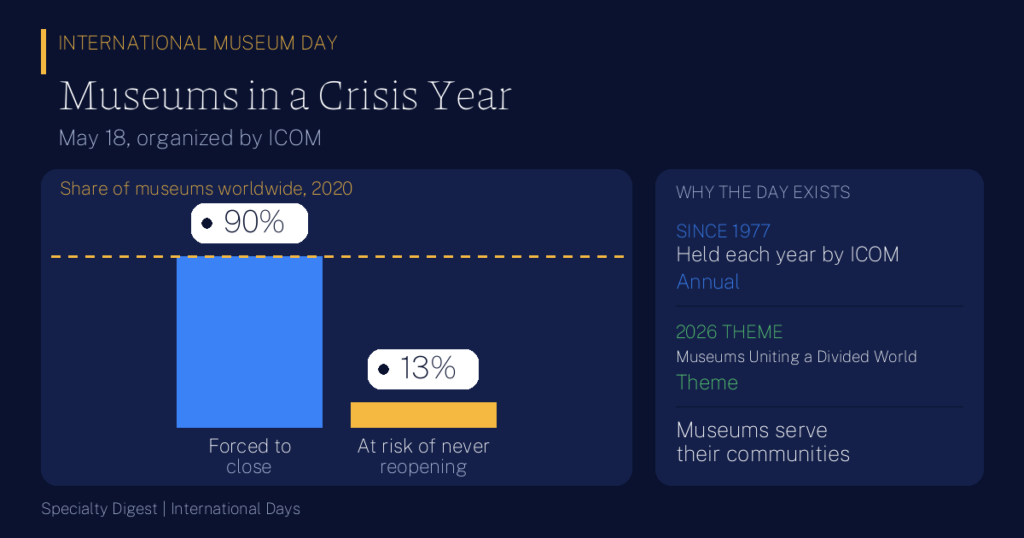
Every museum is a promise that something worth knowing will be kept, explained and shared. International Museum Day, held every year on May 18, celebrates that promise. It is organized by the International Council of Museums (ICOM), the global network of museum professionals, and it asks a simple question: what do museums do for the people around them? The answer has shifted over the decades, from guarding objects to serving communities, and the day follows that shift. Each year carries a theme, and in 2026 it is Museums Uniting a Divided World. The day is a close cousin of World Art Day, because both ask the public to value the people and places that protect culture.
A day created by museum professionals
ICOM was created in 1946, and its own pages state that it has organized International Museum Day each year since 1977. That makes this an observance with a professional origin rather than a political one. Museum workers in many countries chose a single date so that their institutions could speak with one voice, and the idea spread. ICOM says more and more museums take part each year, and UNESCO publishes an article to mark the day.
The choice of a shared date matters more than it might seem. A museum in a large capital and a museum in a small village rarely have the same budget, yet on May 18 they stand in the same line. The day gives a modest institution a reason to invite its neighbors in, and it gives a large one a reason to listen to them.
What counts as a museum
Before the world can celebrate museums, it helps to agree on what they are. On August 24, 2022, in Prague, ICOM’s Extraordinary General Assembly approved a new museum definition. The vote was 487 for, 23 against and 17 abstentions, which ICOM reports as 92.41 percent approval. The definition begins by calling a museum a not-for-profit, permanent institution in the service of society. It adds that museums are open to the public, accessible and inclusive, and that they foster diversity and sustainability.
Notice what the definition leaves out. It does not require a grand building, a famous collection or an entrance fee. It asks about purpose, permanence and public benefit. That is why a science center, a historic house, a university gallery and a community archive can all be understood as museums, and why the day can include them all.
Example 1: the town collection. Imagine a small town where volunteers keep old tools, maps and photographs in a rented hall, open three afternoons a week and free to all. It has no big budget, yet it is permanent, serves its community and shares local heritage. Under the spirit of the definition, size matters less than purpose. The numbers here are made up for illustration.
The numbers behind the day
ICOM does not give a headcount of every participating museum, but it does report that in 2024 International Museum Day saw over 8,000 registered events and more than 50 translations of the official poster. Those figures show a day that works through many small acts rather than one large ceremony. A separate UN News report in 2020 noted that the number of museums worldwide had grown by almost 60 percent since 2012, a sign of how widely the idea has spread.
- 8,000+registered events in 2024
- 50+translations of the official poster in 2024
- Almost 60%growth in the number of museums since 2012, reported in 2020
- 1977year ICOM began organizing the day
When the doors closed
The day took on a harder meaning in 2020. UN News reported that year, drawing on two studies by UNESCO and ICOM, that nearly 90 percent of museums had been forced to close their doors, with more than 85,000 institutions shut. Almost 13 percent were under serious threat of never reopening. The point was not only about buildings. Museums employ guides, conservators, educators and researchers, and they anchor local tourism and learning.
Example 2: a museum without visitors. Suppose a museum earns half its yearly income from tickets and the shop, and closes for six months. Even if its staff keep working, that museum loses about a quarter of its yearly income before any extra costs. A museum with a small reserve may not survive. These numbers are round and illustrative, but they show why closure threatened so many institutions.
Why it matters and who is left out
Museums hold a community’s memory, but memory is only useful if people can reach it. A child who lives far from any museum, a family that cannot afford tickets and a visitor with a disability who finds no ramp or accessible label all lose out. That is why the 2022 definition stresses that museums be accessible and inclusive, and why many museums now invite community members into the work of choosing what is shown and how it is explained.
The yearly themes reflect this widening role. In 2025 the theme was The Future of Museums in Rapidly Changing Communities. In 2026 it is Museums Uniting a Divided World, and UNESCO’s article for the day gives particular attention to Sudan. Museums cannot end divisions by themselves, but they can offer shared ground, a place where people see the same objects and ask the same questions.
- 2025The Future of Museums in Rapidly Changing Communities
- 2026Museums Uniting a Divided World
Example 3: a school visit. Picture a class of 30 students on a free museum trip. If each student then tells two family members what they saw, about 60 more people hear a museum story that week. The figures are round and illustrative, but they show how one visit can spread beyond the building.
How the day is marked
On May 18, or around it, museums open their doors, run free or special programs, host talks and publish online exhibitions. ICOM supplies an official poster each year, translated into many languages, and museums register events so that the day can be seen as a whole. You do not need a famous collection to take part. A visit to a local museum, a question to a curator or a donation of time is enough.
A useful habit is to leave a visit with one question and one fact. Ask who chose the objects on display, who is missing from the story, and how the museum cares for what it holds. Those questions are the same ones the museum profession asks of itself, and they turn a pleasant afternoon into a small act of civic learning.
Key Takeaways
- The day is professional in origin. ICOM has organized it every May 18 since 1977.
- Purpose defines a museum. ICOM’s 2022 definition stresses service to society, accessibility and inclusion.
- The day works through many small events. ICOM reported over 8,000 registered events in 2024.
- 2020 showed how fragile museums are. Nearly 90 percent closed and almost 13 percent faced a risk of never reopening.
- Themes keep the day current. The 2026 theme is Museums Uniting a Divided World.
- Anyone can take part. Visit a local museum, bring a friend and ask what the collection means to your community.
How solid is this? The dates, vote counts and themes come from ICOM and UNESCO pages, and the 2020 closure figures come from UN News reporting on UNESCO and ICOM studies, so they reflect that moment and not today. The three worked examples use round, made-up numbers to show an idea. See also the International Days hub and the International Days Calendar.
More in History