Jazz was born from hardship, improvisation and the meeting of cultures, and it has never stopped crossing borders. On April 30 each year, that history becomes a global event. International Jazz Day asks the world to treat a musical tradition as something larger than entertainment: a classroom, a meeting place and a quiet argument for freedom and mutual respect. It sits comfortably beside World Theatre Day and World Art Day, because all three defend the idea that creative work belongs to everyone.
From a pianist’s idea to a global day
The day began with a musician. According to UNESCO, it was declared at the initiative of pianist and composer Herbie Hancock, who serves as a UNESCO Goodwill Ambassador for Intercultural Dialogue. In November 2011, the UNESCO General Conference proclaimed April 30 as International Jazz Day. A year later, in December 2012, the United Nations General Assembly formally welcomed that decision, according to the official Jazz Day organizers.
The day is chaired and led by the UNESCO Director-General together with Hancock. The Herbie Hancock Institute of Jazz, a nonprofit, plans and produces the annual celebration. This shared arrangement is unusual and useful: an intergovernmental body supplies the mandate, and working musicians supply the energy.
What the day is meant to do
The United Nations describes the day as a way to raise awareness of the virtues of jazz as an educational tool and as a force for peace, unity, dialogue and cooperation among people. The organizers add goals that reach well past music: intercultural dialogue and mutual understanding, stronger international cooperation, freedom of expression, gender equality and the eradication of discrimination.
Why jazz, and not another art form? Because the music carries its values in its method. Jazz depends on improvisation, which means every player must listen before speaking. It grew out of many traditions meeting in one place, and it keeps absorbing new ones, from Arabic instruments to Latin rhythms. UNESCO calls jazz a universal language of freedom, creativity and peace. That claim is not decoration. A band that works well is a small model of a society that works well: shared rules, individual voices and constant response to one another.
Example 1: a classroom band. Imagine a school of 400 students with no music program. A visiting musician runs one free workshop, and 30 students try an instrument for the first time. Even if only 3 of them continue, the school has gained a new habit of listening and collaboration. The numbers are round and illustrative, but they show how a single day can seed a lasting activity.
A day that travels
Each year a different city takes the lead. The official host cities have included Paris, New Orleans and New York in 2012, Istanbul in 2013, Osaka in 2014, Paris in 2015, Washington, D.C. in 2016, Havana in 2017, St. Petersburg in 2018, and Melbourne and Sydney in 2019. In 2020 the planned Cape Town celebration did not take place and the day moved online. Later hosts include Tangier in 2024, described by the UN as the day going to Africa, Abu Dhabi in 2025 and Chicago in 2026.
The 2025 edition in Abu Dhabi, a UNESCO Creative City of Music, ran a five-week citywide series of performances and ended with an all-star concert on April 30 at Etihad Arena. UNESCO said the edition highlighted the city’s creativity and cultural heritage, and organizers paired jazz with traditional instruments such as the oud, qanun and ney. The 2026 edition, the 15th, centered on Chicago, with programming planned from April 1 to May 3 and a global concert on April 30. UNESCO and the organizers named intercultural dialogue, unity and artistic exchange as its themes.
- 2024Tangier, Morocco, jazz as a catalyst for peace
- 2025Abu Dhabi, United Arab Emirates, jazz meets Arabic instruments
- 2026Chicago, United States, the 15th edition
The numbers behind the celebration
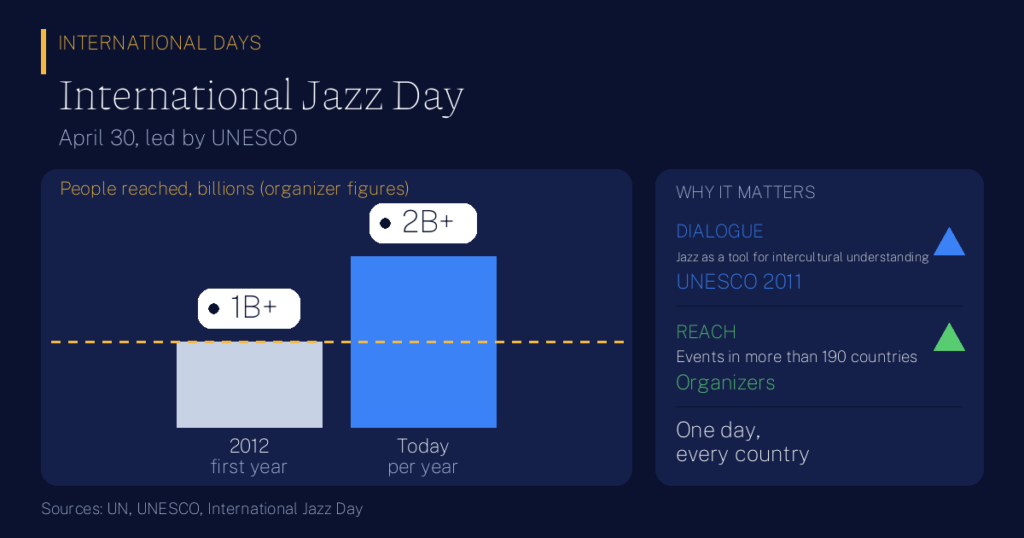
Reach is the day’s calling card. The organizers say thousands of performances, masterclasses, jam sessions and education programs take place each year in more than 190 countries, and that the day reaches more than 2 billion people annually. For comparison, the organizers reported that more than 1 billion people were reached in 2012, the first year. They also report that 2015 brought over 800 events and 2016 nearly 1,000. These are the organizers’ own figures, and no counting method is published, so they are best read as scale rather than precise measurement.
Example 2: counting a town’s audience. Suppose a town of 10,000 people hosts a free evening concert that draws 500 people in person. A local radio stream adds another 1,500 listeners. In total, 2,000 people, or one in five residents, took part in a single evening. The figures are made up, but they show how a day can reach beyond those in the room.
Why it matters, and who it serves
The case for the day rests on access. Music education is often the first program cut when budgets tighten, and jazz in particular can seem distant from young people who never heard it live. The day’s education programs, from masterclasses to community workshops, put working musicians in front of students and neighbors who would not otherwise meet them. Free and open events also lower the cost of taking part.
It matters as well because jazz carries a history. The music emerged from communities that faced severe exclusion, and it became a language of dignity and self-expression. Honoring it means honoring that record while recognizing how many cultures have since made it their own. The UN stresses jazz as a tool for breaking down barriers and reducing tensions, which is why the day appears on the calendar of observances about peace and dialogue.
Example 3: a small venue’s budget. Imagine a neighborhood club that normally charges $15 a ticket and seats 80 people. For its Jazz Day show it opens the doors for free to 80 students and volunteers. The club gives up about $1,200 in ticket sales, and the musicians donate their time. For that cost, 80 young people hear live jazz, which is the kind of trade many community venues make. The numbers are round and illustrative.
How to take part
Taking part does not require a stage. People mark the day by attending a local concert, streaming the global concert, listening to a recording they have never heard, or asking a school to host a workshop. The organizers offer a free livestream of the global concert, and many cities run their own programs around April 30. Players of any level can join a jam session. Listeners can simply spend an hour with an album and read about the musicians behind it.
Key Takeaways
- It began with a musician. UNESCO says the day was declared at the initiative of Herbie Hancock.
- The dates are official. UNESCO proclaimed April 30 in November 2011, and the UN General Assembly welcomed it in December 2012.
- The goals go beyond music. Peace, dialogue, freedom of expression, gender equality and ending discrimination are all named.
- Jazz models cooperation. Improvisation requires listening, which is why the art form suits a day about dialogue.
- The host city changes. Tangier in 2024, Abu Dhabi in 2025 and Chicago in 2026 show the day’s global reach.
- The scale is large but self-reported. Organizers cite over 190 countries and more than 2 billion people reached each year.
- Anyone can join. A concert, a workshop or an hour of listening all count.
How solid is this? The dates and the roles of UNESCO and the UN come from UN and UNESCO pages. Participation and reach figures are reported by the organizers and use no published counting method, so treat them as estimates of scale. The three worked examples use round, made-up numbers to show an idea. See also the International Days hub and the International Days Calendar.
More in Society
- United Nations, International Jazz Day
- UNESCO, UNESCO celebrates jazz: a universal language of freedom, creativity and peace (2025)
- International Jazz Day, About
- UNESCO, International Jazz Day 2025 culminates in Abu Dhabi
- UNESCO, Chicago designated Host City of International Jazz Day 2026
- International Jazz Day, 2026 15th anniversary concert in Chicago