Africa is the continent where humanity began, and it holds some of the oldest and most remarkable places people have ever built, painted, farmed and worshipped in. Yet it is also the region most underrepresented on the list of the world’s most celebrated heritage. African World Heritage Day, observed every May 5, exists to close that gap in attention. It asks the world to look at the continent’s cultural and natural treasures, and to ask who is trained, funded and empowered to protect them. It sits naturally beside the International Day for Biosphere Reserves, since many African heritage sites are living landscapes as well as monuments.
How the day came to be
The day is a product of a single vote. On November 16, 2015, the 38th session of the UNESCO General Conference adopted a resolution proclaiming May 5 as African World Heritage Day. UNESCO’s World Heritage Centre reported that the decision was taken in conjunction with the 10th anniversary of the creation of the African World Heritage Fund, and that it was aimed at increasing international awareness of African heritage.
That fund is the quiet engine behind the observance. The African World Heritage Fund was founded in 2006 to help African countries identify, nominate, conserve and manage their sites. In 2026, UNESCO’s Director-General noted that the day marks the fund’s 20th anniversary. The date and the institution grew up together, and the day is as much about building skills as it is about celebration.
What “World Heritage” means
World Heritage is a status given to places of outstanding value to all of humanity, from ancient cities and rock art to forests, deserts and coral reefs. The 1972 World Heritage Convention created the system, and by July 2025 the list stood at 1,248 sites in 170 countries, according to UNESCO. A site earns a place only after its government nominates it and independent experts judge that it meets strict criteria. Nomination takes years of paperwork, mapping, conservation planning and money.
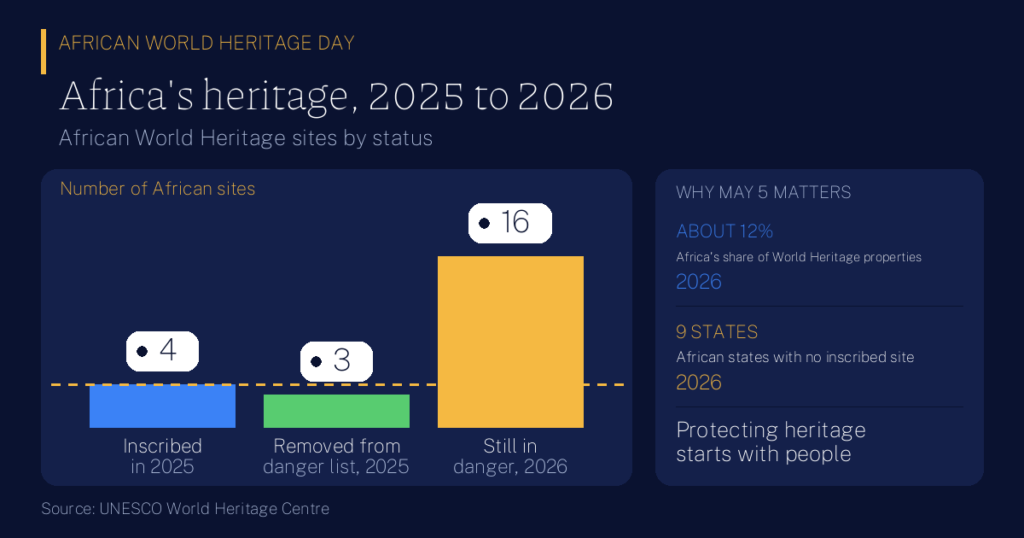
That is where Africa’s challenge begins. The skills and funding that make a strong nomination are unevenly spread, so a continent with immense heritage can end up with a short list. Africa accounts for only about 12 percent of the properties on the World Heritage List, according to UNESCO’s 2026 message for the day, and nine African states still have no property inscribed at all.
Example 1: the nomination gap. Imagine two countries with equally remarkable ancient towns. One has trained heritage officers, a mapping team and a budget for a five-year dossier. The other has a single overstretched official. The first nominates and wins recognition, while the second waits. The numbers are made up and round, but the pattern is the one the day’s founders wanted to change.
Protecting what is already listed
Recognition is only the start. Listed sites face pressures from climate change, development, conflict and neglect, and the World Heritage Committee keeps a separate List of World Heritage in Danger to focus help where it is most urgently needed. UNESCO’s 2026 message reports that sixteen African sites remain on that list.
The recent record shows that rescue is possible. In 2025, four African sites were inscribed on the World Heritage List, and three African sites, in Madagascar, Libya and Egypt, were removed from the List in Danger after improvements to their protection. Removal is a sign of success, because it means the threats that justified the alarm have been addressed.
Example 2: a site back from the brink. Picture a coastal fortress on the danger list because its walls are crumbling. Over five years, the country adds a maintenance team, a visitor fee that funds repairs and a management plan agreed with local residents. Experts return, see the risks reduced and recommend removal from the danger list. The details are invented for illustration, but they follow the logic of the 2025 removals.
People are the real infrastructure
Stones and forests do not protect themselves. The African World Heritage Fund and UNESCO have trained 521 participants from 49 States Parties, including 153 women, according to a UNESCO review of the fund’s first decade, which also counts over 50 training workshops. Those numbers describe the 2006 to 2015 period, and the work has continued since.
The 2026 observance builds directly on this idea. UNESCO titled it “Celebrating Africa’s Heritage, Mentoring the Leaders of Tomorrow” and used it to mark the start of the fourth phase of the Mentorship Programme for African Heritage Professionals. It also launched an initiative called “Voices & Eloquence of African Heritage,” designed to open space for dialogue and to promote African initiatives. The message is simple: lasting protection comes from skilled local people who know a site and care for it for decades.
- 12%of World Heritage properties are in Africa (2026)
- 9African states have no inscribed site (2026)
- 521professionals trained through the fund and UNESCO, 2006 to 2015
- 20years since the African World Heritage Fund was founded (2026)
Example 3: a mentor chain. Suppose one experienced conservator mentors three young professionals over a year. Each of them then mentors three more the next year. After two years, one person’s knowledge has reached twelve. The figures are round and illustrative, but they show why UNESCO invests in mentoring rather than only in single projects.
How the day is marked and what comes next
Each year, UNESCO, the African World Heritage Fund, national heritage authorities and schools mark May 5 with webinars, site visits, exhibitions and training sessions. You do not need a famous monument nearby to take part. Local heritage includes oral traditions, markets, sacred groves and craft skills, and many such places never reach any international list but still define a community.
Progress now depends on three things: more nominations from countries that have none, steady funding for conservation and a new generation of African professionals leading the work. Anyone can help by learning one site’s story, visiting responsibly, or supporting local museums and heritage groups.
Key Takeaways
- One vote created the day. UNESCO’s General Conference proclaimed May 5 as African World Heritage Day on November 16, 2015.
- The day is tied to a fund. The African World Heritage Fund, founded in 2006, marks 20 years in 2026.
- Africa is underrepresented. It holds about 12 percent of World Heritage properties, and nine African states have none.
- Listing needs skills and money. Strong nominations take years of expertise, which is why training matters.
- Rescue can work. Three African sites left the danger list in 2025, while sixteen remain on it.
- People protect places. The 2026 focus on mentoring young heritage professionals aims for lasting local stewardship.
- Heritage is also local. Learning about the places near you is a real way to take part.
How solid is this? UNESCO pages report different totals for African sites depending on the date and the regional grouping, so this article avoids a single site count and uses the share and 2025 and 2026 figures UNESCO states directly. The training figures cover 2006 to 2015. The three worked examples use round, made-up numbers to show an idea. See the International Days hub and the International Days Calendar.
More in History
- UNESCO World Heritage Centre, May 5th: African World Heritage Day (November 2015)
- UNESCO World Heritage Centre, Message from the Director-General for African World Heritage Day (May 5, 2026)
- UNESCO World Heritage Centre, African World Heritage Day 2026 event page
- UNESCO, African World Heritage Day
- UNESCO, 10 years of achievements of the African World Heritage Fund
- UNESCO, World Heritage: 26 new sites inscribed (July 2025)