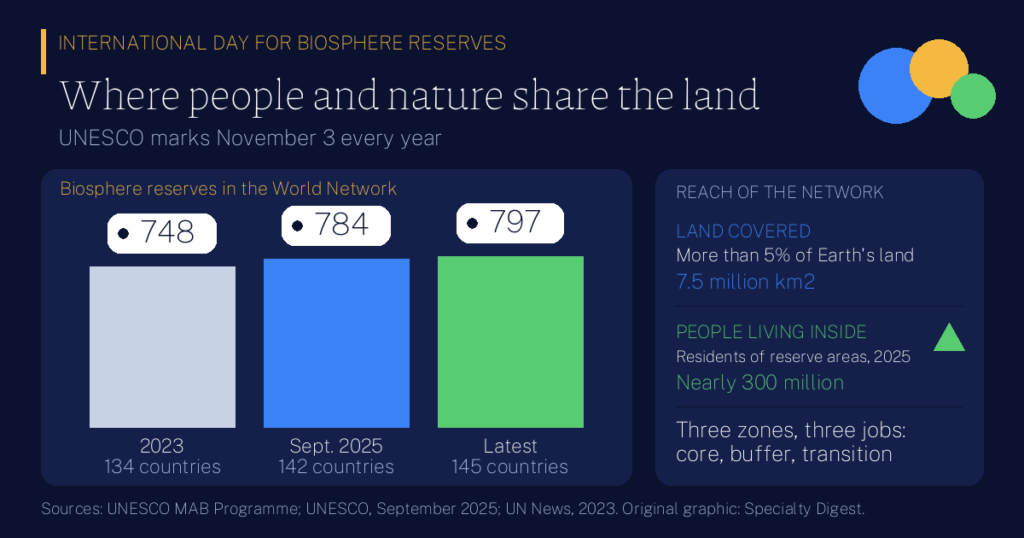
Most protected places are drawn on maps as if people were not there. A biosphere reserve starts from a different idea: that nature and the people who live beside it can be looked after together. The International Day for Biosphere Reserves, observed every year on November 3, puts that idea in front of the public. It is led by UNESCO, the United Nations agency for education, science and culture, and it celebrates a network that, by UNESCO’s current count, spans 145 countries. If you have read about World Water Day, you have met the same thinking, because healthy rivers, wetlands and forests depend on how nearby communities use them.
A day created in 2021
The day is young. It was proclaimed by the UNESCO General Conference at its 41st session in 2021, through 41 C/Resolution 37, and it falls on November 3. That makes it an observance created by UNESCO’s own governing conference rather than by a resolution of the UN General Assembly. The idea it celebrates is older. Biosphere reserves are sites designated under UNESCO’s Man and the Biosphere (MAB) Programme, and the first of them were designated in 1976. From those first designations the list has grown into the World Network of Biosphere Reserves. The day gives that network, and the scientists, rangers, farmers and local officials who run it, a yearly moment of attention.
What a biosphere reserve actually is
A biosphere reserve is not a park with a fence around it. It is a place, on land, coast or sea, organized to pursue three jobs at once: conserving biodiversity, supporting sustainable development, and serving as a site for research, education and learning. UNESCO explains that these jobs are pursued through zoning, and the zones fit together like rings.
The core area holds strictly protected ecosystems dedicated to conserving habitats and species. Around it lies a buffer zone, where activities compatible with conservation, such as research, education and sustainable resource use, are encouraged. The outer ring is the transition area, where communities live and work and where sustainable economic and human development is promoted. The design reflects a practical lesson: protection that ignores local people tends to be fragile, and development that ignores nature tends to wear away what it depends on.
Example 1: reading the map. Imagine a reserve of 1,000 square kilometers, a round number chosen only for illustration. Suppose 100 square kilometers are core area, 300 are buffer zone and 600 are transition area. A visitor who looks only at the core might think the reserve is small. In practice, 90 percent of the land is where research, sustainable farming, careful tourism and ordinary daily life take place, and that is where the reserve touches most people.
The numbers behind the network
UNESCO’s programme page now counts 797 biosphere reserves in 145 countries, without giving a date for that figure. Earlier counts show how fast the network has grown. On the 2023 observance, UN News reported 748 reserves across 134 countries, with 21 new reserves added in the previous two years alone. In September 2025, at the 37th session of the Man and the Biosphere Programme’s International Coordinating Council in Hangzhou, China, UNESCO added 26 new reserves across 21 countries, bringing the network to 784 sites in 142 countries.
- 797biosphere reserves in 145 countries, UNESCO’s latest figure
- 26new reserves in 21 countries, September 2025
- 22transboundary reserves that cross national borders, 2023
- Nearly 300 millionpeople live within reserve areas, 2025
Population follows the same upward path. UNESCO said in 2025 that the reserves directly benefit the nearly 300 million people who live within them, up from the more than 275 million reported by UN News in 2023. A UNESCO article from the same week in 2023 gave a lower estimate of more than 250 million, a reminder that population counts for such sites are estimates and that sources count differently.
Example 2: growth in plain arithmetic. Between the 2023 count of 748 and the latest figure of 797, the network gained 49 sites. If those had arrived at an even pace over two years, that would be about two new sites a month. The monthly framing is only an illustration. In reality designations come in batches, such as the 26 approved at a single council session in 2025.
Why it matters for nature
The land involved is large. UNESCO reports that biosphere reserves cover 7.5 million square kilometers, more than 5 percent of the Earth’s land surface, and that 90 percent of sites overlap with Key Biodiversity Areas, places recognized for their importance to the world’s biodiversity. That overlap is the scientific case for the network. These are not random patches of green. Many sit on ground that matters greatly for wildlife.
A second argument is that reserves work as living laboratories. Because they combine strict protection with working landscapes, they let people compare how ecosystems fare under different levels of human use. Marking the day in 2023, UNESCO Director-General Audrey Azoulay said the network “testifies to the growing awareness that our common future depends upon reconciling lifestyle with greater respect for nature.”
The people inside the map
The transition area is where the human story sits. When nearly 300 million people live within reserve areas, the success of a site depends on whether residents see a benefit. As a general principle, when farmers, fishers, guides and craftspeople earn a decent living in ways that keep the ecosystem intact, protecting the place becomes part of their own interest. When they are left out of decisions, conservation can feel like a restriction imposed from outside. That is why UNESCO describes these places in terms of both conservation and development.
Example 3: a village budget. Suppose a village in a transition area of 2,000 people earns $400,000 a year in total, and a low-impact tourism project adds $40,000 a year. That is a 10 percent rise. Whether it feels meaningful depends on sharing. Split among 100 households it is $400 each, which could cover school fees or tools. Kept by a few owners, it changes little. The numbers are round and illustrative, but the lesson holds: how benefits are shared decides whether people support the reserve.
How the day is marked
The day invites reserve managers, schools and the public to mark November 3 with events at reserve sites and online. UNESCO’s day page does not announce a yearly theme. In 2023, reserve managers from South and Central Asia met in Chennai, India, under the theme Ridge to Reef in the days around the observance, and UNESCO noted that India alone has 12 sites. To take part, you can look up the reserve nearest to you on UNESCO’s list, learn which zone you are standing in, and ask local authorities how residents are involved in its management.
Key Takeaways
- People are part of the design. A biosphere reserve joins conservation, sustainable development and learning in one place.
- Three rings, three jobs. A strictly protected core, a buffer zone for compatible uses and a transition area where communities live and work.
- The network is still growing. It rose from 748 reserves in 2023 to 797 in UNESCO’s latest figure.
- The reach is wide. Reserves cover more than 5 percent of Earth’s land and shelter nearly 300 million residents.
- Nature is the target. UNESCO says 90 percent of sites overlap with Key Biodiversity Areas.
- Shared benefits keep it working. Local support depends on residents gaining from protection.
- You can find one near you. Check UNESCO’s list and ask how your local reserve is managed.
How solid is this? Counts of reserves, countries and residents come from UNESCO and UN News and differ by date, so each is named with its year. UNESCO’s latest figures of 797 reserves, 7.5 million square kilometers and the 90 percent overlap carry no stated date on the pages consulted. Population counts are estimates. The three worked examples use round, made-up numbers. See also the International Days hub and the International Days Calendar.
More in Nature
- UNESCO, International Day for Biosphere Reserves
- UNESCO, What are biosphere reserves?
- UNESCO, Man and the Biosphere (MAB) Programme
- UNESCO, 26 new Biosphere Reserves (September 27, 2025)
- UN News, World’s diverse biospheres making peace with the natural world (November 3, 2023)
- UNESCO, Biosphere reserves are evolving as pockets of hope (November 6, 2023)