Draw one line around the world at the Tropic of Cancer and another at the Tropic of Capricorn, and you enclose a band that holds more than 3 billion people, most of the planet’s wild species and some of its fastest growing cities. It is also a band where poverty, hunger and climate risk gather most heavily. The International Day of the Tropics, observed every year on June 29, asks the world to see this belt as one region with shared opportunities and shared problems. It pairs naturally with the International Day for Biological Diversity, because so much of that diversity lives here.
A report, a resolution, a day
This day grew out of research before it became diplomacy. On June 29, 2014, the first State of the Tropics report was launched in Myanmar. It was the result of a three-year collaboration among 12 leading tropical research institutions. Two years later, more than 70 countries joined in co-sponsoring a General Assembly resolution, and in 2016 the Assembly adopted resolution A/RES/70/267, declaring June 29 of each year the International Day of the Tropics. The date is the same one on which that first report appeared.
According to the United Nations, the day exists to raise awareness of the specific challenges faced by tropical areas and to underline the important role that countries in the tropics will play in achieving the Sustainable Development Goals. It is a day of stocktaking as much as celebration: a chance to ask how much progress the region is making and who is still waiting for it.
What counts as the tropics
The tropics are roughly the area between the Tropic of Cancer in the north and the Tropic of Capricorn in the south, with the Equator running through the middle. Beyond those two lines lie the temperate zones. Because the sun stays high in the sky all year, the region has little of the winter and summer swing that shapes life elsewhere. Its seasons are written in rainfall instead: wet and dry periods, monsoons, and the tropical cyclones and El Niño years that can transform a harvest or flatten a coastline.
The numbers behind the day
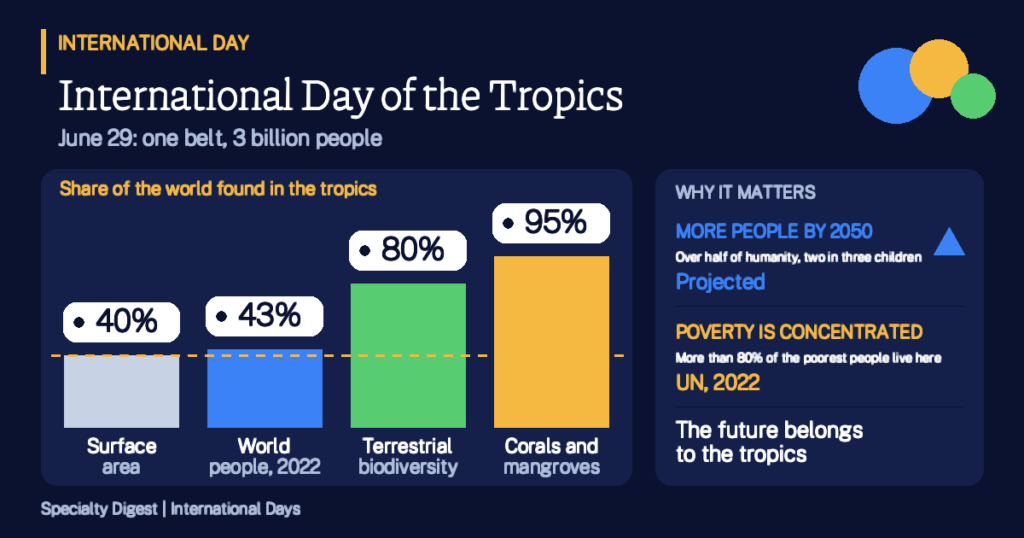
The UN observance page says the tropics account for 40 percent of the world’s total surface area and are host to about 80 percent of its biodiversity. A 2022 UN article adds that the region is home to 80 percent of terrestrial biodiversity and 95 percent of the world’s coral and mangrove ecosystems. The same article puts the tropical population at more than 3 billion people, about 43 percent of humanity in 2022. Nearly half of the world’s forests stand in the tropics, and the region has just over half of the world’s renewable water resources, 54 percent, according to the State of the Tropics 2021 report.
Example 1: the water picture. Imagine the world’s renewable fresh water as 100 buckets. The tropics hold 54 of them. Yet if a tropical region has 1,000 residents, about 500 of them could be considered vulnerable to water stress, because rainfall is uneven, storage is scarce and pipes do not reach everyone. The numbers are round and illustrative, but they show why having water and having access to it are different things.
A region that keeps growing
The weight of the tropics is rising. The State of the Tropics project notes that by 2050 more than half of the world’s people will live in the region, and the UN says it will then host two-thirds of the world’s children. Many of today’s youngest are already tropical: the UN article reports that 56 percent of children under age five lived there in 2022.
Example 2: a classroom of the future. Picture 900 children chosen at random from around the world in 2050. If the UN projection holds, about 600 would live in the tropics and 300 elsewhere. The count is rounded and illustrative, but it shows why decisions on schools, vaccines and jobs in the tropics will shape the global future.
Cities on the rise
Urban growth is where this story becomes concrete. The State of the Tropics project reports that in 2018, 47 percent of the tropical population lived in an urban setting, and roughly 37 percent of that urban population lived in slum conditions. The global urban population is expected to reach 6.3 billion by 2050, with almost 60 percent of that growth in tropical countries.
- More than 3 billionpeople live in the tropics, 2022
- 47%of tropical residents lived in cities, 2018
- 37%of that urban population lived in slum conditions, 2018
- Almost 60%of urban growth to 2050 is expected in tropical countries
Example 3: one city’s math. Suppose a tropical city of 1 million people matched the 2018 regional pattern. About 370,000 residents would live in slum conditions, often without secure housing, clean water or reliable drainage. The figures are illustrative, but they show how quickly a single planning decision on housing or transit touches hundreds of thousands of lives.
Who is left behind
The tropics are rich in life and in people, but not evenly in income. The UN reports that more than 80 percent of the world’s poorest people live there, and the UN Chronicle, citing the State of the Tropics 2020 report, put the share of people in extreme poverty at 85 percent. The observance page adds that more people experience undernourishment in the tropics than in the rest of the world, that biodiversity loss is also greater there, and that slum conditions are more common among urban residents.
Health is part of the picture. The UN page, drawing on the World Health Organization, describes neglected tropical diseases as a group of 20 conditions affecting more than one billion people. Climate change adds pressure: the UN Chronicle warns that rising greenhouse gas emissions mean climate impacts will be pervasive across tropical communities and ecosystems.
How the day is marked
Universities, governments and communities mark the day with events under the hashtags #WeAreTheTropics and #TropicsDay. The State of the Tropics project has kept publishing, including a 2021 focus report on the digital divide and a 2022 report on COVID-19. The UN Chronicle notes that countries in this zone make up the fastest growing digital market in the world, so connectivity is both a risk and an opening. The UN’s own motto for the day is blunt: the future belongs to the tropics.
- 2014First State of the Tropics report launched on June 29
- 2016General Assembly designates June 29 as the International Day of the Tropics
- 2021Focus report: The Digital Divide in the Tropics
- 2022State of the Tropics report on COVID-19
Key Takeaways
- The tropics are a global region. They cover about 40 percent of Earth’s surface and hold more than 3 billion people.
- Most of nature’s variety lives here. About 80 percent of terrestrial biodiversity and 95 percent of corals and mangroves, per the UN.
- The day began with research. A 2014 report by 12 institutions led to resolution A/RES/70/267 in 2016.
- The region is growing fast. More than half of humanity and about two in three children are projected to live there by 2050.
- Gains are uneven. More than 80 percent of the world’s poorest people live in the tropics.
- Cities are the frontline. Almost 60 percent of urban growth to 2050 is expected in tropical countries.
How solid is this? Most figures come from the UN observance page and a 2022 UN article, which draw on the State of the Tropics project; some are undated there, and the projections for 2050 are estimates, not certainties. The UN page does not name a single coordinating agency. The three worked examples use round, made-up numbers to show an idea. See the International Days hub and the International Days Calendar.
More in Nature
- United Nations: International Day of the Tropics
- UN Chronicle: Celebrating the International Day of the Tropics (2021)
- UN Academic Impact: Enhancing Understanding of the Tropics (2022)
- UN Digital Library: A/RES/70/267, International Day of the Tropics
- State of the Tropics: Why do the tropics matter?
- State of the Tropics: Urbanisation