Imagine running a business in a country with no coastline. Your goods must cross at least one neighbor’s territory to reach a port, and every border, road, rail line and form on the way adds time and money. That is daily life for 32 countries that the United Nations calls landlocked developing countries. Each year on August 6, the world pauses to look at what geography does to development, and to ask what can be done about it. The day sits alongside the UN’s other efforts to protect those most at risk of being left behind, such as the work honored on Africa Industrialization Day.
A day born at a conference
The United Nations General Assembly adopted a resolution proclaiming August 6 as the International Day of Awareness of the Special Development Needs and Challenges of Landlocked Developing Countries. According to the UN, the first celebration took place in 2025, during the Third United Nations Conference on Landlocked Developing Countries, held in Awaza, Turkmenistan. That timing was deliberate. Governments had just adopted a ten-year plan for these countries, and the day gives the plan a yearly moment of public attention.
The plan is the Awaza Programme of Action for Landlocked Developing Countries for the Decade 2024 to 2034, which the General Assembly adopted by resolution on December 24, 2024. It sets priorities for transit, trade, infrastructure and cooperation between landlocked countries, their coastal neighbors and development partners.
What “landlocked developing” means
A landlocked developing country is a nation with no direct access to the sea that is also at an earlier stage of economic development. Being landlocked is a fact of geography. The development challenge comes from what follows: dependence on neighbors for access to ports, and exposure to their roads, rules, queues and politics. Sixteen of the 32 are also classed by the UN as least developed countries, which means they face poverty and structural weakness on top of distance.
The numbers behind the day
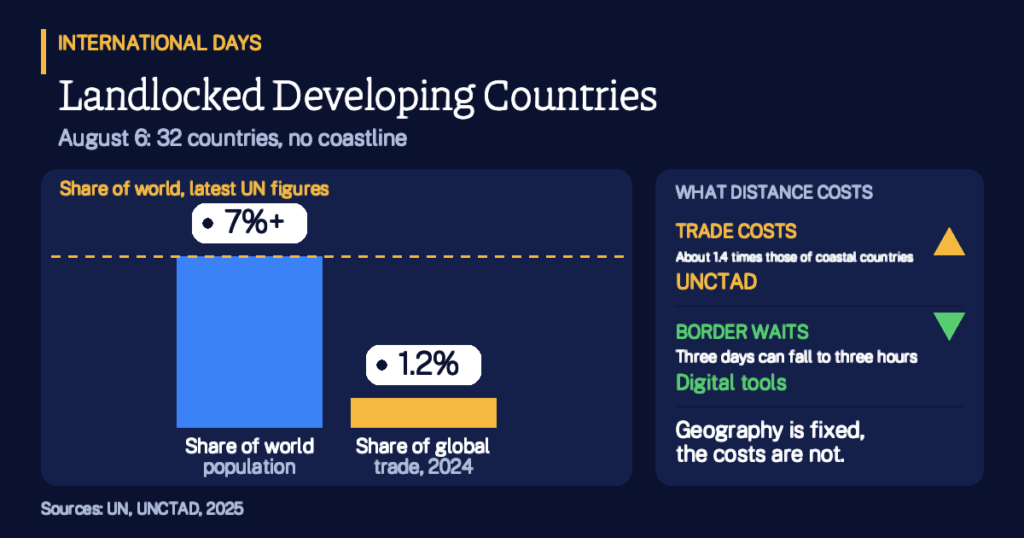
These countries are home to more than 7 percent of the world’s people. Depending on the source and the year, that is somewhere between about 570 million and more than 600 million people. Yet in 2024 they accounted for just 1.2 percent of global merchandise trade, according to UN News, a share that UNCTAD says has not changed in over a decade.
- 32landlocked developing countries worldwide
- 16of them are also least developed countries
- 80%+rely on raw materials for exports
- 0.3%share of global digitally deliverable exports
Why distance costs so much
The UN observance page says trade costs for these countries run about 30 percent higher than for coastal countries, and that average transport costs are more than twice those of their coastal neighbors. UNCTAD, speaking at the 2025 conference, put trade costs at 1.4 times those of coastal countries. The measures differ, but the direction is the same: every shipment pays a geography tax.
Time is the hidden cost. The UN notes that every additional day a product spends in transit reduces trade by about 1 percent. Delays also hurt goods that spoil, such as fresh produce, and make it hard for factories to rely on imported parts arriving on schedule.
Example 1: the cost of waiting. Suppose a shipment normally takes 5 days to reach a port, but paperwork and queues stretch it to 15. Ten extra days would, by the 1 percent rule, mean roughly 10 percent less trade on that route. The numbers are round and illustrative, but they show how small delays add up.
Example 2: the geography tax. Imagine a coastal exporter pays $100 to move a container of goods to market. At 1.4 times the cost, an exporter in a landlocked country pays about $140 for the same goods. If both sell at the same price, the landlocked firm keeps a thinner margin or loses the sale. These figures are illustrative.
Who is left behind
More than 80 percent of these countries depend on raw materials, which leaves their economies exposed to price swings. Foreign direct investment has declined by an average of 2 percent over the past decade, according to UN News, despite more than 135 legal and policy reforms. Only 11 of the 32 have joined the TIR system, an international customs transit arrangement that lets sealed trucks cross borders with fewer stops. People pay too: higher costs for imported food, medicine and fuel reach households, and the isolation can slow the spread of jobs and ideas.
The group is also diverse. The 32 include nations as different as Bolivia and Paraguay in Latin America and Turkmenistan, which hosted the 2025 conference. What unites them is the fact that their access to the world runs through someone else’s territory.
Turning “landlocked” into “landlinked”
At the 2025 conference, UN Secretary-General Antonio Guterres urged countries to “cut red tape, digitize border operations, and modernize transport networks.” Evidence suggests that this works. UNCTAD reports that its ASYCUDA customs system is used in 66 percent of landlocked developing countries, with clearance times cut by up to 90 percent in some cases. The UN says digital tools can cut waiting times at borders from three days to three hours, and the Northern Corridor in East Africa has done so at the Malaba crossing. The UN regional commission for Asia and the Pacific estimates that paperless trade could cut trade costs by up to 30 percent for landlocked countries in that region.
Example 3: hours saved. If 100 trucks cross a border each day and each saves 69 hours, from 72 hours down to 3, that is 6,900 truck hours saved every day. At that scale, a faster border changes what a country can profitably sell. These numbers are illustrative.
The Awaza Programme of Action builds on this idea of linking, not just crossing. It points to better corridors, shared customs data, rail and road links, and reliable partnerships with coastal neighbors. The day, in turn, asks everyone, from governments to shippers to schools, to notice a problem that rarely makes headlines.
Key Takeaways
- 32 countries have no coast. They sit in Africa, Asia, Europe and Latin America and depend on neighbors to reach the sea.
- The day is new. The UN says it was first celebrated in 2025 at the Awaza conference in Turkmenistan.
- Big population, small trade. Over 7 percent of people, but 1.2 percent of global merchandise trade in 2024.
- Geography is costly. Trade costs average about 1.4 times those of coastal countries, according to UNCTAD.
- Time matters as much as money. Each extra day in transit reduces trade by about 1 percent.
- Digital borders help. Paperless customs can cut waits from days to hours and trade costs by up to 30 percent in Asia and the Pacific.
- There is a plan. The Awaza Programme of Action covers 2024 to 2034 and the day keeps it in view.
How solid is this? Figures come from UN pages and UNCTAD statements published in 2025, and some differ by source: population is given as roughly 570 to over 600 million, and trade cost comparisons use different measures. Savings from digital tools are reported examples, not guarantees. The three worked examples use round, made-up numbers to show an idea. See also the International Days hub and the International Days Calendar.
More in Society
- United Nations, International Day of Awareness of the Special Development Needs and Challenges of Landlocked Developing Countries
- UN News, Landlocked nations invisible to much of the world (August 2025)
- UN News, Landlocked to landlinked: UN summit seeks to turn geography into opportunity (August 2025)
- UNCTAD, Turning geography into opportunity (August 2025)
- United Nations, Awaza Programme of Action for Landlocked Developing Countries 2024 to 2034
- United Nations, LLDC3 infographic: 32 countries by region