On August 22 each year the United Nations pauses to remember people who were attacked, injured or killed because of what they believe, or because of what others assumed they believe. The International Day Commemorating the Victims of Acts of Violence Based on Religion or Belief is a quiet observance. It has no parade and no yearly slogan. It asks for something simpler: that societies name the harm, support the people who suffered it, and protect the freedom of every person to hold, change or not hold a belief. It falls one day after the remembrance of victims of terrorism, and the two days share a thread of respect for those who have been harmed.
How the day came to be
The General Assembly created the day on May 28, 2019, in resolution A/RES/73/296 of its 73rd session. The text is short. In its first paragraph the Assembly decided to designate August 22 as the International Day Commemorating the Victims of Acts of Violence Based on Religion or Belief. In the second it invited Member States, UN organizations, regional bodies, civil society, individuals and the private sector to observe the day in an appropriate manner. In the third it asked the Secretary-General to bring the resolution to their attention. The resolution sets no yearly theme and names no lead agency, so the day belongs to everyone who chooses to mark it.
The preamble supplies the reasoning. It recognizes the importance of giving victims and their families appropriate support and assistance, in accordance with applicable law, and it points to promoting tolerance and respect for religious and cultural diversity. It also refers to interreligious, interfaith and intercultural dialogue and its role in combating religious hatred, incitement and violence. Preamble wording does not bind states the way the operative paragraphs do, but it shows what the day is for.
What the phrase actually covers
The title chooses its words with care. Religion or belief is wider than any one faith. Article 18 of the Universal Declaration of Human Rights, adopted in 1948, protects freedom of thought, conscience and religion, including the freedom to change one”s religion or belief. That protection reaches members of large and small traditions, people who hold non-religious convictions, and people who are simply perceived to belong to a group.
Violence here means harm done to people or to what they hold sacred. Researchers who track it, such as the Pew Research Center, look at physical harassment in several forms: damage to property, physical assaults, detentions, displacement and killings. The day does not rank faiths or compare suffering. It recognizes victims wherever they live and whatever they believe.
The numbers behind the day
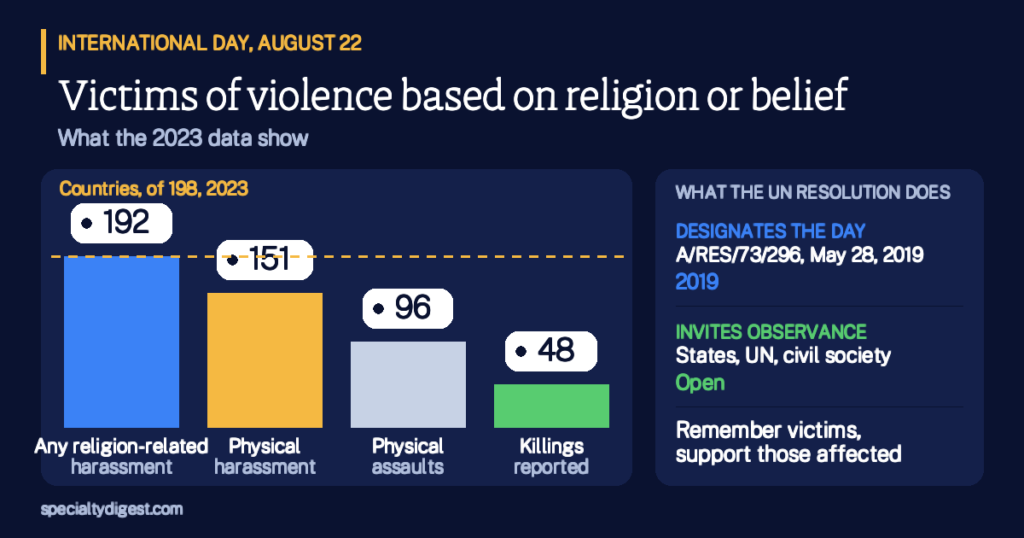
The most detailed global count comes from the Pew Research Center, which scores 198 countries and territories each year. Its 2023 data, released in June 2026, found religion-related harassment in 192 of the 198. That matches the high set in 2022 and is the highest in the study”s 16 years. Governments harassed religious groups in 185 countries and private actors in 175. Physical harassment of some kind, as opposed to words or restrictions, occurred in 151 countries, or 76 percent, up from 145 the year before.
Pew also tracks social hostilities, meaning acts by private individuals, organizations and groups. Fifty-five countries had high or very high levels in 2023, up from 45 in 2022 but still below the peak of 65 in 2012.
These measures count countries where an activity occurred, not the number of victims. They show how widespread a problem is, not how severe it is in any one place.
- May 28, 2019date the General Assembly adopted the resolution
- 192 of 198countries with religion-related harassment, 2023
- 151countries with physical harassment, 2023
- 55countries with high or very high social hostilities, 2023
Who is affected
No single group carries the whole burden. In 2023, Pew found Christians harassed in 165 countries, Muslims in 143 and Jews in 98, up from 90 in 2022. Pew attributes the rise for Jews in part to antisemitic statements after the October 7, 2023 attack on Israel and the military campaign in Gaza. Smaller communities were affected too: followers of folk religions in 50 countries, Hindus in 32 and Buddhists in 22.
What the data cannot show
Counting hate is hard, and different counts answer different questions. The OSCE Office for Democratic Institutions and Human Rights (ODIHR) published its hate crime report for 2024 on November 6, 2025. It drew on official information from 46 states, with statistics broken down by bias motivation for 33 countries, and on incident reports from 125 civil society groups, UNHCR and OSCE field operations. In all, 12,714 hate incidents were recorded, 5,370 of them with detailed descriptions processed by ODIHR. Those totals cover every kind of bias, not only religion.
Example 1: the quiet gap. Imagine a town where 1,000 incidents of religious hatred occur in a year, but victims report only 100 because they fear retaliation or doubt anyone will act. Official statistics would show 100, one tenth of the real number. The numbers are round and illustrative, but the gap between what happens and what is recorded is why researchers use several sources.
Example 2: when more reports is good news. Suppose a city receives 40 reports of religious hate incidents in a year, then launches outreach and a trusted reporting line. Reports rise to 60 the next year. The increase may mean more people trust the system, not that hatred grew by half. The figures are made up, but the lesson holds: a number needs context.
Why remembrance matters
Violence based on belief rarely stops with one person. Damage to places of worship and cemeteries reaches a whole community, and Pew counted property damage in 120 countries and displacement in 58 in 2023. When families leave a home they have lived in for generations, the loss includes neighbors, memory and trust. The day exists so that those who survived, and those who did not, are acknowledged rather than forgotten. It also sits close to World Humanitarian Day, which honors people who help others in crisis.
Example 3: the cost of one attack. Suppose vandals damage a small place of worship and repairs cost $50,000. Insurance pays $20,000 and neighbors of many faiths raise the other $30,000. The money is illustrative, but it shows what the resolution means by support and assistance: practical help, offered in accordance with applicable law, that tells victims they are not alone.
How the day is marked, and where to turn
The resolution invites observance in an appropriate manner, so there is no single format. Common ways include moments of silence, statements by public leaders, interfaith gatherings, school lessons on tolerance and respect, and events that listen to survivors. The most useful steps are often small: learn how your own community records and responds to hate incidents, and support groups that help victims.
If you or someone you know has been targeted, call local emergency services if there is immediate danger. Many countries also have hate crime reporting lines, human rights commissions and community organizations that offer support, and a trusted friend or community leader can help you decide what to do next.
Key Takeaways
- The day is short and clear. The General Assembly set it on August 22 in resolution A/RES/73/296, adopted May 28, 2019.
- It protects belief in every form. Religion or belief covers large faiths, small ones and non-religious convictions.
- The problem is widespread. Pew found religion-related harassment in 192 of 198 countries in 2023.
- Physical harm is not rare. Physical harassment occurred in 151 countries, and killings in 48.
- Many groups are affected. Christians, Muslims, Jews and smaller communities all faced harassment in 2023.
- Numbers need care. They count countries or recorded incidents, and under-reporting can hide the true scale.
- Support matters. Helping victims and building trust across communities is what the day asks of everyone.
How solid is this? The resolution details come from the UN document A/RES/73/296. The Pew figures cover 2023, were released in June 2026, and measure countries rather than victims. The OSCE figures cover all hate crime, not only religion, and depend on what governments and groups report. The three worked examples use round, made-up numbers to show an idea. See also the International Days hub and the International Days Calendar.
More in Society
- United Nations General Assembly, resolution A/RES/73/296, International Day Commemorating the Victims of Acts of Violence Based on Religion or Belief (2019)
- United Nations, International Day Commemorating the Victims of Acts of Violence Based on Religion or Belief
- UN Meetings Coverage, General Assembly proclaims 22 August International Day for Victims of Violence Based on Religion, Other Beliefs (2019)
- Pew Research Center, Harassment of religious groups around the world in 2023 (2026)
- Pew Research Center, More countries had elevated levels of social hostilities involving religion in 2023 (2026)
- OSCE ODIHR, 2024 hate crime report now available (2025)