- Date
- September 16, every year
- Established
- Resolution A/RES/78/259, January 9, 2024
- Key fact
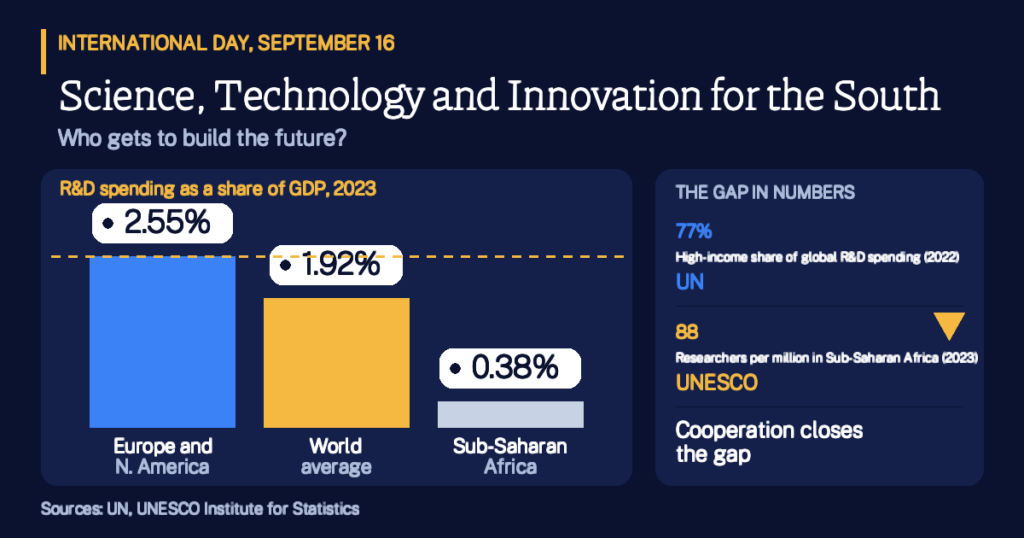
- High-income countries make up 77% of global R&D spending (UN, 2022)
Ideas travel quickly, but the ability to produce them does not. A laboratory, a trained researcher, a reliable internet connection and a steady research budget are unevenly spread across the planet, and that gap shapes who invents the vaccines, crops, energy systems and software of the future. The International Day of Science, Technology and Innovation for the South, observed every September 16, asks the world to look at that gap and to close it through cooperation. It is a young observance, but the question behind it is old: who gets to build tomorrow?
A day born in Havana
The day grew out of the political voice of developing countries. According to the United Nations, leaders of the Group of 77 and China agreed to designate September 16 at their Summit on Science, Technology and Innovation, held in Havana on September 15 and 16, 2023. The summit produced the Havana Declaration, circulated at the UN as document A/78/393.
The General Assembly then acted quickly. On January 9, 2024, it adopted resolution A/RES/78/259, proclaiming September 16 as the International Day of Science, Technology and Innovation for the South. The text stresses the importance of using scientific and technological achievements for sustainable development, in line with the 2030 Agenda and the Addis Ababa Action Agenda. It invites governments, UN bodies, universities, civil society and the private sector to mark the day and to present cooperation projects that help developing countries build capacity in these fields. The day was first observed in 2024, and UNCTAD described the 2025 observance as the second.
What the words mean
“The South” is shorthand for developing countries, many of them in Africa, Asia and Latin America, which often share concerns about access to technology, finance and training. “Science” is the systematic study of how the world works. “Technology” is knowledge turned into tools and methods. “Innovation” is the step where a new idea is put to practical use, whether that is a drought-tolerant seed, a mobile payment service or a low-cost diagnostic test.
The day also connects to Sustainable Development Goal 9, whose Target 9.5 calls for enhancing scientific research and upgrading technological capabilities in all countries, in particular developing countries. It names two measures, spending on research and development (R&D) as a share of the economy, and the number of researchers per million people. Both are tracked by UNESCO. This day sits alongside the water and sanitation observances, such as World Water Day, because solving those problems also depends on engineers, scientists and affordable technology.
The numbers: money for discovery
The United Nations notes that global R&D spending rose to about $2.5 trillion in 2022, but that it remains concentrated in developed countries and China. High-income countries make up 77% of that spending, while low-income countries contribute just 0.3%.
The UNESCO Institute for Statistics shows the same pattern in its 2026 data release. Worldwide, R&D rose from 1.71% of GDP in 2015 to 1.92% in 2023. Europe and Northern America stood at 2.55% and Eastern and South-Eastern Asia at 2.42%, while Sub-Saharan Africa invested 0.38%. About 73% of countries still invest less than 1% of GDP in research.
Example 1: one percent of the economy. Imagine a country with a $100 billion economy that spends 0.4% of it on R&D, or $400 million a year. Raising that to 1% would mean $1 billion. The numbers are round and illustrative, but they show that a small shift in share can multiply the funding available for labs, universities and start-ups.
The numbers: people who do the work
Money is only half the story, because research is done by people. UNESCO reports that the world had 1,486 researchers per million inhabitants in 2023, up from 1,141 in 2015. Europe and Northern America had 4,358 per million in 2023, while Sub-Saharan Africa had 88. Women made up 31.4% of researchers worldwide in 2023.
The gap is sharp in health. The UN reports that in 2022 high-income countries had 59 times more health researchers than low-income countries, and that only 0.2% of health research grants went to low-income countries. When science is done mostly elsewhere, the problems studied tend to be the problems of the places that fund it.
Example 2: a thin bench. Suppose a region of 10 million people has 88 researchers per million, which is 880 researchers in all. At the 2023 world average of 1,486 per million, it would have about 14,860. The figures are round and illustrative, but they show how many more minds would be working on local crops, climate risks and health needs.
Why it matters now
Frontier technologies, such as artificial intelligence, advanced robotics and gene editing, are reshaping economies. UNCTAD Secretary-General Rebeca Grynspan said on September 16, 2025, citing the agency’s Technology and Innovation Report, that the combined market value of frontier technologies may grow from $2.5 trillion in 2023 to $16.4 trillion in 2033, a sixfold increase in ten years. Countries that cannot take part risk being left outside the largest new markets.
Cooperation is the answer the day promotes. The UN Technology Bank, operational since 2018, serves 45 least developed countries, and UNCTAD has served since 1992 as secretariat of the UN Commission on Science and Technology for Development. These are examples of South-South and North-South partnerships in practice.
Example 3: sharing the tool. A cooperative of 1,000 farmers each needs a weather-forecasting service that would cost $50 a year alone. Together they buy one shared license for $10,000, or $10 each. The numbers are round and illustrative, but they show why shared platforms and open data can put technology within reach.
How the day is marked, and what progress needs
The resolution invites governments, UN agencies, universities, civil society and businesses to mark the day with events and to showcase cooperation projects. In 2025 the observance included a G77 and China event in New York. Groups of students, researchers and policymakers can use the date to ask practical questions: Does our country meet its R&D goals? Do girls and women have a path into laboratories? Can local innovators reach funding and markets?
Progress needs steady public funding, training that keeps talented people at home or connected to them, open access to knowledge, and fair terms for sharing technology. The G77 statement of 2025 cited the Secretary-General’s progress report (A/80/81-E/2025/62), which found that nearly half of the Sustainable Development Goal targets are not advancing at the necessary pace.
Key Takeaways
- The day is new but the need is old. The General Assembly proclaimed September 16 on January 9, 2024, in resolution 78/259.
- It began with developing countries. The Group of 77 and China chose the date at their Havana summit in 2023.
- Research money is concentrated. High-income countries make up 77% of global R&D spending and low-income countries 0.3%.
- People matter as much as budgets. Sub-Saharan Africa had 88 researchers per million people in 2023, against 4,358 in Europe and Northern America.
- Health research is lopsided. Only 0.2% of health research grants went to low-income countries in 2022.
- The stakes are rising. UNCTAD projects frontier technologies to grow from $2.5 trillion in 2023 to $16.4 trillion in 2033.
- Cooperation is the tool. Shared platforms, training and fair technology transfer can narrow the gap.
How solid is this? Research figures come from UNESCO Institute for Statistics releases and the United Nations, and each cites its own year. UNESCO revises earlier years with each release, so older reports show slightly different values. The frontier technology figure is a projection, not a measurement. The three worked examples use round, made-up numbers to show an idea. See also the International Days hub and the International Days Calendar.
More in Science
- United Nations, International Day of Science, Technology and Innovation for the South
- UN General Assembly resolution A/RES/78/259 (2024), UN Digital Library
- UNCTAD, statement on the International Day of Science, Technology and Innovation, September 16, 2025
- Group of 77 and China, statement of September 16, 2025
- UNESCO Institute for Statistics, 2026 R&D Data Release
- UN Statistics Division, SDG Extended Report 2024, Goal 9