Breathing is the one vital act nobody notices until it becomes difficult. A cough that will not leave, a staircase that suddenly feels steep, a child who wheezes at night: these are often the first moments when people think about their lungs at all. World Lung Day, observed every year on September 25, was created to end that habit of silence. It is a global campaign to raise awareness about lung health and the urgent need to reduce the burden of respiratory disease, and it asks governments, organizations and individuals to act on prevention, research and fair access to care. It sits beside other health observances such as World Pharmacists Day, because many lung treatments reach patients through pharmacies.
A campaign led by the people who treat lung disease
World Lung Day was initiated by the Forum of International Respiratory Societies, usually called FIRS, together with its partners. FIRS brings together major professional bodies in the field. A FIRS statement from 2023 lists the American College of Chest Physicians (CHEST), the American Thoracic Society, the Asian Pacific Society of Respirology, the Latin American Thoracic Association, the European Respiratory Society, the International Union Against Tuberculosis and Lung Diseases, the Pan African Thoracic Society, and the Global Initiative for Asthma and for Chronic Obstructive Lung Disease. It describes FIRS as having over 70,000 members worldwide.
The sources checked for this article describe the day as an annual awareness campaign led by these societies. They do not give a founding year, so none is stated here. Each year FIRS picks a theme. The 2021 theme was “Care for Your Lungs,” with four pillars: say no to tobacco, protect lungs through vaccination, breathe clean air and exercise regularly. The 2023 theme was “Access to Prevention and Treatment for All. Leave No One Behind.” The 2026 theme is “A Lifetime of Lung Health.”
What “lung health” actually covers
Lung disease is not one illness. Chronic respiratory diseases, such as chronic obstructive pulmonary disease (COPD) and asthma, are one of the four main groups of noncommunicable diseases, alongside cardiovascular disease, cancer and diabetes. Infections form a second family. Tuberculosis, for example, mainly attacks the lungs and remains the world’s leading cause of death from a single infectious agent. A third family is environmental: smoke and polluted air harm the lungs whether the source is a cigarette, a cooking fire or a busy road. Because the causes differ, the answers differ too, from vaccines and medicines to clean fuels and smoke-free laws.
The numbers behind the day
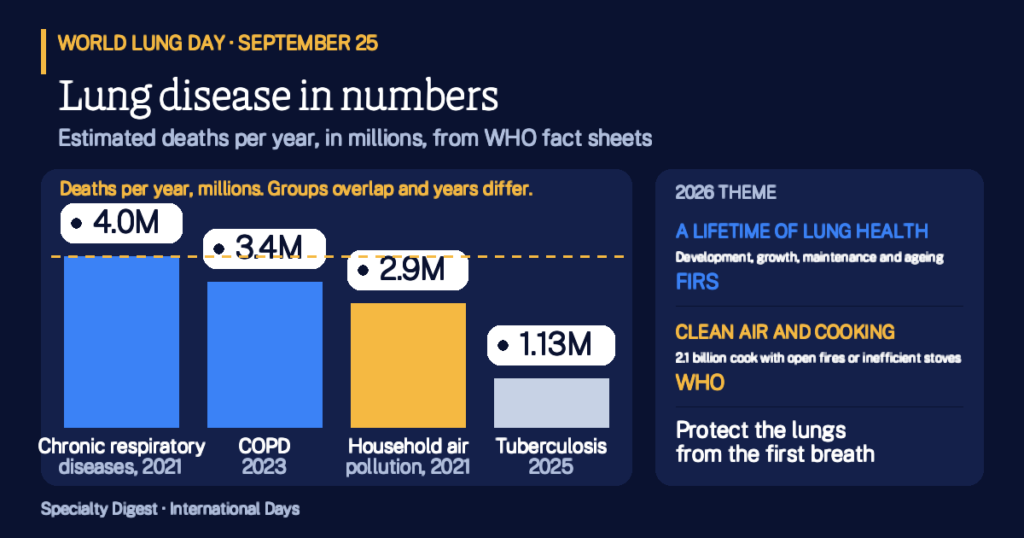
WHO estimates that chronic respiratory diseases caused about 4 million deaths in 2021, out of at least 43 million deaths from noncommunicable diseases that year. COPD alone was the third leading cause of death worldwide, with 3.4 million deaths in 2023, about 6 percent of all deaths. It is also the seventh leading cause of poor health worldwide, measured in years of healthy life lost.
- 3.4 millionCOPD deaths in 2023, about 6% of all deaths
- 10.6 millionpeople fell ill with tuberculosis in 2025
- 1.13 millionpeople died of tuberculosis in 2025
- 2.1 billionpeople cook with open fires or inefficient stoves
Example 1: the share of the toll. Suppose a country records 100,000 deaths in a year and 6,000 come from COPD. That matches the global share of about 6 percent, and it means roughly one death in 17 traces back to one lung disease. The numbers are round and illustrative, but they show why a single, often preventable condition deserves its own day.
The air we breathe, indoors and out
Air quality is the thread that ties many lung problems together. WHO estimates that ambient, or outdoor, air pollution caused 4.2 million premature deaths worldwide in 2019, and that outdoor and household air pollution together are associated with 6.7 million premature deaths a year. In 2019, 99 percent of the world’s people lived where WHO air quality guideline levels were not met. Of the outdoor pollution deaths that year, 14 percent were from COPD, 14 percent from acute lower respiratory infections and 4 percent from lung cancer, while 68 percent were from heart disease and stroke, a reminder that polluted air harms the whole body.
Indoor air matters just as much. About 2.1 billion people cook with open fires or inefficient stoves. WHO estimates that household air pollution caused 2.9 million deaths a year in 2021, including more than 309,000 deaths of children under 5, and that women and children bear the greatest burden. At current rates, only 78 percent of the world’s people are expected to have access to clean cooking by 2030, which would leave nearly 1.8 billion without it.
Example 2: one kitchen. Picture a village where 200 households cook over open fires and a program supplies 50 of them with clean stoves. A quarter of the homes now breathe far less smoke each day. The figures are made up for illustration, but they show how progress arrives home by home, and why the gap is so large when it is counted in billions.
Who is left behind
Lung disease falls hardest where health services are thinnest. Nearly 90 percent of COPD deaths in people under 70 occur in low- and middle-income countries. The causes differ by income. Tobacco smoking accounts for over 70 percent of COPD cases in high-income countries, but 30 to 40 percent in low- and middle-income countries, where household air pollution is a major risk factor. That is why the 2023 World Lung Day theme called for equal access to prevention and treatment.
Infection adds to the divide. Tuberculosis made an estimated 10.6 million people ill in 2025 and killed 1.13 million, yet it is preventable and curable. WHO says efforts have saved an estimated 86 million lives since 2000, but only about two in five people with drug-resistant TB accessed treatment in 2025.
Example 3: a clinic’s budget. Imagine a clinic that can afford either a spirometer, the breathing test that detects COPD early, or a month of emergency oxygen. Without the test, patients arrive late and need the oxygen more often. The choice is invented for illustration, but it captures why early diagnosis and access to basic tools are central to the campaign.
A lifetime of lung health
The 2026 campaign, “A Lifetime of Lung Health,” looks at lungs across the whole span of life instead of at one disease or age. FIRS names four focus areas, and together they read like a ladder from the first breath to old age.
Anyone can take part. FIRS invites the global respiratory community to share stories of action for lung health, using the hashtag #WorldLungDay, and provides a toolkit for supporters. Individuals can mark the day by checking whether their home has clean air, asking about smoke-free rules at school and work, and talking to a clinician about a cough that lasts.
- 2021Care for Your Lungs
- 2023Access to Prevention and Treatment for All. Leave No One Behind.
- 2026A Lifetime of Lung Health
Key Takeaways
- One day, many diseases. World Lung Day covers COPD, asthma, infections such as tuberculosis, and the effects of polluted air.
- The toll is large. COPD caused 3.4 million deaths in 2023, about 6 percent of all deaths.
- Air quality is a lung issue. 2.1 billion people cook with open fires or inefficient stoves, and 2.9 million deaths in 2021 were linked to household air pollution.
- Poorer countries carry the burden. Nearly 90 percent of COPD deaths in people under 70 occur in low- and middle-income countries.
- Tuberculosis is curable. It still made 10.6 million people ill in 2025, and only about two in five with drug-resistant TB got treatment.
- Think across a lifetime. The 2026 theme links lung development, growth, maintenance and ageing.
- Small actions count. Avoid tobacco smoke, cook with cleaner fuels where possible and see a clinician about a lasting cough.
How solid is this? Figures come from WHO fact sheets and FIRS pages, and each carries its own year, because the sources report different years. Many are modeled estimates and are revised over time. The three worked examples use round, made-up numbers. This article gives no founding year for the day because the sources checked do not state one. See the International Days hub and the International Days Calendar.
More in Health
- FIRS, World Lung Day
- FIRS, World Lung Day 2026 campaign: A Lifetime of Lung Health
- WHO, Chronic obstructive pulmonary disease (COPD) fact sheet
- WHO, Noncommunicable diseases fact sheet
- WHO, Household air pollution fact sheet
- WHO, Ambient (outdoor) air quality and health fact sheet
- WHO, Tuberculosis fact sheet