Every public decision leaves a trail: a budget, a contract, a school inspection, a pollution permit. Whether ordinary people can see that trail is the subject of the International Day for Universal Access to Information, observed every year on September 28. The day treats information as a public good and as a right. When people can see how decisions are made, they can question them, claim the services they are entitled to, and protect their health, land and savings. It is a natural companion to World Press Freedom Day, because a free press and open public records work best together.
From a UNESCO decision to a UN day
The day began inside UNESCO. In 2015, following the adoption of 38 C/Resolution 57, the UNESCO General Conference proclaimed September 28 as the International Day for Universal Access to Information. For several years it was marked mainly by UNESCO and its partners, with celebrations in roughly 20 to 26 countries a year since 2016, according to UNESCO.
In October 2019, the 74th UN General Assembly proclaimed September 28 as the day at the UN level, and it did so by consensus. UNESCO reports that Liberia led the proposal, with Argentina, Canada, Costa Rica, Sierra Leone and Ukraine among the main co-sponsors and 23 more countries joining at adoption. The Assembly text is listed as resolution 74/5. UNESCO describes the aim as raising awareness of the right to seek and receive information, which is part of the right to freedom of expression and is key to sustainable development.
What “access to information” really means
The phrase covers two ideas that work together. The first is the right of people to request information held by public bodies, such as records, budgets and decisions. The second is the duty of those bodies to publish key information without waiting to be asked. UNESCO says equal and universal access to information is essential to promote human rights and dignity, to eradicate poverty and to build inclusive knowledge societies.
The United Nations tracks this through Sustainable Development Goal target 16.10, which calls for public access to information and protection of fundamental freedoms. Its indicator 16.10.2 counts countries that adopt and implement constitutional, statutory or policy guarantees for public access to information. UNESCO is the UN custodian agency for that indicator, so it collects the data and reports on progress.
Example 1: the school budget. Imagine a village where parents hear that a school repair fund was spent, but the classroom roof still leaks. Under an access to information law, a parent files a short written request for the fund’s records. If the body must reply within a set period, say 20 working days, the family learns what was bought and from whom. The numbers here are round and illustrative, but the pattern is the point: a clear request process turns rumor into a checkable record.
The numbers behind the day
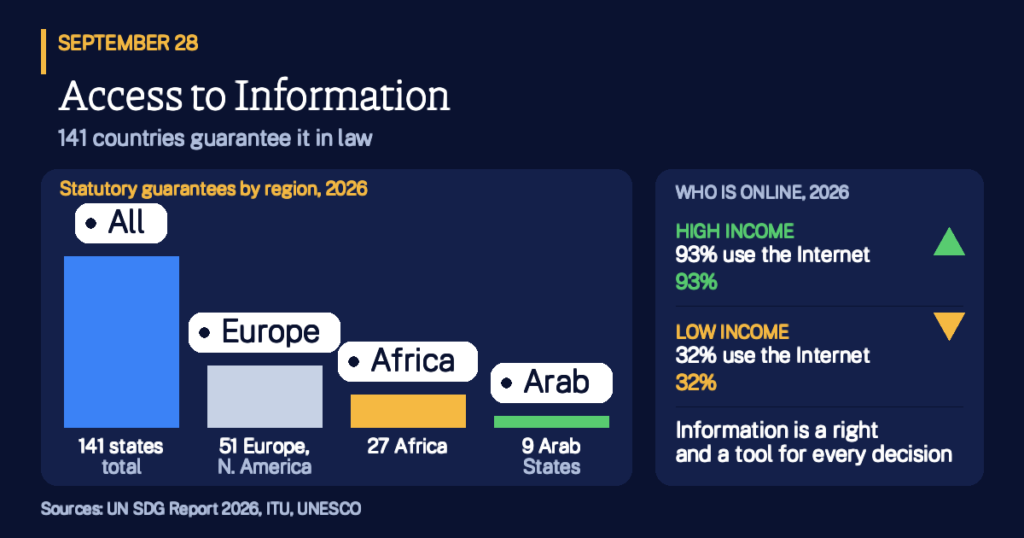
The UN’s 2026 Extended Report on the Sustainable Development Goals, with data as of April 2026, states that 141 UN Member States have adopted statutory guarantees for public access to information, with Cuba and Senegal among the most recent adopters. By region, that is 51 countries in Europe and North America, 27 in Latin America and the Caribbean, 27 in Asia and the Pacific, 27 in Africa and 9 in the Arab States.
- 141UN Member States with statutory guarantees, 2026
- 198Member States and territories invited to the UNESCO survey
- 123respondents in 2025, up from 43 in 2019
- 105respondents citing primary legislation in 2025
A law on paper is only the start. Of the 123 respondents, 105 say access is guaranteed through primary legislation and 62 rely on secondary legislation or regulations, so the two groups overlap. Participation in the survey has risen steadily, which means the picture of implementation is getting clearer each year, though it is still built on what countries choose to report.
The digital divide is an information divide
Today much public information lives online, so who can get online decides who can get informed. The International Telecommunication Union (ITU) estimates that 6.3 billion people, or 76 percent of the world’s population, use the Internet in 2026, and that 2 billion remain offline. Use stands at 93 percent in high-income countries but only 32 percent in low-income countries.
Example 2: the offline gap. Suppose a low-income country has 10 million people and Internet use matches the 32 percent group figure. Then 3.2 million are online and 6.8 million are not. If a ministry posts its health clinic schedule only on a website, the larger share never sees it. The figures are round and illustrative, which is why governments are urged to pair online portals with radio, print and community notice boards.
Why this right protects everything else
Open records help people check whether promises were kept, and the day’s 2025 theme, Ensuring Access to Environmental Information in the Digital Age, shows why the right reaches far beyond politics. People living near a factory, a river or a mine need to know what is released, what is permitted and what is monitored. UNESCO held the 2025 global event in Manila, Philippines, on September 29 and 30, marking the tenth anniversary of the day’s designation.
Example 3: the river permit. Picture a town downstream from a plant. Residents ask for the plant’s discharge permit and the last three inspection reports. If the answer is a clear file, they can compare the limits with the results. If the answer is silence, that silence is itself a signal worth raising. The scenario is illustrative, but it shows how a request for records can turn a worry into evidence.
Access also depends on trust. Information must be accurate, understandable and delivered without unreasonable cost, and people who ask must be safe from retaliation. These are the conditions UNESCO’s monitoring tries to capture when it asks countries not only whether a law exists but whether it is implemented.
How the day is marked
Each year UNESCO and partners hold events that bring together information commissioners, journalists, librarians, civil society and officials. In 2026 the global celebration took place in Sierra Leone from September 28 to 30, alongside the 17th International Conference of Information Commissioners, which UNESCO says drew more than 200 participants from 41 countries. Anyone can join in by filing a request, reading a public budget or asking a local office how to obtain records.
- 2015UNESCO General Conference proclaims the day (38 C/Resolution 57)
- 2019UN General Assembly, 74th session, adopts the day by consensus
- 2025Ensuring Access to Environmental Information in the Digital Age
- 2026Global event in Sierra Leone with the 17th International Conference of Information Commissioners
Key Takeaways
- It is a right, not a favor. UNESCO ties access to information to freedom of expression and to sustainable development.
- The day has two layers. UNESCO proclaimed it in 2015 and the UN General Assembly adopted it by consensus in October 2019.
- Laws are spreading. 141 UN Member States had statutory guarantees as of 2026, from 51 in Europe and North America to 9 in the Arab States.
- Implementation lags the text. The UN indicator tracks countries that adopt and implement guarantees, and reporting still depends on what countries share.
- Connectivity shapes access. About 2 billion people are offline, and Internet use is 32 percent in low-income countries against 93 percent in high-income ones.
- It reaches daily life. From school budgets to river permits, records let people check decisions that affect them.
- You can use it. Learn how to request records where you live, and ask public offices to publish key information proactively.
How solid is this? The count of 141 states comes from the UN’s 2026 report on SDG 16.10.2 and relies on country reporting and UNESCO’s survey, with 123 respondents in 2025. Internet figures are ITU estimates for 2026 and are revised over time. The three worked examples use round, made-up numbers to show an idea. See also the International Days hub and the International Days Calendar.
More in Society
- UNESCO. International Day for Universal Access to Information.
- UNESCO. UN proclaims International Day for Universal Access to Information (2019).
- UNESCO. International Day for Universal Access to Information 2025.
- UN. Sustainable Development Goals Extended Report 2026, Goal 16.
- UNESCO. The Right to Access to Information.
- ITU. 6.3 billion people now online, yet digital divides persist (November 3, 2026).
- United Nations Library. Universal Access to Information.