Somewhere between the farm and the dinner table, a large share of the world’s food never gets eaten. It spoils in a warehouse, rots in a truck with no cooling, is trimmed away in a factory, is passed over on a shelf, or is scraped from a plate. The International Day of Awareness of Food Loss and Waste, observed every September 29, asks a plain question. If so many people go hungry, and growing food takes land, water and energy, why do we throw away so much of it? Like World Water Day, it points at a resource we tend to treat as endless.
From a UN vote to a yearly day
The day was created by the UN General Assembly. On December 19, 2019, it adopted resolution 74/209, without a vote, and proclaimed September 29 as the International Day of Awareness of Food Loss and Waste. The Food and Agriculture Organization of the United Nations (FAO) and the UN Environment Programme (UNEP) lead the observance. The first one took place on September 29, 2020, as the world prepared for the 2021 Food Systems Summit.
The day supports target 12.3 of the Sustainable Development Goals, which aims by 2030 to halve per capita global food waste at the retail and consumer levels and to reduce food losses along production and supply chains. Each year has a theme. Recent ones include “Climate finance for FLW reduction” in 2024 and “Expansion and strengthening of stakeholder efforts” in 2025. For 2026, FAO lists “Transformative Potential of Reducing Food Loss and Waste.” In 2024 the day was marked on September 27, because the 29th fell on a Sunday.
Loss and waste are different problems
The two words are not interchangeable. Food loss happens early in the chain, from harvest up to but not including retail. It usually comes from weak infrastructure: no cold storage, poor roads, rough handling, pests, or crops that spoil before they reach a market. Food waste happens late, in shops, restaurants, canteens and homes. It usually comes from choices: buying too much, cooking too much, misreading date labels, or rejecting produce for its looks. Because the causes differ, so do the cures. Loss is fixed mostly with investment in storage, transport and farm skills. Waste is fixed mostly with planning, better labels and changed habits. FAO and UNEP use a global index to monitor progress toward target 12.3, and they report loss and waste as separate numbers.
The numbers behind the day
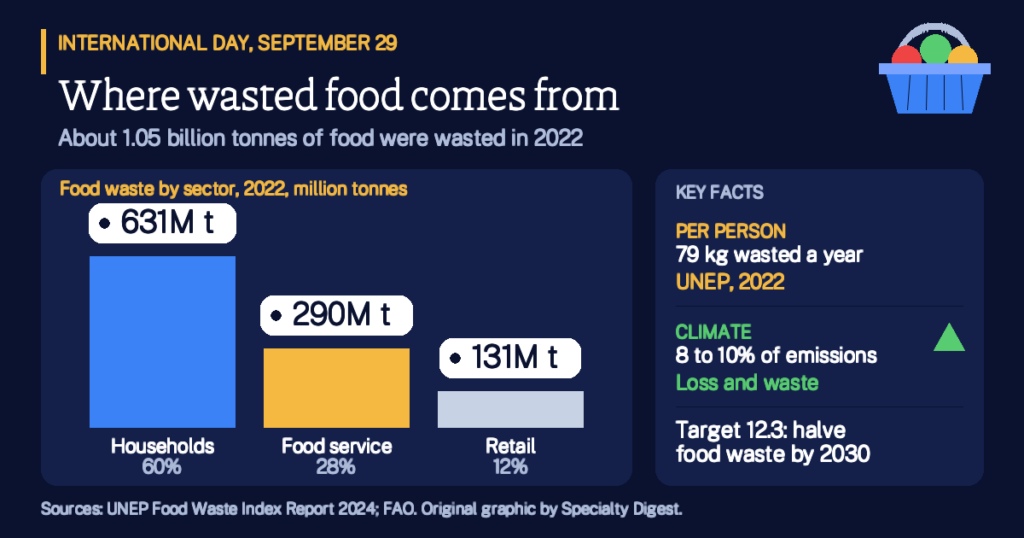
UNEP’s Food Waste Index Report 2024 found that 1.05 billion tonnes of food went to waste in 2022, an average of 79 kilograms for every person on Earth. About 19 percent of the food available to consumers was wasted at the retail, food service and household levels. On top of that, about 13 percent of food is lost in the supply chain between harvest and retail, an estimate attributed to FAO. UNEP describes the waste as roughly one billion meals every day.
Homes were the largest source. Households accounted for 631 million tonnes, about 60 percent of the total, followed by food service at 290 million tonnes and retail at 131 million tonnes.
- 1.05 billion tof food wasted worldwide in 2022
- 79 kgwasted per person in 2022
- 1 billionmeals wasted every day, by UNEP’s description
- 8 to 10%of global greenhouse gas emissions come from food loss and waste
The money is large too. FAO puts the value of food lost between harvest and retail at about US$400 billion a year (2019), and UNEP puts wasted food at more than US$1 trillion a year (2024). In 2020, FAO noted that losses for fruits and vegetables exceed 20 percent.
Example 1: the grocery bill. Imagine a family of four that spends $800 a month on food and wastes about one-fifth of it. That is roughly $160 a month, or $1,920 a year, thrown away. The numbers are round and illustrative, but they show how a small habit adds up.
Why hunger and climate are part of the story
FAO figures published in 2026 put hunger at between 608 million and 696 million people in 2025, about one in thirteen, and say about 2.69 billion people could not afford a healthy diet. Wasted food will not simply be shipped to those who need it. Still, a food system that loses less needs less land, water and energy for the same harvest, and that matters for supply and prices. The OECD-FAO Agricultural Outlook 2024 to 2033 estimates that halving food loss and waste would cut the number of undernourished people by 153 million by 2030 and cut agricultural emissions by 4 percent.
Climate is the other thread. Food loss and waste contributes an estimated 8 to 10 percent of global greenhouse gas emissions, and FAO estimates that food never eaten uses 28 percent of the world’s agricultural land, about 1.4 billion hectares (2013). Growing food that no one eats means spending resources for nothing.
Example 2: the tomato farmer. Suppose a farmer harvests 10 tonnes of tomatoes, and without cool storage 2 tonnes spoil before sale. At an illustrative $300 per tonne, that is $600 of lost income, plus the water, seed and labor already spent. A simple shaded storage shed could change that picture.
Who bears the cost
Every country wastes food, but the costs fall unevenly. Smallholder farmers lose income when crops spoil before sale. Low-income households spend a large share of their budgets on food, so every discarded meal matters more. Cities and municipalities pay to collect and treat the waste. And everyone shares the climate bill. Loss tends to dominate where storage and transport are weakest, while waste dominates where food is cheap and plentiful, which is why a single remedy never fits all places.
How the day is marked and what progress needs
FAO and UNEP use the day to bring governments, businesses and communities together around the target. The 2024 event stressed the critical need for financing, and the 2026 theme looks at what reducing loss and waste can unlock. Governments can measure their own losses and waste, invest in cold chains and set targets. Businesses can improve forecasting, packaging and date labels. Households can plan meals, store food properly and use leftovers.
Example 3: a school canteen. Say a canteen serves 500 meals a day and 10 percent comes back uneaten, or 50 meals. Over a 180-day school year that is 9,000 meals. Halving the waste with better portion sizes would save 4,500 meals. The numbers are round and illustrative, and they mirror the logic of target 12.3.
- 2020Ensuring food security for all
- 2022Efficient use of natural resources and climate change mitigation
- 2024Climate finance for FLW reduction
- 2025Expansion and strengthening of stakeholder efforts
- 2026Transformative Potential of Reducing Food Loss and Waste
Key Takeaways
- Loss and waste are two problems. Loss happens from harvest to retail; waste happens at shops, restaurants and homes.
- The scale is huge. About 1.05 billion tonnes of food were wasted in 2022, or 79 kilograms per person.
- Homes lead. Households were about 60 percent of the waste, so daily habits matter.
- Climate is at stake. Food loss and waste contributes an estimated 8 to 10 percent of global greenhouse gas emissions.
- Hunger makes it urgent. Hundreds of millions of people go hungry while food is lost and wasted.
- The goal is clear. Target 12.3 aims to halve per capita food waste at retail and consumer levels by 2030 and cut losses along supply chains.
- Small steps count. Plan meals, store food well and ask how your school, workplace or shop handles surplus.
How solid is this? Waste figures are modeled estimates from UNEP’s 2024 report using 2022 data, and the loss share is an FAO estimate that is revised over time. The 2026 theme is as listed by FAO. The three worked examples use round, made-up numbers to show an idea. See also the International Days hub and the International Days Calendar.
More in Society
- UN General Assembly. International Day of Awareness of Food Loss and Waste, resolution 74/209 (adopted December 19, 2019).
- FAO. International Day of Awareness of Food Loss and Waste.
- FAO. Food Loss and Food Waste.
- FAO. Tackling food loss and waste from the farm to the table and beyond (September 27, 2024).
- UN News. With 783 million people going hungry, a fifth of all food goes to waste (March 2024), reporting the UNEP Food Waste Index Report 2024.
- UNEP. Food Waste Index Report 2024.
- UN News. Food loss and waste ‘an ethical outrage’, UN chief says on International Day (September 2020).