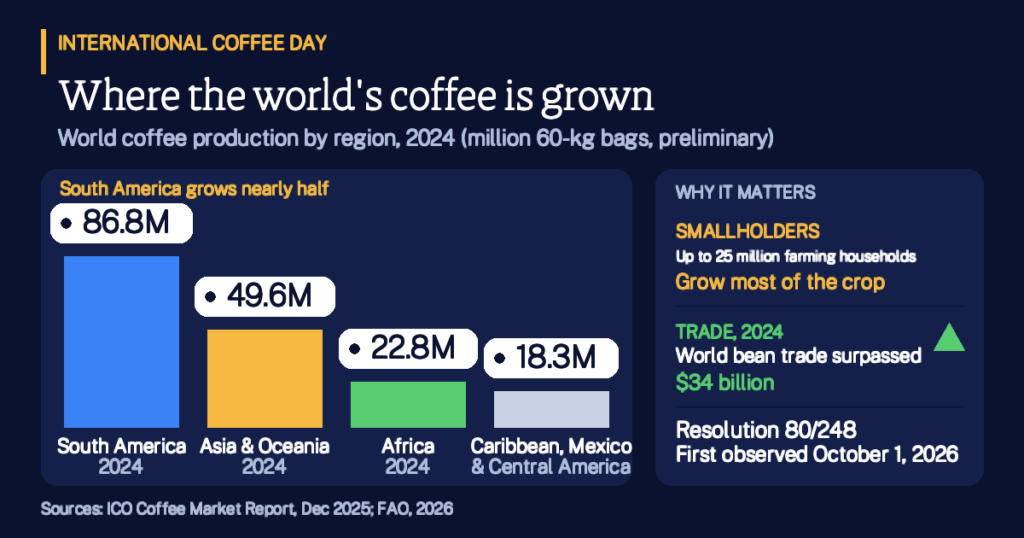
Every morning, hundreds of millions of cups are poured from a crop that most drinkers never see growing. Behind each cup stand farming families, often on small plots, who carry the risks of weather, pests and price swings. International Coffee Day, observed every year on October 1, was created to put those people and that crop in view. It is one of the newest days on the United Nations calendar: the first official observance took place on October 1, 2026.
A day that took more than a decade to reach the United Nations
The date did not begin at the UN. In 2014, members of the International Coffee Organization (ICO) agreed to observe a common International Coffee Day on October 1. For years it was a trade and community celebration. In 2025, the Food and Agriculture Organization (FAO) Conference, at its 44th session, adopted a proposal for a UN day and sent it on for consideration by the General Assembly.
On March 10, 2026, the General Assembly adopted resolution A/RES/80/248 and designated October 1 as International Coffee Day. FAO welcomed the decision and was invited to help organize the observance together with relevant organizations, in particular the ICO.
What the resolution says
The resolution recognizes the cultural, social and historical significance of coffee. It also ties the crop to four Sustainable Development Goals: no poverty (SDG 1), zero hunger (SDG 2), gender equality (SDG 5), and decent work and economic growth (SDG 8). It calls on governments, international organizations, civil society, Indigenous Peoples, local communities, businesses and academia to share knowledge and work toward a fairer, more resilient and more sustainable coffee sector.
The UN’s observance page points to the Coffee Cultural Landscape of Colombia, recognized by UNESCO, as one example of how growing coffee shapes landscapes and ways of life. The first observance also coincided with the International Year of the Woman Farmer 2026, a fitting match for a crop whose work is shared across whole households.
Counting the cup: what the numbers say
Coffee is a large, global commodity. FAO reports that world production exceeded 11 million tonnes in 2024, that about 8 million tonnes were traded internationally, and that the value of production was roughly $25 billion. World trade in coffee beans surpassed $34 billion that year. The European Union and the United States are the largest importing and consuming markets, while Brazil and Viet Nam together account for nearly half of world production.
The ICO counts in 60-kilogram bags. Its December 2025 report shows production reaching a preliminary 177.5 million bags in 2024, up 5.2 percent, while consumption was 175.1 million bags, up 1.4 percent. In the three years before, consumption ran ahead of production each time, a cumulative shortfall of 17.91 million bags.
- 25 millionfarming households, up to, according to FAO
- 11 million tonnesworld coffee production in 2024, FAO
- $34 billionworld trade in coffee beans in 2024, FAO
- 117.3 millionbags drunk in importing countries in 2024, ICO
Example 1: how many cups in a bag. Suppose one cup uses 10 grams of roasted coffee. A 60-kilogram bag then makes about 6,000 cups. At that round rate, a harvest of 175 million bags could pour roughly one trillion cups. The numbers are illustrative, but they show how much daily life rests on a crop grown by families far from where it is drunk.
Who grows it, and who is left holding the risk
FAO says the coffee sector supports the livelihoods of up to 25 million farmers and their families, and that smallholders produce about 80 percent of the world’s coffee. UN materials note that estimates vary depending on whether sources count farmers, farms, households or farming families, so treat the figure as a good guide rather than a census. The UN also notes that smallholders often capture only a limited share of the value created along the chain.
For some countries coffee is also a national lifeline. In 2024 it made up 27.9 percent of all merchandise exports in Ethiopia, 20.1 percent in Uganda and 19.5 percent in Burundi. In Ethiopia and Uganda, coffee export revenue exceeded the entire food import bill.
Example 2: a price swing on one small farm. Imagine a family that sells 20 bags a year. If the price falls by $20 per bag, income falls by $400. That may sound small, yet for a household with a few hectares and few other crops, it can decide whether school fees are paid. The figures are round and made up, but the exposure is real.
A crop under climate pressure
Coffee is sensitive to heat, rain and pests. The UN lists extreme temperatures, irregular rainfall, drought, excess rain, pests and disease among the pressures on growers, and the ICO has reported that El Nino and heavy rain in Brazilian growing areas affected prices and harvest expectations in 2026. FAO’s Director-General has cited projections that up to 50 percent of current coffee-growing areas may become unsuitable by 2050. That figure is a projection, not a measurement, and it shows why planting, shade, forests and water all matter to the future cup. The link between trees and crops is explored in International Day of Forests.
Example 3: a country’s exposure. Take an imaginary exporter with $5 billion in goods exports, 20 percent of them coffee, or $1 billion. A 10 percent fall in coffee earnings would cost $100 million, enough to strain the budget for imports, health and schools. This is a round illustration, not a forecast for any country.
How the day is marked, and what progress needs
The inaugural observance was held at FAO headquarters in Rome under the title Celebrating Coffee, Honouring the People Behind Every Cup. FAO work in Honduras, Guatemala and Uganda has also reached more than 200,000 smallholders with traceability efforts. In Rwanda, an assessment cited by the UN found that sales doubled among participating farmers and that their income rose 32 percent. Progress, in short, tends to come from better organization, fairer access to markets, and support for women and young people in the work.
Before the UN day, the ICO had already used the date for its own yearly themes:
- 2021Coffee’s Next Generation
- 2023Joining forces for a safer coffee supply chain
- 2024Collaboration: Coffee, Your Daily Ritual, Our Shared Journey
- 2026Celebrating Coffee, Honouring the People Behind Every Cup (event title)
For consumers the day is a prompt to ask a simple question: who grew this, and did they share fairly in its value?
Key Takeaways
- It is a new UN day. Resolution A/RES/80/248 of March 10, 2026 made October 1 International Coffee Day, first observed in 2026.
- The goals are broad. The resolution links coffee to poverty, hunger, gender equality and decent work.
- The crop is huge. FAO counts over 11 million tonnes produced and over $34 billion traded in 2024.
- Smallholders carry it. Up to 25 million farming households grow most of the world’s coffee, often with little share of the value.
- Some economies depend on it. Coffee was 27.9 percent of Ethiopia’s goods exports in 2024.
- Climate is the long-term risk. FAO cites projections that up to half of current growing areas could become unsuitable by 2050.
- Ask where your cup comes from. Fairer chains start with informed buyers.
How solid is this? FAO reports tonnes and the ICO reports 60-kg bags, so the two are different measures and are not directly comparable. Farmer counts vary by definition, the 2024 ICO figure is preliminary, and the 2050 figure is a projection. The three worked examples use round, made-up numbers. See also the International Days hub and the International Days Calendar.
More in Society
- United Nations, International Coffee Day (observances page)
- FAO, FAO welcomes UN resolution instituting International Coffee Day (March 2026)
- FAO, First UN International Coffee Day celebrates the people behind every cup (October 2026)
- FAO, Coffee (key facts)
- FAO Director-General, Transforming the global coffee value chain (July 2025)
- International Coffee Organization, Coffee Market Report, December 2025
- International Coffee Organization, International Coffee Day