Every October the world looks up on purpose. World Space Week, held from October 4 to 10, is a global celebration of space science and technology that its organizers call the world’s largest space event, and it carries the formal backing of the United Nations. It asks ordinary people a simple question: what has the journey beyond our atmosphere done for life on Earth, and what should it do next? Like World Water Day, it turns a technical subject into a public conversation, open to classrooms, clubs, museums and families.
Two anniversaries, one week
The week is bracketed by two anniversaries. October 4 marks the 1957 launch of Sputnik 1, the first human-made Earth satellite, which opened the space age. October 10 marks the 1967 entry into force of the Treaty on Principles Governing the Activities of States in the Exploration and Use of Outer Space, which the UN’s observance page calls the “Magna Carta of Space.” One date celebrates what technology made possible. The other celebrates the idea that activity in space should follow shared rules.
Between those two dates the story moves quickly. A human first orbited the Earth on April 12, 1961, when Yuri Gagarin made his flight. The United Nations has kept a Register of Objects Launched into Outer Space since 1962, and the Registration Convention, which strengthened that duty, entered into force in 1976. The Week itself came later, as a way to bring all of this out of laboratories and treaty rooms and into public life.
Example 1: a school plans its week. Imagine a school of 400 students that gives every class one hour during the Week for a space project, with ten classes running one project each. That is about 400 student hours devoted to a single idea in five days. The numbers are round and illustrative, but they show how a modest plan, repeated by thousands of organizers, builds a worldwide event.
How the United Nations made it official
On December 6, 1999, the General Assembly adopted resolution 54/68 and proclaimed World Space Week, to be held each year from October 4 to 10. The World Space Week Association notes that the declaration came in 1999 and points to the report of the Third United Nations Conference on the Exploration and Peaceful Uses of Outer Space, known as UNISPACE III, as the document in which the Week was founded. Guidance comes from the Committee on the Peaceful Uses of Outer Space and its secretariat, the UN Office for Outer Space Affairs (UNOOSA), based in Vienna.
Each year the Association’s board, working with UNOOSA, chooses a theme. The themes show how the conversation has widened, from unity in 2018, to sustainability in 2022, to climate in 2024, to life beyond Earth in 2025.
- 2018Space Unites the World
- 2022Space and Sustainability
- 2024Space and Climate Change
- 2025Living in Space
The Week in numbers
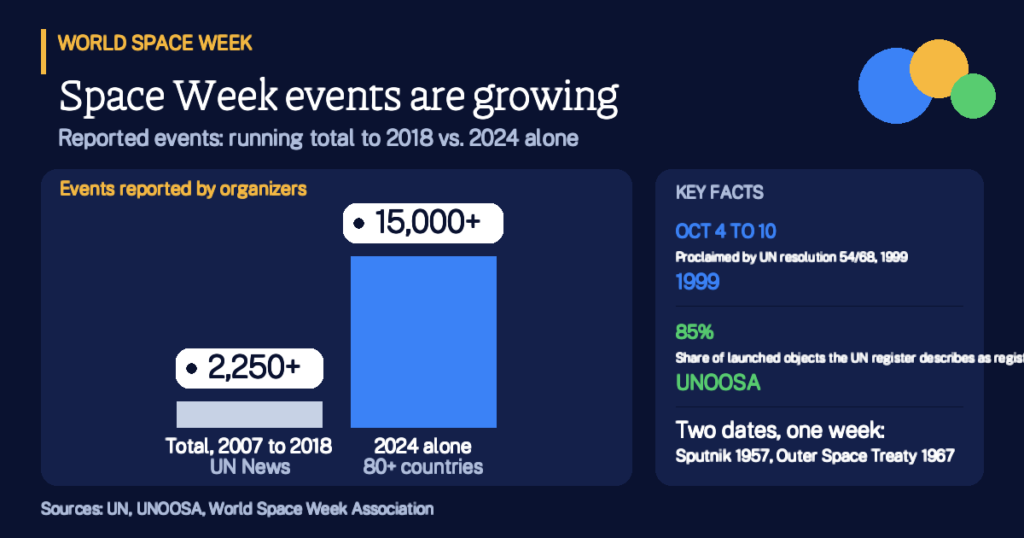
Growth is the clearest sign that the idea has traveled. UN News reported in 2018 that since 2007 more than 94 nations had taken part in more than 2,250 Space Week events, drawing more than 1.3 million attendees. In 2024, the Week’s 25th anniversary, the Association told the UN’s Scientific and Technical Subcommittee that more than 15,000 events were held in over 80 countries. Pakistan reported the most events, followed by Saudi Arabia, Ireland, Croatia, Romania and Turkey.
- 15,000+events in 2024
- 80+countries took part in 2024
- 25years since resolution 54/68, marked in 2024
- 25+UN entities and the World Bank Group routinely use space applications
Example 2: what the average hides. Divide 15,000 events by 80 countries and you get roughly 190 events per country. That is a round, illustrative average. The real picture is uneven, since a few countries reported far more events than others, which is exactly why the Association names its top performers. Averages help you picture scale, but they never replace the country-by-country list.
The rulebook behind the rockets
A celebration of space would be incomplete without the rules that make it shared. Since 1962 the United Nations has maintained a Register of Objects Launched into Outer Space, and UNOOSA keeps it today. The register page states that approximately 85 percent of all satellites, probes, landers, crewed spacecraft and space station flight elements launched into Earth orbit or beyond have been registered with the Secretary-General. The page gives no year for that share, so it should be read as the UN’s own description of the register rather than a dated measurement.
Example 3: reading the register. Suppose 100 spacecraft were launched in some period. At the UN’s described share, about 85 would appear in the register and about 15 would not. The numbers are round and made up for illustration. The point is that a register is only as useful as its coverage, so every missing entry is a small gap in the public record of who put what in orbit.
Why it matters beyond the launch pad
Space is not a distant hobby. According to the UN observance page, at least 25 United Nations entities and the World Bank Group routinely use space applications in their work. The UN’s page also reminds readers that the Week is a chance to see how these tools serve sustainable development. When the 2024 theme was Space and Climate Change and the 2022 theme was Space and Sustainability, the message was the same: the view from orbit is a tool for people on the ground.
The 2025 theme, Living in Space, looked ahead. The Association described it as the growing reality of sustained human presence beyond Earth. Whatever the future holds, the 1967 treaty and the register show that the world has already agreed on one principle, that activity in space is a matter for shared rules and shared records.
How the Week is marked
There is no single ceremony. Organizers, from schools to science centers, register their own events, and the Association’s website keeps a public event list sorted by country and year. Anyone can join: attend an event, host a small one, or simply spend an evening looking at the sky. The theme for each year is announced in advance by the Association and UNOOSA. A confirmed 2026 theme was not found in the sources reviewed for this article, so check the UNOOSA World Space Week page for the current one.
Key Takeaways
- Two dates frame the Week. October 4 recalls Sputnik 1 in 1957 and October 10 recalls the Outer Space Treaty entering into force in 1967.
- It is an official UN observance. The General Assembly proclaimed it in resolution 54/68 on December 6, 1999.
- It has grown a great deal. More than 15,000 events in over 80 countries were reported for 2024, against 2,250 total events reported from 2007 to 2018.
- Themes track the times. They moved from unity to sustainability, climate and living in space between 2018 and 2025.
- Shared rules matter. The UN has kept a register of space objects since 1962, and approximately 85 percent of launched objects are described as registered.
- Space serves Earth. At least 25 UN entities and the World Bank Group routinely use space applications.
- Anyone can take part. Find an event, host one, or look up and ask what space is for.
How solid is this? Dates, the resolution number and the themes come from UN and UNOOSA pages. The event counts come from UN News (2018) and a 2025 statement by the World Space Week Association, so they are organizer-reported, and the two numbers measure different things. The 85 percent register figure carries no date on the UN page. The three worked examples use round, made-up numbers. See the International Days hub and the International Days Calendar.
More in Science
- United Nations, World Space Week observance page
- UNOOSA, World Space Week
- World Space Week Association, UN-Declared
- UN News, Marking World Space Week (October 4, 2018)
- World Space Week Association, statement to the COPUOS Scientific and Technical Subcommittee (2025)
- UNOOSA, United Nations Register of Objects Launched into Outer Space