Polio once filled hospital wards with children who could no longer walk, and in much of the world it has almost vanished. That change did not happen by luck. It happened because billions of vaccine doses were delivered, often door to door, by health workers and volunteers. World Polio Day, observed every year on October 24, asks a simple question: since we have come this close, how do we finish the job? It pairs naturally with World Toilet Day, because poliovirus spreads where sanitation is poor.
A day built on a birthday
World Polio Day was established by Rotary International to commemorate the birth of Jonas Salk, who led the first team to develop a vaccine against poliomyelitis. Unlike many days in this series, it is not a General Assembly designation. It is an awareness day led by Rotary, with strong support from the World Health Organization (WHO) and other partners in the Global Polio Eradication Initiative (GPEI).
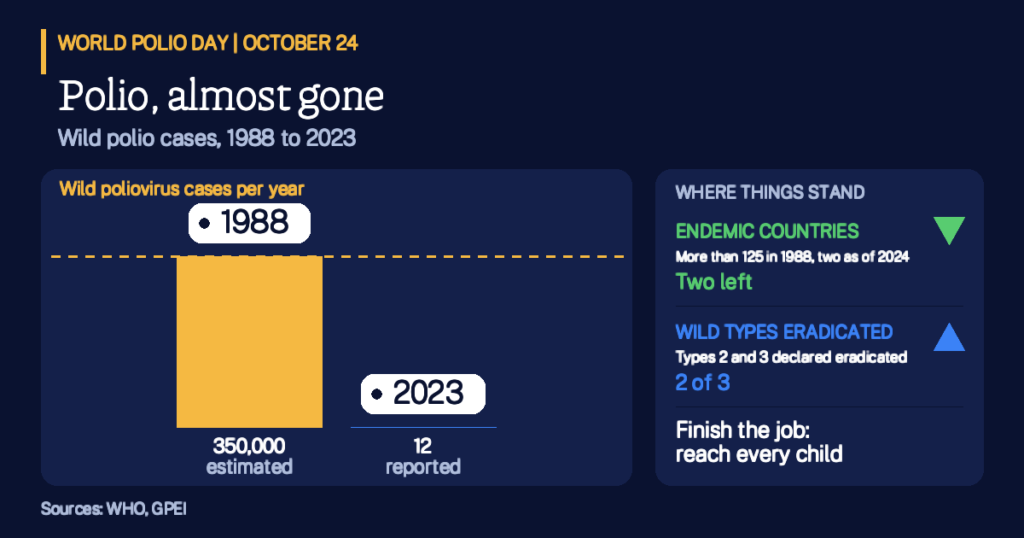
The background is a decision taken decades ago. In 1988, the World Health Assembly adopted a resolution for the worldwide eradication of polio, which launched the GPEI. At that time, polio was estimated to paralyze about 350,000 people a year in more than 125 endemic countries. October 24 gives the campaign a yearly moment to report progress and ask for the final push.
What polio is, and why it frightens
Polio is caused by a virus that spreads from person to person, mainly through the fecal-oral route. Most people who catch it have no symptoms, which is exactly why it travels quietly. But in a small share of cases the damage is permanent. According to WHO, one in 200 infections leads to irreversible paralysis, usually in the legs. Among those who are paralyzed, 5 to 10 percent die when their breathing muscles become immobilized.
Example 1: the quiet outbreak. Imagine 10,000 children in a district are infected over one season. At the one-in-200 ratio, about 50 would be paralyzed, yet the other 9,950 would show little or nothing. Health workers would see only the visible tip, so by the time the first paralyzed child is reported, the virus has already moved well beyond that village. The numbers are round and illustrative, but they explain why surveillance matters.
There is no cure for polio. It can only be prevented. The polio vaccine, given multiple times, can protect a child for life. Two vaccines are in use, the oral polio vaccine and the inactivated polio vaccine, and WHO describes both as effective and safe.
The numbers behind the day
The scale of progress is hard to overstate. WHO reports that cases due to wild poliovirus have fallen by over 99 percent since 1988. GPEI counts 12 reported wild cases in 2023, compared with the estimated 350,000 in 1988. As of 2024, wild poliovirus type 1 remains endemic in two countries, Pakistan and Afghanistan.
- 350,000estimated cases a year in 1988
- Over 99%drop in wild polio cases since 1988
- 12wild cases reported in 2023
- 20 million+people able to walk who would otherwise be paralyzed
There are three types of wild poliovirus, and two have been beaten. Type 2 was last detected in India in 1999 and was declared eradicated in September 2015. Type 3 has not been detected anywhere since 2012, and the independent Global Commission for the Certification of Poliomyelitis Eradication declared it globally eradicated, an announcement made on World Polio Day in 2019. Agencies date the type 3 milestone to 2019 or 2020, so we cite the announcement and the last detection. Only type 1 is left in the wild.
Example 2: why almost is not enough. Suppose a country of 20 million children reaches high coverage, and a few pockets of 1,000 children stay unvaccinated. A single imported infection in one pocket can still spark paralysis there and seed spread to nearby areas. The figures are made up for illustration, but this is why eradication means reaching every child, not most children.
A world map turning polio-free
WHO certifies progress one region at a time. The Americas were certified polio-free in 1994, the Western Pacific in 2000, and the European Region in June 2002. The South-East Asia Region followed on March 27, 2014, and in 2020 Africa became the fifth region to be certified wild poliovirus-free.
Why the last mile is the hardest
Three things make the finish difficult. First, the virus hides in silent infections. Second, it persists where children are hard to reach, whether because of insecurity, remote geography or weak health services. Third, the oral vaccine can, in rare cases and under low immunity, lead to vaccine-derived poliovirus. For example, an outbreak of circulating vaccine-derived poliovirus type 2, detected in Syria in 2017, was declared over in December 2018, and over 1.5 million vaccine doses were given in north-western Syria as part of the response. The answer to that risk is more and better vaccination, not less.
Polio also remains a Public Health Emergency of International Concern under the International Health Regulations, and WHO’s Polio IHR Emergency Committee keeps meeting to review the situation, most recently with a statement dated November 13, 2026. For the public, the practical meaning is simple: travel and surveillance rules remain in place until the risk is gone.
Why finishing pays off
WHO says eradication would save at least US$40 to 50 billion, mostly in low-income countries. The human gain is larger still. More than 20 million people are able to walk today who would otherwise have been paralyzed. Polio campaigns have also carried other help: WHO estimates that about 1.5 million childhood deaths have been prevented through vitamin A given during polio immunization activities.
Example 3: the value of a missed dose. A child needs several polio doses to be fully protected. If a family attends three of four scheduled visits because the clinic is far away, the child may be only partly protected, and a community with many such children is easier for the virus to enter. If outreach teams cover that last visit for 100 families, the whole neighborhood gains. The numbers are illustrative, but they show why the unglamorous work of follow-up carries the program.
How the day is marked, and what you can do
Rotary clubs mark October 24 with immunization drives, fundraising and community events such as collective walks, while WHO and GPEI use the date to report progress and urge continued funding. Individuals can help in simple ways: check that their own children are fully vaccinated, support vaccination workers and campaigns, and share accurate information about the vaccine.
Key Takeaways
- The day honors a vaccine pioneer. Rotary International created it to commemorate the birth of Jonas Salk.
- Progress is enormous. Wild polio cases have fallen over 99 percent since 1988, from an estimated 350,000 to 12 reported in 2023.
- Two of three wild types are gone. Types 2 and 3 are eradicated, and type 1 remains endemic only in Pakistan and Afghanistan as of 2024.
- Most infections are silent. One in 200 causes irreversible paralysis, so surveillance has to look past visible cases.
- There is no cure, only prevention. Multiple vaccine doses can protect a child for life.
- Every child counts. A few unprotected pockets can keep a virus alive anywhere.
- The payoff is large. Finishing the job would save at least US$40 to 50 billion and keep millions of children walking.
How solid is this? Figures come from the WHO fact sheet and GPEI pages, and each is dated where a date was available. The 1988 baseline is an estimate, and case counts are revised as laboratories report. Sources differ by a year on when type 3 was formally declared eradicated. The three worked examples use round, made-up numbers to show an idea. See also World Toilet Day, the International Days hub and the International Days Calendar.
More in Health
- WHO, Poliomyelitis fact sheet (2025)
- WHO, Poliomyelitis questions and answers
- Global Polio Eradication Initiative, About Polio
- GPEI, Polio Today general fact sheet
- WHO Europe, World Polio Day marks a major milestone (2019)
- WHO, Statement of the Forty-sixth Meeting of the Polio IHR Emergency Committee (2026)