Most people think about transport only when it fails: a late bus, a jammed road, a flat tire. Yet the way people and goods move shapes almost everything else, from the air in a city to whether a child can reach school or a farmer can reach a market. World Sustainable Transport Day, observed every year on November 26, asks the world to treat movement as a system that must be safe, affordable, accessible and kind to the climate. It belongs with other days that tie everyday life to global goals, such as World Children’s Day, because the most basic rights, health, learning and work, all depend on being able to get somewhere.
From a conference to a United Nations day
The idea grew out of a series of global meetings. The first Global Sustainable Transport Conference took place in Ashgabat, Turkmenistan, on November 26 and 27, 2016, and the second followed in Beijing, China, on October 14 to 16, 2021. Later, in resolution A/RES/77/286, the General Assembly decided to declare November 26 as World Sustainable Transport Day. It invited governments, the UN system and other stakeholders to mark the day through education and events that raise public knowledge about sustainable transport.
The stated purpose is broad. The day recognizes the role of safe, affordable, accessible and sustainable transport systems in supporting economic growth, improving social welfare and strengthening cooperation and trade among countries. It also has a companion effort: the UN Decade of Sustainable Transport, declared in 2023 to begin in 2026. Its implementation plan, developed by the UN Department of Economic and Social Affairs with the regional commissions, was launched at UN Headquarters in New York on December 10, 2025.
What “sustainable transport” really means
The phrase is easy to misread as “electric cars.” The definition is wider. A 2016 report by the Secretary-General’s High-level Advisory Group describes sustainable transport as the provision of services and infrastructure for the mobility of people and goods. It should be safe, affordable, accessible, efficient and resilient. Notice how many of those words have nothing to do with fuel. A cheap bus that is unsafe fails the test, and so does a clean train that few people can reach or pay for.
The numbers behind the day
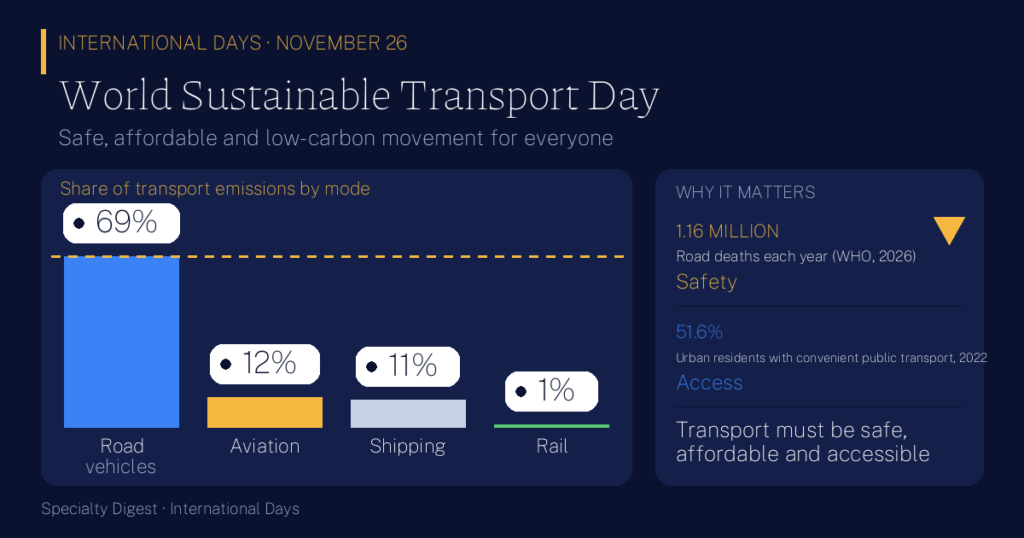
Transport accounts for roughly 15 percent of total greenhouse gas emissions, making it the fourth largest source, according to UN climate fast facts that draw on the IPCC. Road transport makes up about 69 percent of all transport emissions, aviation about 12 percent, shipping about 11 percent and rail about 1 percent. The same UN source notes that since 2010 the sector’s emissions have increased faster than those of any other end-use sector, and that without action they could grow by up to 65 percent by 2050.
The International Energy Agency adds a sense of scale and of dependence. Global carbon dioxide emissions from transport grew by more than 250 million tons in 2022 to nearly 8 billion tons, and the sector still relies on oil products for nearly 91 percent of its final energy.
Example 1: the commuter switch. The UN reports that shifting from cars to public transportation can cut up to 2.2 tons of carbon emissions per person each year. Suppose a city persuades 1,000 drivers to switch. That would be about 2,200 tons a year, the upper end of what each switch can save. The numbers are round and illustrative, but they show how small daily choices add up when a city makes the better option easy.
Safety: the quiet crisis on every road
Transport is also a public health question. The World Health Organization estimates that approximately 1.16 million people die each year in road traffic crashes, according to its fact sheet updated in July 2026. Road traffic injuries are the leading cause of death for children and young adults aged 5 to 29. More than half of all road deaths are among vulnerable road users, including pedestrians, cyclists and motorcyclists.
The burden is uneven. About 92 percent of road deaths occur in low- and middle-income countries, which hold around 60 percent of the world’s vehicles. The Decade of Action for Road Safety 2021 to 2030 aims to cut road deaths and injuries by at least 50 percent by 2030, and General Assembly resolution A/RES/74/299 sets the same goal of halving them.
Who is left behind
Access is the other half of the story. UN data from 2022, covering 1,507 cities in 126 countries, show that only 51.6 percent of the global urban population has convenient access to public transport. In practice, that means almost half of city residents face longer, costlier or riskier trips to work, school and clinics. A 2023 World Bank blog adds that globally about 1 billion people live at least 2 kilometers away from a good road.
- 1.16 millionroad deaths each year, WHO fact sheet, July 2026
- 51.6%of urban residents with convenient public transport, 2022
- 1 billionpeople at least 2 km from a good road, World Bank blog, 2023
- 91%of transport energy still from oil products, IEA
Example 2: the distant road. Imagine a farm family that lives 5 kilometers from the nearest road that works year-round. If rains cut off the track for three months a year, a quarter of their selling season is lost, and so are chances to reach a clinic in time. The numbers are made up for illustration, but this is the kind of cost the figure of 1 billion people hides.
Women, children, older people and people with disabilities feel these gaps most. A bus stop without a safe path, a fare that eats a large part of a wage, or a train without step-free access can shut someone out of work or school entirely. The UN describes sustainable transport as a cross-cutting accelerator for goals on poverty, inequality, gender empowerment and climate, which is why one day covers so many concerns.
How the day is marked, and what progress needs
The General Assembly asked for education and events, and the UN page suggests simple actions such as riding a bike. Real progress, though, depends on decisions made far from any single day: planning cities so that homes, jobs and schools are close together, funding reliable and safe public transport, protecting people on foot and on bicycles, and moving freight and aviation toward cleaner fuels. Battery-electric vehicles charged with low-carbon electricity have lower lifecycle emissions than internal combustion vehicles, but cleaner cars alone do not fix crowding, safety or access.
Example 3: one bus lane. Picture a bus carrying 50 riders. If each of those riders would otherwise travel alone in a car, that bus replaces about 50 cars on the road. Even if cars usually carry more than one person, the space and fuel savings are large. The figures are rounded and illustrative, but they explain why dedicated bus lanes and safe walking routes are among the cheapest ways to move more people with less harm.
Key Takeaways
- Sustainable means more than green. The UN definition asks transport to be safe, affordable, accessible, efficient and resilient.
- Transport is a climate lever. It accounts for roughly 15 percent of greenhouse gas emissions, and road vehicles produce about 69 percent of that.
- Safety is part of sustainability. About 1.16 million people die on roads each year, and crashes lead deaths for ages 5 to 29.
- The risk is uneven. Low- and middle-income countries have around 60 percent of vehicles but 92 percent of road deaths.
- Access is unfinished. Only 51.6 percent of city residents had convenient public transport in 2022.
- Daily choices count. The UN estimates that switching from cars to public transportation can save up to 2.2 tons of carbon per person each year.
- Planning beats patching. Safer streets, reliable transit and compact cities help everyone at once, and the Decade of Sustainable Transport starting in 2026 is built to push that agenda.
How solid is this? Emission shares come from a UN fast-facts sheet citing the IPCC and carry no stated reference year, and the personal carbon savings are the UN page’s upper-end estimates. Road death figures are WHO estimates, and the public transport figure is a 2022 UN indicator. The three worked examples use round, made-up numbers to show an idea. See also the International Days hub and the International Days Calendar.
More in Society
- United Nations, World Sustainable Transport Day (resolution A/RES/77/286)
- United Nations, Fast Facts: Climate and Transport (citing IPCC)
- World Health Organization, Road traffic injuries fact sheet (July 2026)
- United Nations, Sustainable Development Goals Report 2023, Goal 11
- International Energy Agency, Transport
- World Bank, Sustainable transport for a livable future (2023)