Chess has no ball, no field and no electricity requirement. It needs two people, a board and a willingness to think a few moves ahead. That simplicity is why a game with roots in antiquity is played in schools, prisons, refugee camps and online servers on every continent. World Chess Day, observed each year on July 20, is the United Nations’ way of saying that a game can carry real public value. It sits comfortably beside the International Day of Play, which makes a similar case for the serious work that play does.
A day born of a federation
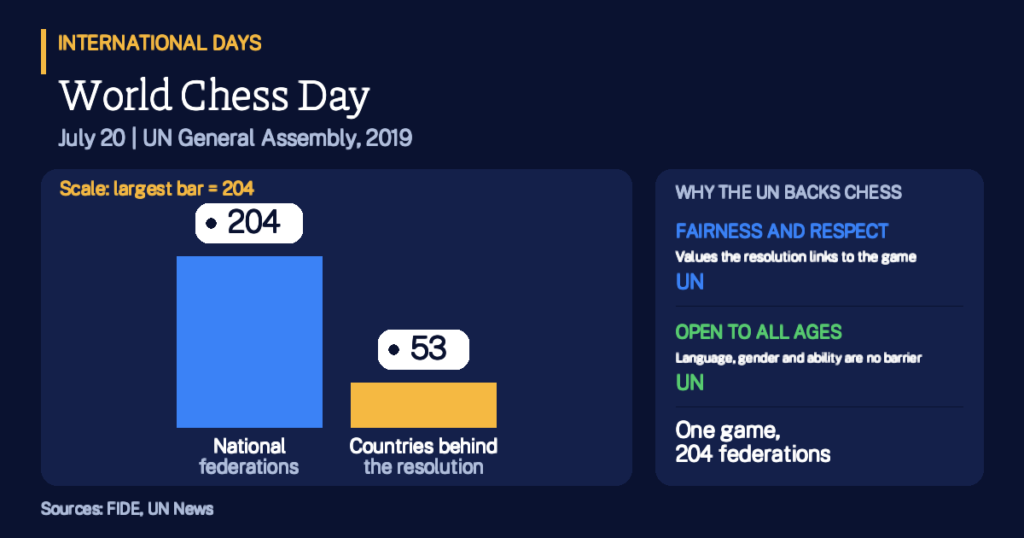
The date comes from a founding. The International Chess Federation, known by its French initials FIDE, was established in Paris in 1924. Its motto, “Gens una Sumus,” is Latin for “We are one family.” Today FIDE is based in Lausanne, was recognized by the International Olympic Committee in 1999, and counts 204 countries as affiliate members through their national chess federations.
According to FIDE, July 20 had been marked as World Chess Day since 1966, an idea that FIDE says was proposed by UNESCO. The step that made it a global observance came on December 12, 2019, when the UN General Assembly unanimously adopted a resolution proclaiming July 20 as World Chess Day, to mark the date of FIDE’s establishment in 1924. The text was tabled by Armenia and co-sponsored by 52 other countries, so 53 countries stood behind it.
What the United Nations sees in the game
The resolution is not about tournaments. As described by FIDE and UN News, it reflects on the power of chess to help people move beyond national boundaries and to break down racial, political and social barriers. It notes that because chess promotes fairness and mutual respect, it can contribute to an atmosphere of tolerance and understanding among peoples and nations.
It also ties the game to the 2030 Agenda for Sustainable Development, pointing to chess opportunities in strengthening education and health, empowering women and girls, and fostering solidarity, cooperation and peace. In the UN’s own words, chess is affordable, inclusive and can be played anywhere, across barriers of language, age, gender, physical ability and social status.
The numbers behind the day
Counting players is hard, because most games happen informally. UN News reported in 2021 that some 605 million adults play chess regularly, although the article did not name its source, so treat it as an estimate. Polls cited by FIDE in 2019 found a surprisingly stable 70 percent of adults in the United States, United Kingdom, Germany, Russia and India had played chess at some point in their lives. FIDE’s own description says more than 60 million games are played every day on average, with no year given.
These figures measure different things, so they should not be added together or compared line by line. Federation membership counts countries, the 605 million estimate counts regular adult players, and the poll counts people who have ever played. Together they say the game is widely known, but none of them says how many people have access to a board, a coach or the time to play.
- 204countries with a national chess federation in FIDE
- 53countries behind the 2019 UN resolution, Armenia plus 52 co-sponsors
- 605 millionadults who play regularly, UN News estimate, 2021
- 60 milliongames a day on average, per FIDE, year not stated
Example 1: a school club. Suppose a school of 500 students starts a chess club and 70 percent of the students already know the rules from home. That is about 350 students who could join a first meeting without a lesson. The numbers are round and illustrative, but they show why chess is easy to begin: many people already know the basics.
Why a board game matters to public life
The UN’s argument is practical. A set costs little, rules are the same everywhere, and a game needs no shared language. The 2020 UN News report on the first observance added a health angle, saying chess can be played safely indoors or online and can help reduce anxiety and improve mental health. Neither UN News article cites a study for that claim, so it is best read as the UN’s view of the game’s value, not a medical finding. The 2021 report also noted that interest in chess had reportedly doubled during the pandemic, again without a figure.
A game also teaches by consequence. Every move changes the position, and a mistake shows up quickly on the board, which is why many teachers value chess for practicing patience, planning and accepting a loss. Those are widely held teaching views rather than results measured in the sources above.
Example 2: learning to plan. Picture a student who plays one 20 minute game a day on school days. Over a 180 day school year that is 3,600 minutes, or 60 hours, spent weighing moves and living with the results. The figures are round and illustrative, but they show how a small daily habit adds up to real practice at thinking ahead.
Who gets a seat at the board
Chess is unusual among competitive pursuits because strength is not tied to size, speed or strength of body. A young player can face an older one, and people with different physical abilities can play on equal terms. That is the idea behind the resolution’s references to age, gender and physical ability, and its language on empowering women and girls. Inclusion is a goal rather than a guarantee, since access to coaches, sets and time still varies widely between and within countries.
Example 3: a community program. Imagine a library lends 20 chess sets and hosts a weekly open evening. If 30 neighbors of mixed ages attend and each pairs with someone new, that is 15 new pairings a week and about 600 over a 40 week year. The numbers are made up for illustration, but they show how cheap equipment can build connection.
How the day is marked
The United Nations has marked the day with events and publications. FIDE reported a high-level UN meeting titled “Chess for recovering better,” and the UN has issued stamps celebrating World Chess Day. Around the world, federations, schools and clubs hold tournaments, simultaneous exhibitions and online events on or near July 20. You can take part with a single game, a lesson for a beginner or a visit to a local club.
Key Takeaways
- The date is a founding anniversary. July 20 marks FIDE’s establishment in Paris in 1924.
- The UN made it official in 2019. The General Assembly proclaimed the day on December 12, 2019, after a text tabled by Armenia with 52 co-sponsors.
- The case is about values. The UN links chess to fairness, mutual respect, tolerance and understanding.
- The game is global. FIDE counts 204 national federations, and UN News estimated 605 million regular adult players in 2021.
- Inclusion is the promise. The UN describes chess as playable across barriers of language, age, gender, physical ability and social status.
- Health claims need care. UN News says chess can ease anxiety, but it cites no study.
- Taking part is easy. One game with a friend is enough to join in.
How solid is this? The founding date, the 2019 adoption and the sponsor counts come from FIDE and UN News. The 605 million figure is an unsourced estimate in a UN News article, the 70 percent figure comes from polls cited by FIDE, and the 60 million games a day carries no year. The three worked examples use round, made-up numbers. See also the International Days hub and the International Days Calendar.
More in Society
- FIDE, UN adopts July 20 as World Chess Day (2019)
- UN News, First-ever World Chess Day, helps calm nerves during COVID-19 pandemic (2020)
- UN News, Chess calms nerves, improves mental health amidst COVID crisis (2021)
- FIDE, About FIDE
- United Nations, World Chess Day observance page
- UN Digital Library, World Chess Day record