Most international days begin with a vote. This one began with a meeting. In 1992, hundreds of Black women gathered in one city, compared notes on the barriers they shared, and chose a date to keep the conversation going. More than three decades later the United Nations made that date official. July 25 is now the International Day for Women and Girls of African Descent, a day to recognize their contributions and to ask why so many of them still face double barriers, one tied to race and one tied to gender. Researchers call this overlap intersectionality, and the numbers below show why the idea matters.
A meeting in Santo Domingo
On July 25, 1992, around 300 women of African descent from 32 countries across Latin America and the Caribbean arrived at the First Meeting of Latin American and Caribbean Black Women in Santo Domingo, Dominican Republic. According to the UN human rights office (OHCHR), the gathering led to the creation of the Network of Afro-Latin American, Afro-Caribbean and Diaspora Women, known by its Spanish initials RMAAD. Its participants chose July 25 as the International Day of Afro-Latin American, Afro-Caribbean and Diaspora Women.
For years the date was kept by networks, activists and some agencies. In 2024 the UN General Assembly made it a day for the whole world. UN Women’s regional office for Latin America and the Caribbean cites the decision as resolution A/RES/78/323. The idea moved from a regional women’s movement to the global calendar.
What “African descent” means here
In Latin America and the Caribbean the common term is Afro-descendant. It refers to people descended from Africans, many of whom were brought to the Americas through the transatlantic slave trade, and whose communities have shaped the music, food, language and economies of the region for centuries. The day is not only about the past. It sits inside a larger UN effort: the first International Decade for People of African Descent ran from 2015 to 2024, and OHCHR reports that a Second International Decade, 2025 to 2034, was proclaimed on December 17, 2024. The day for women and girls gives that long agenda a sharper focus.
The numbers behind the day
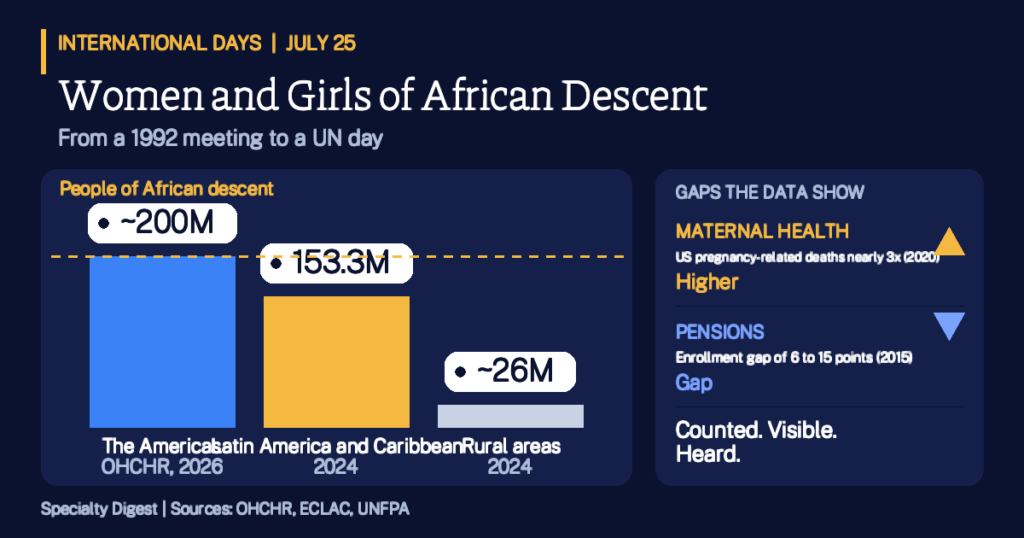
OHCHR describes the Americas as home to around 200 million people of African descent. For Latin America and the Caribbean, an FAO and ECLAC study (2025) puts the Afro-descendant population at 153.3 million as of 2024, or 23.3 percent of the total, and about 26 million of them live in rural areas. The same report also gives a figure of 23.7 percent from an earlier source, a reminder that population counts depend on the survey and the year.
Work, pay and old age
A landmark ECLAC study, Afrodescendent Women in Latin America and the Caribbean: Debts of Equality (2018), documents how race and gender stack up in the labor market. In Ecuador, it reports, one out of every five women of African descent works as a domestic servant (2010 data). Domestic work is often informal, which can mean no contract, no sick pay and no pension. The same study finds that the gap in pension enrollment between employed Afro-descendants and others runs from 6 percentage points in Ecuador to nearly 15 points in Brazil (2015).
- 153.3 millionAfro-descendants in Latin America and the Caribbean, 2024
- 1 in 5Afro-descendant women in Ecuador work as domestic servants, 2010
- 6 to 15 pointspension enrollment gap, from Ecuador to Brazil, 2015
- 93%of Brazil’s children and adolescents in domestic work are Afro-descendant girls, 2013
Example 1: what a 15-point gap means. Imagine 1,000 employed workers in each of two groups. In one group 700 are enrolled in a pension plan, and in the other 550 are. The gap is 15 points, which means 150 more workers in the second group will reach old age with no pension of their own. The numbers are round and illustrative, but the arithmetic shows how a small-sounding percentage becomes many real lives.
Health and the risk of giving birth
The UN Population Fund (UNFPA) published an analysis in 2023 of maternal health among women and girls of African descent in the Americas. It reports that pregnancy-related mortality is nearly three times higher for Afro-descendant women than for others in the United States (2020 data), 2.5 times higher in Suriname (2016 to 2017) and 1.6 times higher in Colombia (2020). In Latin America and the Caribbean as a whole, the maternal mortality ratio rose 15 percent between 2016 and 2020, and adolescent girls aged 15 to 19 had 60.7 births per 1,000 between 2015 and 2020.
Example 2: reading a ratio. Suppose a country records 20 pregnancy-related deaths per 100,000 births among one group of women. If another group faces a ratio nearly three times higher, the rate would be about 60 per 100,000. In a place with 100,000 births to that group each year, that is roughly 40 additional deaths. The rates are made up for illustration, and the point is that ratios hide real people.
Counted, visible, heard
Behind many gaps sits a quieter one: whether a group is counted at all. Counts move with how questions are asked. Panama’s census, for example, recorded 8.8 percent of people as Afro-descendant in 2010 and 31.7 percent in 2023, according to the FAO and ECLAC report. Where people are not counted, services and budgets may not reach them.
Example 3: why a count matters. Picture a rural district of 2,000 residents that mirrors the regional rural share of 22.5 percent. About 450 residents would be Afro-descendant. If a survey misses half of them, planners would see 225 people and may build a school, clinic or road for a community half the true size. The district is imaginary and the numbers are round, but the mechanism is the one that data advocates describe.
How the day is marked and what progress needs
UN Women’s Latin America and the Caribbean office lists priorities for the day: economic autonomy, care systems, ending structural racism, leadership participation and sustainable financing. For 2026 it organized a webinar on the full, equal and meaningful participation of Afro-descendant women and girls in achieving gender equality. Governments, universities, museums and community groups also use the day to hold talks, share histories and press for disaggregated data, meaning figures broken down by race and gender so gaps become visible. The day links closely to the International Day for the Elimination of Racial Discrimination.
Key Takeaways
- The day began with a meeting. About 300 women from 32 countries met in Santo Domingo on July 25, 1992, and the UN made the date official in 2024.
- The population is large. Latin America and the Caribbean have 153.3 million Afro-descendants, and the Americas about 200 million.
- Race and gender overlap. Barriers add up, from domestic work to pensions to health care.
- Work has gaps. One in five Afro-descendant women in Ecuador was a domestic servant in 2010, and pension gaps reached nearly 15 points in Brazil in 2015.
- Health risks differ. Pregnancy-related mortality is nearly three times higher for Afro-descendant women in the United States.
- Counting is power. Data broken down by race and gender shows who is left behind.
- Action continues. A Second International Decade runs from 2025 to 2034, so the day is part of a long program.
How solid is this? Population figures are estimates that differ by source and year, and the ECLAC and UNFPA findings are drawn from studies published in 2018 and 2023, so newer data may differ. The three worked examples use round, made-up numbers to show an idea. See also the International Days hub and the International Days Calendar.
More in Society
- OHCHR, 25 July: A legacy of unity and collective action (2026)
- UN Women Latin America and the Caribbean, International Day of Afro-descendant Women and Girls (2026)
- OHCHR, Second International Decade for People of African Descent (2024)
- FAO and ECLAC, People of African descent in Latin America and the Caribbean (2025)
- ECLAC, Afrodescendent Women in Latin America and the Caribbean: Debts of Equality (2018)
- UNFPA, Maternal Health of Women and Girls of African Descent in the Americas (2023)