A river that begins as snow on a ridge may end up in a glass, a rice field or a power station hundreds of miles away. Most people never climb the mountain it came from, yet they drink from it. International Mountain Day, observed every December 11, asks the world to notice that debt. Only about 15 percent of the world’s people live in mountains, according to the United Nations, but far more depend on them. This article explains why the day exists, what mountains give the rest of us, who is left behind, and what the latest themes ask. It pairs naturally with World Water Day, because mountains are often called the water towers of the world.
From a Year of Mountains to a yearly day
The day grew out of a longer campaign. On November 10, 1998, the UN General Assembly proclaimed 2002 the International Year of Mountains, adopting the draft resolution without a vote. The draft invited the Food and Agriculture Organization (FAO) to take the lead in collaboration with other UN bodies. The Year drew attention to the fragile environments and often overlooked communities of high country.
Attention fades once a Year ends, so the General Assembly designated December 11 as International Mountain Day. It has been observed every year since 2003, and FAO is the coordinating agency, mandated to lead the observance globally. The 2025 celebration was the 23rd. Each year has a theme, and the day gives governments, scientists and mountain communities a shared moment to ask for action.
What mountains do for everyone
Mountains work as natural reservoirs. Snow falls in the cold months, lies on slopes and glaciers, then melts in warmer, drier seasons, so rivers keep running when rain does not fall. UNESCO’s 2025 World Water Development Report says mountains provide up to 60 percent of the world’s annual freshwater flows. The UN also notes that river basins with their headwaters in mountains supply freshwater to half of humanity.
That water does heavy work. The same UNESCO report warns that receding glaciers and dwindling snowfall will affect two-thirds of all irrigated agriculture in the world. Mountains also hold a great deal of the planet’s biodiversity and cultural diversity, because each valley, altitude and climate zone shelters its own plants, animals and traditions. FAO chose biodiversity as the theme in 2020 for that reason.
The numbers behind the day
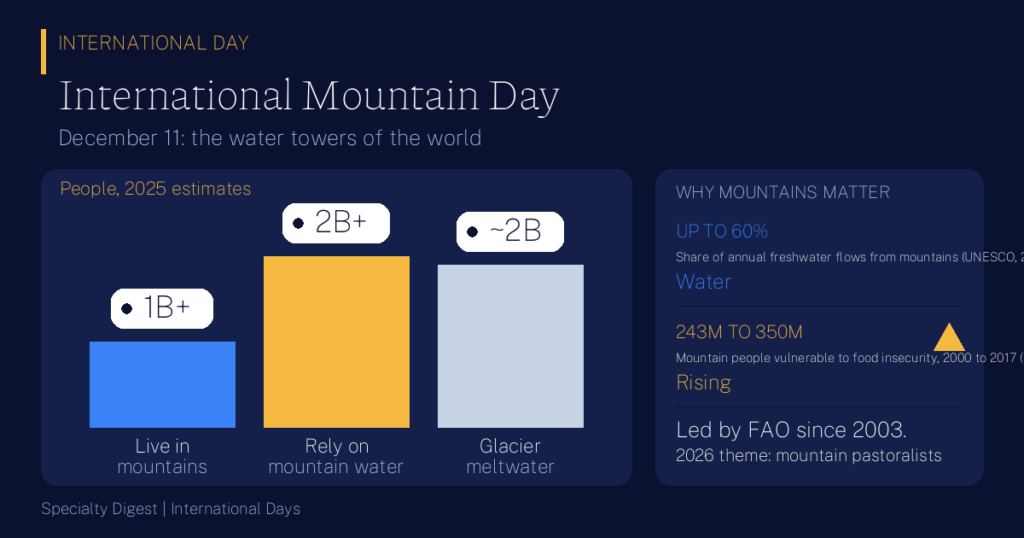
UNESCO’s 2025 report puts more than one billion people in mountainous regions and says over two billion directly rely on water that originates in mountains. FAO adds that meltwater from glaciers supports nearly two billion people. These groups overlap but are not the same, and the gap between them is the point: far more people live downstream than upstream.
Example 1: the town below the snowline. Picture a town of 100,000 people whose river is fed by a snowfield. Suppose, in this made-up case, the river supplies 60 percent of the town’s water and the snowfield shrinks by a fifth over some decades. The town does not lose a fifth of its supply evenly. It loses water in the late summer, when it is needed most. The numbers are round and illustrative, but the seasonal squeeze is the real risk.
Glaciers: the water towers are shrinking
The 2025 theme was “Glaciers matter for water, food and livelihoods in mountains and beyond.” It coincided with the UN International Year of Glaciers’ Preservation 2025. The World Meteorological Organization (WMO) says glaciers and ice sheets store about 70 percent of the world’s freshwater, and that more than 275,000 glaciers cover roughly 700,000 square kilometers. FAO says glaciers are melting at unprecedented rates, and the WMO reports that 2023 brought the largest glacier mass loss in five decades of record keeping.
There is a caution here. UNESCO notes that in many regions freshwater flows depend more on seasonal snowpack melt than on glaciers themselves. That is why scientists speak of the whole cryosphere, the frozen parts of the planet, and why FAO’s 2025 projects ranged from artificial glaciers in Kyrgyzstan, which have stored over 1.5 million cubic meters of ice, to youth training in Pakistan. Mountain regions are also warming faster than the global average, according to FAO.
Example 2: the thirsty season. Suppose a valley’s farms use 100 units of water in a dry summer, and meltwater normally supplies 40 of them. If warming brings the melt earlier in spring, farmers may find that the 40 units arrive before crops need them. The total might look similar over a year, yet the harvest suffers. These units are made up for illustration only.
The people left behind
Mountains are rich in water and poor in services. Steep land makes roads, clinics and schools costly to build, and fields are small and exposed to landslides, frost and drought. The UN reports that 311 million rural mountain people in developing countries live in areas exposed to progressive land degradation, and that 178 million of them are considered vulnerable to food insecurity. FAO’s director-general noted in 2020 that the number of mountain people in developing countries vulnerable to food insecurity rose from 243 million in 2000 to almost 350 million in 2017. UNESCO says up to half of rural mountain dwellers in developing countries suffer from food insecurity.
The 2026 theme turns to one group that knows the high country well: “Mountain pastoralists: Sustaining rangelands, knowledge and livelihoods.” Pastoralists are herders who move animals across seasonal pastures, often above the tree line. Their grazing routes and inherited knowledge of weather and grass are part of how mountain land stays productive, and the theme asks that these ways of living be sustained rather than overlooked.
Example 3: the herder’s calendar. Imagine a family with 200 sheep that spends 4 months of each year on a high meadow and 8 in a lower valley. If a warmer climate makes the high meadow usable for one month longer, the family gains a month of free grazing. If the route is blocked or the grass degrades, they lose it. The figures are invented and rounded, but they show how closely a way of life is tied to the calendar of the mountain.
How the day is marked
FAO and its Mountain Partnership, a United Nations alliance of governments and organizations, support events around the world each year. Schools, scientists and communities hold talks, hikes, photo contests and clean-ups. You can take part by learning where your own water comes from, supporting mountain farmers by buying their products, and treating the hills you visit with care.
- 2020Mountain biodiversity
- 2025Glaciers matter for water, food and livelihoods in mountains and beyond
- 2026Mountain pastoralists: sustaining rangelands, knowledge and livelihoods
Key Takeaways
- Mountains are shared infrastructure. They supply up to 60 percent of annual freshwater flows, according to UNESCO in 2025.
- More people live downstream than upstream. Over 2 billion rely on mountain water, while over 1 billion live in the mountains.
- The day has a clear origin. It followed the 2002 International Year of Mountains and has been observed since 2003, led by FAO.
- Glaciers are under strain. The WMO reports that 2023 saw the largest glacier mass loss in five decades of records.
- Snow matters as much as ice. In many regions flows depend more on seasonal snowpack than on glaciers.
- Mountain communities face real risks. Vulnerability to food insecurity rose from 243 million to almost 350 million between 2000 and 2017.
- Local knowledge is a resource. The 2026 theme honors pastoralists who sustain rangelands and livelihoods.
How solid is this? Figures come from UN agencies, FAO, UNESCO and the WMO, and the year of each is named in the text. Population and water-dependence numbers are estimates that overlap and change with each report, and the UN background page does not date its 15 percent and 311 million figures. The three worked examples use round, made-up numbers to show an idea. Explore the International Days hub and the International Days Calendar.
More in Nature
- United Nations, International Mountain Day: Background
- FAO Mountain Partnership, International Mountain Day
- FAO Newsroom, International Mountain Day 2025 and glacier preservation (December 2025)
- FAO, We must not leave mountains and mountain people behind (2020)
- UNESCO, Glaciers and mountains: melting water towers (World Water Development Report 2025)
- WMO, International Year of Glaciers’ Preservation 2025
- UN Meetings Coverage, GA/9499: Year 2002 proclaimed International Year of Mountains (1998)