Friendship rarely appears in treaties or budgets, yet it is the thread that holds communities together. International Day of Friendship, observed every year on July 30, asks the world to take that thread seriously. The United Nations General Assembly created the day in 2011 on a simple idea: friendship between peoples, countries, cultures and individuals can inspire peace efforts and build bridges between communities. In recent years, health science has given the idea a second and more personal meaning. Close ties are not only pleasant, they protect health, and their absence is now treated as a global health concern. The day sits comfortably beside the International Day for Tolerance, because tolerance often begins as a friendship.
From a peace idea to a UN day
The roots of the day lie in the idea of a Culture of Peace. According to the UN, the day follows a proposal by UNESCO to define a Culture of Peace, which the General Assembly adopted in 1997. UN News reported that the Assembly then voted to designate July 30 as International Day of Friendship, and that the resolution was adopted unanimously.
The reasoning is written into the resolution. Friendship, the Assembly recognized, can contribute to the efforts of the international community to promote dialogue among civilizations, solidarity, mutual understanding and reconciliation. Member states and UN bodies are invited to observe the day in line with their own customs, including through education and public awareness. The resolution places special emphasis on young people, as future leaders, taking part in community activities that include different cultures and promote understanding and respect for diversity.
What friendship means in the UN’s sense
In everyday life, a friend is someone you trust. The UN uses the word in a wider sense, covering friendship between individuals but also between cultures, communities and nations. The link between the two is trust. People who know and trust one another across lines of language, faith or history are harder to turn into enemies, and communities with many such ties tend to solve problems through dialogue. The UN’s own commentary on the day describes peace as something built thread by thread, in daily acts of trust.
Example 1: the school exchange. Suppose a school of 600 students pairs 100 of them with students from a neighboring community that has long kept its distance. Each pair meets monthly for a year. The numbers are round and illustrative, but the idea is the one the UN describes: 100 personal friendships mean 100 families who now know a name and a face on the other side. That is how trust begins to travel.
The numbers behind the day
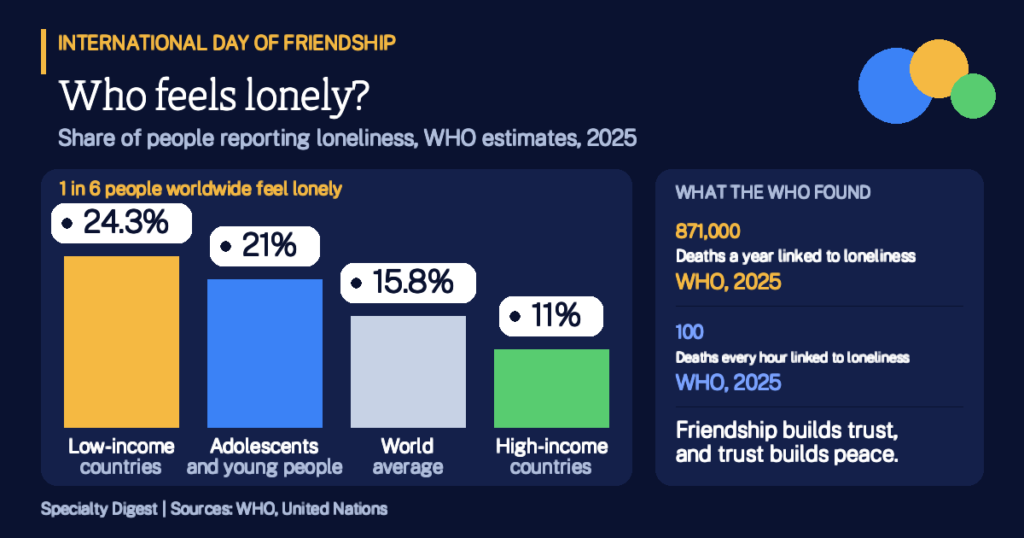
Friendship is hard to count, but its absence has been measured. In 2025, the WHO Commission on Social Connection reported that about 1 in 6 people worldwide, or 15.8 percent, feel lonely. Rates are highest among the young: about 21 percent of adolescents and young people say they are lonely, and rates generally fall with age. The gap between rich and poor countries is wide. In low-income countries, 24.3 percent of people report loneliness, against 11 percent in high-income countries. Rates are similar for men and women.
- 1 in 6people worldwide feel lonely, WHO 2025
- 871,000deaths each year linked to loneliness
- 100deaths every hour linked to loneliness
- 24.3% vs 11%loneliness in low-income vs high-income countries
Why friendship is a health matter
The WHO says social connection can reduce inflammation, lower the risk of serious health problems, support mental health and help prevent early death. Loneliness and social isolation, in turn, increase the risk of stroke, heart disease, diabetes, cognitive decline and premature death, and lonely people are twice as likely to become depressed. WHO estimates that loneliness is linked to about 100 deaths every hour, more than 871,000 deaths a year.
Those figures are estimates from a statistical model, and loneliness is not the same as having few friends. A person can be lonely in a crowd, or content with one close companion. Still, the direction of the evidence is clear enough that the World Health Assembly adopted its first resolution on social connection in May 2025, and the WHO Commission on Social Connection, launched in November 2023, published its report on June 30, 2025.
Example 2: the arithmetic of 100 an hour. If 100 deaths an hour is taken at face value, a single day carries about 2,400 and a single week about 16,800. These round numbers are only multiplication, not new data, but they show why a health agency treats friendship as more than a nicety.
Who is left out
Loneliness is not spread evenly. The WHO notes that adolescents and young people report the highest rates, and that the burden is heavier in low-income countries. Separate from loneliness, social isolation, meaning few contacts rather than a feeling, affects up to 1 in 3 older adults and 1 in 4 adolescents, according to WHO. People living in conflict, displacement or poverty often lose the networks that others take for granted. For them, the UN’s emphasis on involving young people in activities that cross cultural lines is practical, not sentimental.
Example 3: a town of 12,000. At 1 in 6, a town of 12,000 people would hold about 2,000 who feel lonely. The numbers are round and illustrative, and real towns vary, but the sum shows that this is not a rare problem hiding in a few homes. A library, a club or a shared meal that connects even a quarter of them reaches 500 people.
How the day is marked, and what to do
The UN encourages governments, international organizations and civil society groups to hold events that promote dialogue, solidarity and reconciliation, and it invites each community to observe the day in its own way. The UN page for the day names no separate annual theme. Ordinary actions fit the spirit: reach out to someone you have lost touch with, invite a neighbor from a different background to a meal, or support a youth program that brings different communities together. If loneliness is weighing on you or someone you know, talk to a trusted person or a local health professional.
Key Takeaways
- The day has a clear purpose. The General Assembly designated July 30 so friendship could help build dialogue, solidarity and reconciliation.
- It grows from the Culture of Peace. The UN links the day to a UNESCO proposal adopted by the Assembly in 1997.
- Loneliness is widespread. WHO estimates 1 in 6 people worldwide feel lonely.
- The burden is uneven. Rates reach 24.3 percent in low-income countries, against 11 percent in high-income ones, and are highest among the young.
- It is a health issue. WHO links loneliness to about 871,000 deaths a year and to higher risks of stroke, heart disease and depression.
- Youth are central. The resolution stresses involving young people in cross-cultural activities.
- Small acts count. A call, a shared meal or a welcome to a newcomer is how trust starts.
How solid is this? The loneliness and death figures are modeled estimates from the WHO Commission on Social Connection, published in 2025, and may be revised. The date of the day is fixed. The three worked examples use round, made-up numbers to illustrate an idea. See also the International Days hub and the International Days Calendar.
More in Society
- United Nations, International Day of Friendship
- UN News, General Assembly designates friendship day (2011)
- WHO, Social connection linked to improved health and reduced risk of early death (2025)
- WHO, Social connection questions and answers (2025)
- WHO Commission on Social Connection, From loneliness to social connection (2025)
- WHO Commission on Social Connection