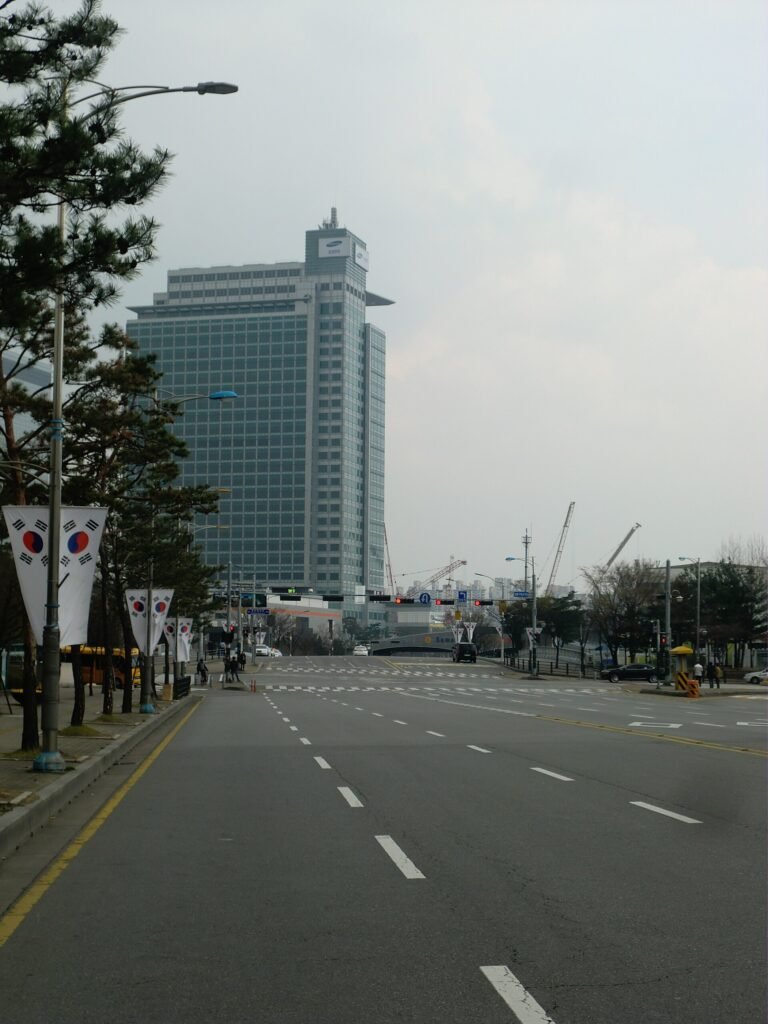
Samsung Electronics is a South Korean electronics and semiconductor company, headquartered in Suwon, that makes memory chips, smartphones, televisions, displays and home appliances. For 2025 it reported annual consolidated revenue of 333.6 trillion Korean won and operating profit of 43.6 trillion won, according to its own results announcement. It is the main subsidiary of the Samsung Group.
History of Samsung Electronics
The company was founded in 1969 as Samsung Electric Industries in Suwon, South Korea. At that time the Samsung Group was known mostly as a trading business, and it entered electronics by cooperating with Japanese manufacturers. Its early products included televisions, calculators, refrigerators, air conditioners and washing machines.
Samsung moved into semiconductors in 1974 by acquiring a small chip-making company. In 1983 its founder, Lee Byung-chul, declared that the group would become a maker of dynamic random-access memory (DRAM), which is the fast working memory used in computers. A year later Samsung announced that it had developed a 64-kilobit DRAM chip.
In 1988 Samsung Electric Industries merged with Samsung Semiconductor and Communications to form Samsung Electronics. The same year it launched its first mobile phone in South Korea, although early sales were poor and quality problems damaged its reputation through the mid-1990s.
Under chairman Lee Kun-hee, the company changed course in the 1990s. It cut many weak product lines and focused on designing and making advanced components and on investing in new technology. That strategy helped turn it from a low-cost manufacturer into one of the largest suppliers of memory chips and consumer electronics.
Products and services of Samsung Electronics
Samsung’s results announcement divides the business into two main divisions. The Device Solutions (DS) Division makes semiconductors, including memory, system chips and contract chip manufacturing. The Device eXperience (DX) Division covers consumer devices such as smartphones, televisions and household appliances. Samsung Display, a subsidiary that reports separately, makes screens for phones, televisions and other devices.
The DS Division has three main businesses. The Memory Business sells DRAM and NAND flash, the chips that store data in devices and servers. The System LSI Business designs chips such as image sensors for cameras. The Foundry Business manufactures chips designed by other companies.
In the fourth quarter of 2025, the Foundry Business began mass production of its first-generation chips on a 2 nanometer process, a measure of the minimum feature size that refers to a generation of advanced semiconductor manufacturing. It also began shipments of 4 nanometer base dies for high bandwidth memory (HBM), a stacked memory that supplies data quickly to artificial intelligence processors.
Samsung Display’s fourth quarter results were driven by small and medium displays for smartphones and by growing sales in the IT and automotive markets. The company also noted the launch of new quantum dot OLED products for large displays. Its screens use OLED technology, in which each pixel gives off its own light.
For 2026 the company said the DX Division plans to expand AI-driven product offerings and integrate AI across its devices, features and services, while protecting profit through stable component supply and efficiency measures. The DS Division aims to expand sales of AI-related DRAM and NAND products.
Corporate structure and operations
Samsung Electronics is a listed company within the wider Samsung Group, a family of affiliated South Korean businesses. The encyclopedia entry compiled by Gale describes it as the chief subsidiary of the group and the largest electronics producer in Asia at the time of publication.
For the fourth quarter of 2025, the company posted its highest quarterly consolidated revenue ever, at 93.8 trillion won, which was 9 percent above the previous quarter. Operating profit for the quarter, also a record, was 20.1 trillion won.
The DS Division produced quarterly revenue of 44.0 trillion won and an operating profit of 16.4 trillion won. Samsung Display added 9.5 trillion won in revenue and 2.0 trillion won in operating profit. The DX Division’s revenue fell 8 percent from the previous quarter because new smartphone models had a smaller launch effect and competition was intense.
Research and development spending reached a full-year record of 37.7 trillion won in 2025, with 10.9 trillion won spent in the fourth quarter alone.
Impact of Samsung Electronics
Samsung’s memory chips sit inside a large share of the world’s computers, phones and data centers. The company said that the Memory Business set an all-time high for quarterly revenue and operating profit in the fourth quarter of 2025, helped by expanded sales of HBM and other high-value products, as well as a market-wide rise in prices.
Its position shows how closely consumer electronics depend on chips. The same advanced manufacturing processes serve mobile phones, servers and cars, so demand for artificial intelligence computing now influences Samsung’s earnings as much as demand for handsets.
In its early years, Samsung declared that its electronics business would focus on exports, a strategy tied to South Korea’s industrial policy at the time. Today it competes at the leading edge of chip manufacturing.
Challenges and criticism
Samsung’s own report shows several pressure points. Smartphone competition is intense, and sales depend on the timing of new model launches. Memory earnings depend on prices, which can swing sharply, and the company said supply availability was limited in the fourth quarter.
Its System LSI Business reported lower earnings in the fourth quarter because of seasonal weakness and changes to the schedules of key customers. The Foundry Business said earnings improved only a little because of provisional costs, even though revenue rose.
The company is also working to regain ground in the high-end HBM market. In its announcement it said the Memory Business aims to reestablish a leadership position there through its HBM4 products. The phrasing indicates that its position in the segment that supplies AI processors had weakened.
More in Electrical Engineering
Key facts
- Samsung Electronics reported 2025 consolidated revenue of 333.6 trillion Korean won and operating profit of 43.6 trillion won.1
- Fourth quarter 2025 revenue of 93.8 trillion won was the highest quarterly consolidated revenue in the company history.1
- Samsung spent a record 37.7 trillion won on research and development in 2025.1
- Samsung Electronics was founded in 1969 as Samsung Electric Industries in Suwon, South Korea.2
- The Device Solutions Division makes memory, system chips and foundry services, while the Device eXperience Division covers consumer devices.1
Related concepts
Quick checkWhat does the Device Solutions Division make?Show answer
Semiconductors, including memory chips, system chips such as image sensors, and contract chip manufacturing.
Sources
- Samsung Electronics, Samsung Electronics Announces Fourth Quarter and FY 2025 Results, January 29, 2026 (Samsung Newsroom), https://news.samsung.com/be/samsung-electronics-announces-fourth-quarter-and-fy-2025-results
- Gale via Encyclopedia.com, Samsung Electronics Co., Ltd. company profile, https://www.encyclopedia.com/social-sciences-and-law/economics-business-and-labor/businesses-and-occupations/samsung-electronics-co-ltd
Editorially reviewed by Specialty Digest Editorial TeamLast reviewed November 4, 2026Researched and drafted with AI assistanceReport an issue