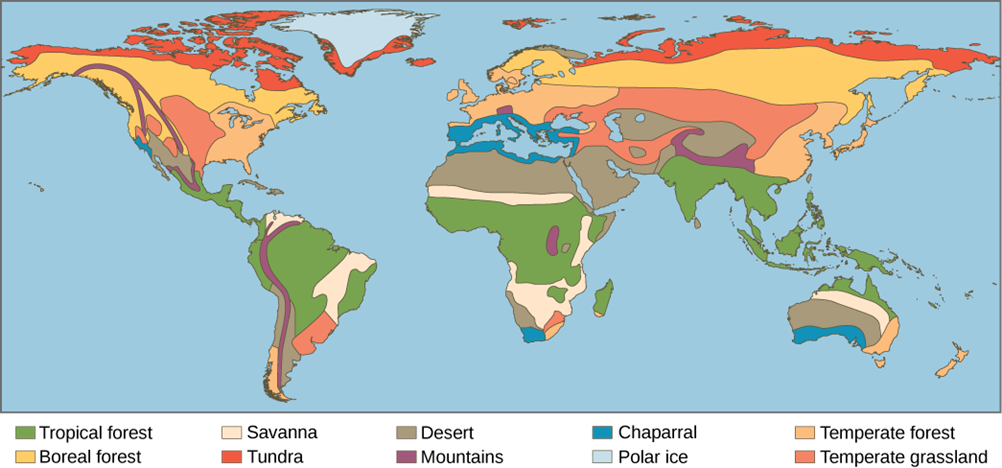
A biome is a large-scale ecological community characterized by distinctive climate conditions, vegetation types, and animal life, typically classified according to dominant plant structure and the overall temperature and precipitation patterns that shape a region’s ecology. Major biome categories include tropical rainforest, desert, grassland, temperate forest, boreal forest or taiga, tundra, and various aquatic biomes such as freshwater and marine systems, each supporting characteristic communities of species adapted to its particular environmental conditions.
While individual ecosystems within a biome can vary considerably in their specific plant and animal composition, the biome concept captures broader patterns that recur across similar climate zones on different continents, which is why, for example, temperate forests in eastern North America and parts of East Asia share many structural and functional similarities despite containing largely different species, having evolved independently under comparable climate conditions.
Terrestrial Biomes
Tropical rainforests, found near the equator in regions such as the Amazon basin, Central Africa, and Southeast Asia, are characterized by consistently warm temperatures and high rainfall throughout the year, supporting the greatest biodiversity of any terrestrial biome, with a single hectare sometimes containing hundreds of tree species and an enormous diversity of insects, birds, and other wildlife. Deserts, by contrast, are defined primarily by extremely low precipitation rather than temperature alone, since both hot deserts like the Sahara and cold deserts like parts of Antarctica qualify under this classification.
Temperate forests and grasslands occupy the mid-latitudes, experiencing pronounced seasonal variation in temperature, while boreal forest, also called taiga, forms a vast belt across northern North America, Europe, and Asia, dominated by cold-tolerant coniferous trees adapted to long, harsh winters. Tundra, found at the highest latitudes and elevations, supports low-growing vegetation adapted to a short growing season and permanently or seasonally frozen subsurface soil known as permafrost.
Aquatic Biomes
Freshwater biomes include lakes, rivers, and wetlands, each supporting distinct communities shaped by factors such as water flow, depth, and nutrient availability, while marine biomes encompass everything from shallow coral reefs and coastal estuaries to the open ocean and deep-sea environments, representing by far the largest biome category on Earth by total area and total volume of habitable space.
Marine biomes vary enormously with depth and distance from shore, since factors such as light penetration, pressure, and temperature change dramatically from sunlit coastal waters to the permanently dark, cold conditions of the deep ocean floor, producing correspondingly distinct communities of organisms specifically adapted to each zone.
Climate as the Defining Factor
Climate, particularly average temperature and the amount and seasonal distribution of precipitation, is generally considered the primary factor determining which biome develops in a given region, since these conditions directly shape what types of vegetation can survive, which in turn determines the structure of habitat available to animal life. This climate-driven relationship explains why biome maps closely track global climate zone maps, with each major climate type generally corresponding to a characteristic biome.
Local factors such as soil type, elevation, and fire frequency can modify this general climate-driven pattern, occasionally producing biome boundaries that do not perfectly align with climate zone boundaries alone, which is part of why ecologists continue to refine biome classification systems to better capture the real-world complexity of how climate and local conditions interact.
Biomes Under Climate Change
As global temperatures rise, many biome boundaries are expected to shift, with some researchers projecting that certain biomes, including some alpine and arctic tundra areas, could shrink substantially or disappear entirely from parts of their current range as warming conditions allow forest or shrubland to expand into territory that was previously too cold to support it. These shifts have significant implications for the species adapted to each biome, many of which may struggle to track suitable conditions if their required habitat shifts faster than they can disperse to new locations.
Changes in precipitation patterns associated with climate change are also expected to alter biome boundaries independently of temperature shifts, potentially expanding desert and grassland biomes in some regions while shifting forest boundaries in others, adding further complexity to efforts to predict how global vegetation patterns will look in future decades.
Human Impact on Biomes
Human activity has dramatically altered the extent and condition of nearly every major biome on Earth, with tropical rainforests facing extensive clearing for agriculture and logging, grasslands converted to cropland across much of their historical range, and even remote tundra and boreal forest biomes increasingly affected by resource extraction, infrastructure development, and the indirect effects of climate change.
Conservation efforts increasingly focus on protecting representative examples of each biome type, recognizing that preserving biodiversity requires maintaining functioning examples of the full range of biomes rather than concentrating protection efforts on any single type, since each biome supports species and ecological processes that cannot be replicated in a different biome type.
FAQ
What determines which biome exists in a particular region?
Climate, especially average temperature and the amount and seasonal pattern of precipitation, is the primary factor determining which biome develops, since it shapes which vegetation types can survive there.
What is the difference between a biome and an ecosystem?
A biome is a large-scale category defined by climate and dominant vegetation type that can span continents, while an ecosystem refers to a specific community of organisms interacting with their immediate environment in a particular location.
How is climate change expected to affect biomes?
Climate change is expected to shift biome boundaries, potentially shrinking cold-adapted biomes like tundra while allowing forest or shrubland to expand into previously unsuitable areas, with precipitation changes further altering desert and grassland extent.
More in Ecology
Editorially reviewed by Specialty Digest Editorial TeamLast reviewed November 4, 2026Researched and drafted with AI assistanceReport an issue