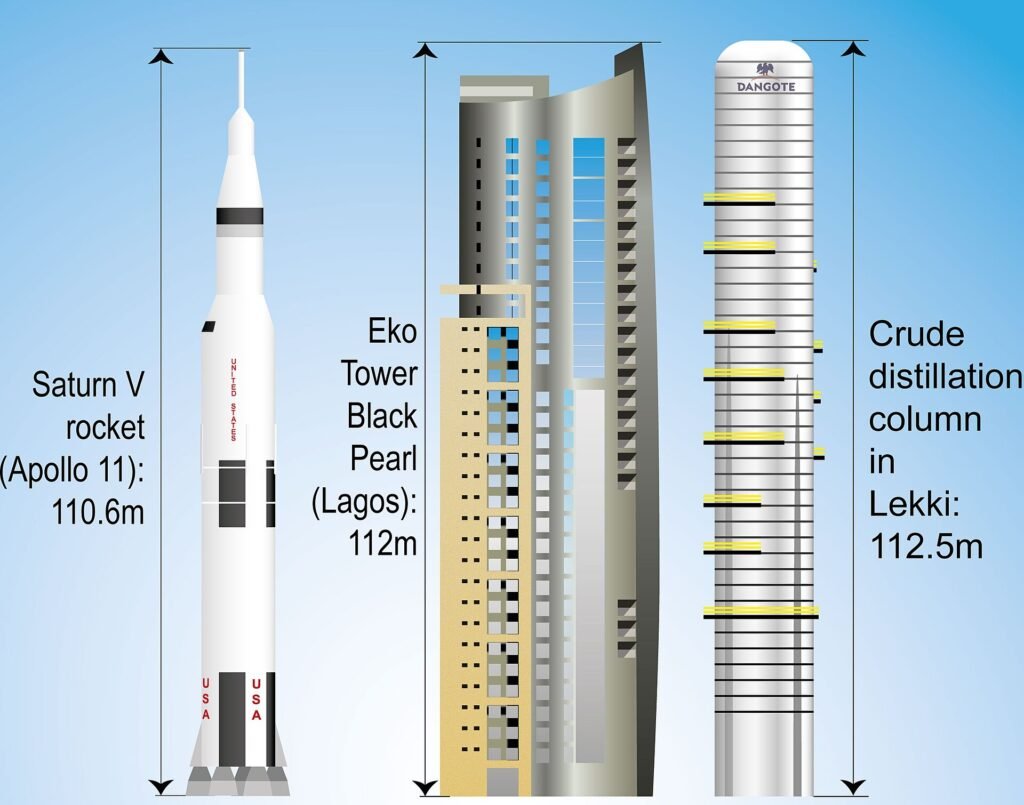
Dangote Group, formally Dangote Industries Limited, is a Nigerian conglomerate founded by Aliko Dangote that makes and sells cement, sugar, salt, fertilizer and refined petroleum products. It dates its beginnings to 1981, when it started as a trading business. Its best-known operations are Dangote Cement, the largest listed company in West Africa according to the group, and the Dangote Petroleum Refinery in Lekki, near Lagos, which a trade-press report calls Africa’s largest refinery.
History of Dangote Group
Dangote Cement’s history page says that Dangote Industries was founded by Aliko Dangote in 1981 as a trading business, with an initial focus on importing bagged cement and commodities such as rice, sugar, flour and salt. The group’s about page adds that Aliko Dangote began his business career in 1978, trading in rice, sugar and cement, before moving into full-scale manufacturing. Over time the group imported bulk cement into terminals at Apapa and Port Harcourt, bagged it, and distributed it.
During the 1990s the group decided to turn from trading into integrated manufacturing. Obajana Cement Plc was incorporated by the Kogi State Government in November 1992. In 2000 Dangote Industries acquired Benue Cement Company from the federal government during privatization, and in 2002 it acquired Obajana Cement Plc, although no factory yet existed. Construction of the first plant began in 2004, and in 2007 the Obajana plant was commissioned with two production lines and a capacity of 5 million tonnes a year, which the company says made it the largest plant in Sub-Saharan Africa.
In 2010 Obajana Cement was renamed Dangote Cement Plc and merged with Benue Cement, and it listed on the Nigerian Stock Exchange in October of that year. In 2011 the group’s non-Nigerian cement interests were moved into the company. New plants and lines followed: Ibese in Ogun State opened in 2012 with 6 million tonnes of capacity across two lines, and South African plants at Delmas and Aganang opened in 2014. Senegal started operating in December 2014 and Cameroon in 2015.
Businesses and products of Dangote Group
The group describes itself as a diversified and fully integrated conglomerate that provides basic needs. Its about page lists cement, sugar, salt, condiments, packaging, energy, port operations, fertilizer and petrochemicals. Its home page names cement, refinery, fertilizer, sugar and salt as the main industries, and it says the group intends to supply essential products in Africa through industrial innovation, social impact and sustainability.
Dangote Cement, which operates plants in Nigeria and in several other African countries, is a subsidiary of the group. The company’s website lists operations in Cameroon, Congo, Cote d’Ivoire, Ethiopia, Ghana, Senegal, Sierra Leone, South Africa, Tanzania and Zambia, in addition to Nigeria. Cement is the base product for building and infrastructure, and the group says its strategy relies on building local manufacturing capacity to create jobs and reduce imports.
The refinery is the group’s most prominent newer project. According to Engineering News, the Lekki refinery was designed for 650,000 barrels per day and sits within a larger petrochemical complex that includes a subsea pipeline to move natural gas. The article reports a cost of about $19 billion and a site of 25,000 hectares. Dangote’s home page describes it in 2026 as Africa’s largest single-train refinery, with a stated capacity of 700,000 barrels per day. That is higher than the 650,000 used by the refinery’s managing director, who said that 650,000 is the insured level and that the design could support 700,000. For more on natural gas as a fuel, see the linked entry.
Corporate structure and operations
Dangote Industries is led by a group president and chief executive, Aliko Dangote. The about page lists several family members as group executive directors, with responsibilities that include commercial operations, the family office and oil and gas commercial work. It also names a vice president for oil and gas who is responsible for the refinery, fertilizer, petrochemicals and upstream businesses.
Group figures vary by page and date. The about page gives annual turnover in excess of US$4 billion for 2016, 12 or more African countries in one place and 17 in another, and 30,000 or more employees. The home page in 2026 gives 12 or more countries of operation and more than 55,000 employees across Africa. Readers should treat these as company statements and check which year each figure refers to.
The group’s profile also includes service businesses. Its news page in 2026 reported the launch of a driver monitoring control room by Dangote Transport, support for a proposed Dangote deep seaport in Ogun State, and a planned initial public offering for the refinery and petrochemicals business, which had secured US$1 billion in backing in August 2026, according to the group.
Impact of Dangote Group
Dangote Group matters to Nigeria because it makes bulk goods that the country once imported in large quantities, among them cement, sugar and now petroleum products. The group says its aim is to reduce capital flight and increase local value addition. The refinery is also intended to help end Nigeria’s reliance on imported refined fuel, according to Engineering News and to a 2026 trade report.
The group’s founder, Aliko Dangote, was named co-chair of the US-Africa Business Center by the U.S. Chamber of Commerce in September 2016 and joined the board of the Clinton Health Access Initiative in April 2017. The group says Dangote Cement was the first Nigerian company to join the Forbes Global 2000 list. The refinery sits in the Lekki area of Lagos State, which is a major hub for the country’s trade.
Challenges and delays
The refinery’s path to full operation was slow, and the sources are open about it. Engineering News reported in May 2023 that commercial startup had been delayed owing to operational issues at its power plant, and that downstream units were not expected to start until later in the year. Hydrocarbon Processing reported in February 2026 that the refinery began operations in 2024 and had been running at about 450,000 to 485,000 barrels per day during its startup phase, amid difficulties securing enough local crude.
The refinery’s managing director said that large greenfield refineries typically need 18 to 24 months of ramp-up and that the crude distillation unit had run reliably since January 2024. He said planned maintenance was complete and that full-capacity test runs would take place in February 2026. Figures on actual output can change quickly, so readers should check recent reports.
Key facts
- Dangote Industries was founded by Aliko Dangote in 1981 as a trading business.2
- The Obajana cement plant was commissioned in 2007 with a capacity of 5 million tonnes a year, and Dangote Cement listed on the Nigerian Stock Exchange in October 2010.2
- The Dangote refinery in Lekki began operations in 2024 and has a nameplate capacity of 650,000 barrels per day.4
- The group's 2026 home page reports operations in more than 12 countries and more than 55,000 employees across Africa.3
Related concepts
Quick checkHow large is the Dangote refinery?Show answer
Its nameplate capacity is 650,000 barrels per day, which is the insured level according to its managing director, though the group's home page states 700,000.
Sources
- Dangote Industries Limited, About Us, https://www.dangote.com/about-us
- Dangote Cement Plc, Our History, https://cement.dangote.com/our-history/
- Dangote Industries Limited, Home page (news and group figures, 2026), https://www.dangote.com/
- Hydrocarbon Processing, Nigeria's Dangote Refinery to begin full-capacity tests in February, February 4, 2026, https://hydrocarbonprocessing.com/news/2026/02/nigeria-s-dangote-refinery-to-begin-full-capacity-tests-in-february/
- Engineering News, Lekki oil refinery, Nigeria: project update, May 19, 2023, https://engineeringnews.co.za/print-version/lekki-oil-refinery-nigeria-update-2023-05-19
Editorially reviewed by Specialty Digest Editorial TeamLast reviewed November 4, 2026Researched and drafted with AI assistanceReport an issue