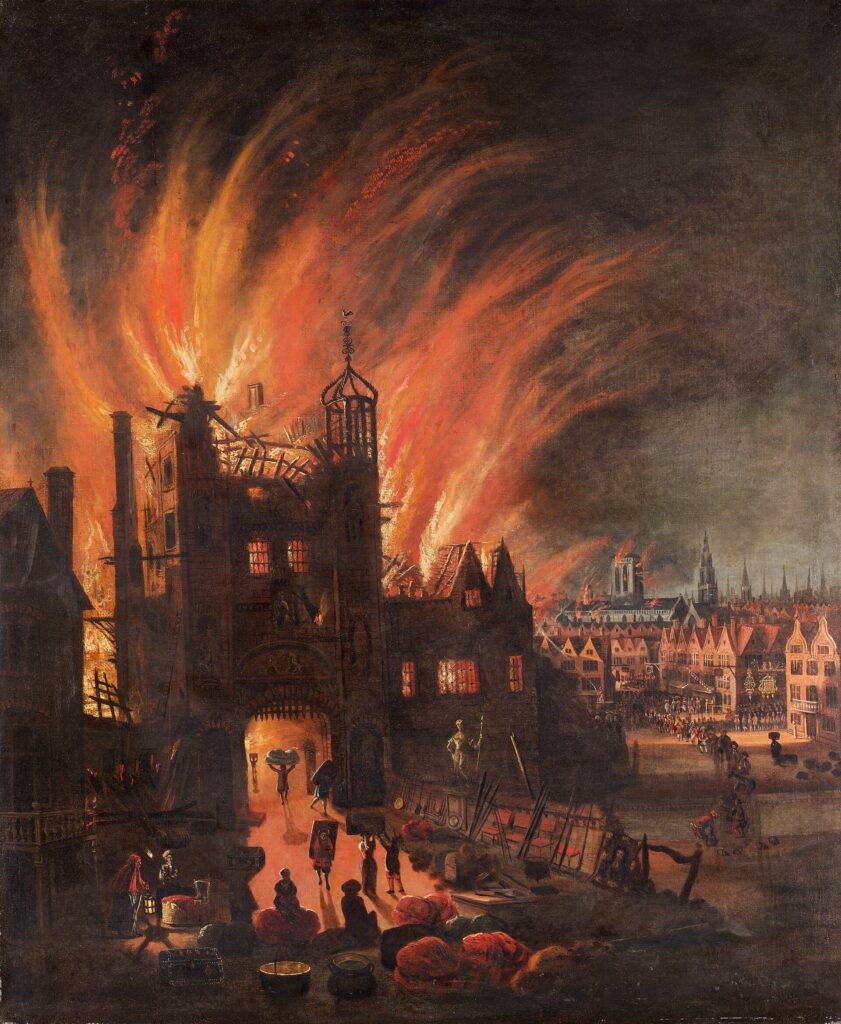
The Great Fire of London was a fire that burned through the medieval City of London from 2 to 6 September 1666. It began in a bakery on Pudding Lane and destroyed more than 13,000 houses, dozens of churches and St Paul’s Cathedral, yet only six deaths are known.
Background to the Great Fire of London
In 1666 London was one of the largest cities in Europe, and the walled City at its center was crowded with timber and thatched houses built along narrow lanes. The year before, the Great Plague had killed thousands of Londoners, so the city was already weakened. The summer of 1666 was long and hot, and the wooden buildings were extremely dry.
The fire started in the house and bakery of Thomas Farynor, the king’s baker, on Pudding Lane near London Bridge. According to the Royal Museums Greenwich, the Farynor family woke in the early hours of Sunday 2 September to smoke from the ground floor and escaped through an upstairs window. Their maid, who was too frightened to follow, died. She is the first known victim of the fire.
Course of the Great Fire
The fire spread quickly because a strong wind blew embers onto nearby warehouses and wharves full of flammable goods. Fires were common in the city, and the Lord Mayor, Sir Thomas Bludworth, dismissed the early reports and hesitated to order houses pulled down to make firebreaks. The diarist Samuel Pepys, who had been woken by news of the fire, hurried to the royal palace at Whitehall to warn King Charles II. The king ordered firebreaks and offered soldiers, though the mayor at first declined them.
By Monday 3 September many residents had fled across the Thames or camped in open fields to the north. Fear spread that the fire was an attack, and people who looked foreign, especially the Dutch and the French, were attacked or jailed. Looting was widespread, and carts from the countryside charged high prices to carry people’s belongings. Pepys is known to have buried a wheel of Parmesan cheese in his garden to protect it.
Charles II’s brother James, Duke of York, took charge of the fire-fighting. Soldiers and volunteers pulled down buildings and used gunpowder to blow up houses in the fire’s path, but the explosions also started rumors of an invasion. Historic UK describes how the king himself helped pass buckets of water. On the evening of Tuesday 4 September, St Paul’s Cathedral caught fire. Its roof and walls fell, setting alight goods that people had stored inside for safety.
The fire then threatened the gunpowder stores at the Tower of London, and nearby buildings were blown up to protect them. Just before midnight on 4 September the wind shifted and dropped. By Wednesday afternoon the flames could finally be contained, and the fire was out by 6 September. Sources count the duration differently. The Royal Museums Greenwich describes almost four days of burning in one passage and five days from 2 to 6 September in another.
Damage and casualties
The figures vary slightly by source. The Royal Museums Greenwich reports that 87 churches, 52 company halls and more than 13,000 houses were destroyed, that as many as 100,000 people lost their homes and that about 85 percent of the City was destroyed. Historic UK gives 89 parish churches and 57 halls, says about one fifth of London was left standing, and estimates the property loss at 5 to 7 million pounds, a very large sum at the time.
Both sources agree that only six deaths are known. The true number was probably higher, because the deaths of poor residents were often not recorded. Survivors with no relatives to take them in camped in open spaces around London, where food ran short and illness spread.
A French watchmaker named Hubert confessed to starting the fire and was hanged. It was later realized that he had not been in England when the fire began. Historians today attribute the fire to an accident in the bakery, not to any plot.
Aftermath and rebuilding
The fire left tens of thousands of people without homes and with little food, and the burned City had to be rebuilt almost from scratch. Historic UK says that Sir Christopher Wren was given the task of rebuilding London, and a surviving map reproduces his plan for a new layout of the City. Such plans make the aftermath an early example of ambitious urban planning, though the sources opened for this entry do not describe how much of any plan was adopted.
Wren was given the task of rebuilding the churches. According to Historic UK he rebuilt 52 City churches, and he designed the new St Paul’s Cathedral, which was begun in 1675 and completed in 1711. The Monument to the Great Fire, a column 202 feet tall, was designed by Wren and Robert Hooke. The City of London owns and manages it, and visitors can climb its 311 steps.
Significance and legacy of the Great Fire
The fire is one of the best-documented disasters of its century because Pepys and the diarist John Evelyn left detailed eyewitness accounts. These diaries let historians follow the fire hour by hour and see how officials, merchants and ordinary people reacted.
It also reshaped the capital. Historic UK argues that the fire cleared overcrowded and disease-ridden streets and that a new London emerged from the ruins. Wren’s churches and his new St Paul’s Cathedral gave the City a different skyline, although the fire came at an enormous cost to the people who lost their homes and businesses.
The Great Fire also remains a reminder of how rumor spreads during a crisis. The attacks on foreigners and the false confession of Hubert show how fear of outsiders can follow a disaster. Today the event is remembered in the Monument, in school lessons, and in the memory of the bakery on Pudding Lane where it began.
More in History
Key facts
- The fire began in the early hours of Sunday 2 September 1666 in Thomas Farynor's bakery on Pudding Lane.1
- It burned until about 6 September, destroying more than 13,000 houses and, by Royal Museums Greenwich counts, 87 churches and 52 company halls.1
- St Paul's Cathedral was destroyed on the evening of 4 September 1666.12
- Only six deaths are known, though the true number may have been higher.12
- The Monument, 202 feet tall and designed by Christopher Wren and Robert Hooke, commemorates the fire.3
Related concepts
Quick checkWhere and when did the Great Fire of London start?Show answer
It started in the early hours of Sunday 2 September 1666 in the bakery of Thomas Farynor on Pudding Lane, near London Bridge, and burned until about 6 September.
Sources
- Royal Museums Greenwich, The Great Fire of London, https://www.rmg.co.uk/stories/topics/great-fire-london
- Historic UK, The Great Fire of London, https://www.historic-uk.com/HistoryUK/HistoryofEngland/The-Great-Fire-of-London/
- The Monument, City of London, official site, https://www.themonument.org.uk/
Editorially reviewed by Specialty Digest Editorial TeamLast reviewed November 4, 2026Researched and drafted with AI assistanceReport an issue